

Mary Lou Williams recorded “Night Life” under her own name in 1930. One side of the record is an exacting stride performance; the other is a blues. Together they catch what a career-spanning label misses: Williams did not simply pass through changing styles. She shaped them from within. From the beginning of her recorded career, she treated difference as material to organize at the keyboard. 2
That approach required a long memory and a current ear. Williams could make a big band swing, write an extended concert suite, help younger bebop musicians work through harmony, compose sacred music, and explain jazz history in a lecture-performance. She did not regard those activities as unrelated phases. The blues remained the structural connection, not a period she had outgrown.
Pittsburgh’s little piano girl
Williams was born Mary Elfrieda Scruggs in Atlanta on May 8, 1910. Her family moved to Pittsburgh during the Great Migration. She learned at the keyboard by observation and ear, performing in the homes of affluent white families while still a child and becoming locally known as the “Little Piano Girl.” 2
The nickname can make prodigious talent sound protected. Professional childhood placed her inside unequal social arrangements. A Black girl entered private homes to provide entertainment, and her ability created income and access without removing segregation. She also heard working musicians when touring bands passed through Pittsburgh, a city with its own dense jazz networks.
By her teens she was on the vaudeville circuit. She married saxophonist John Williams and carried his surname into a career that soon exceeded the supporting roles commonly offered to women in bands. The road taught repertory, timing, and how an arrangement had to function for performers night after night. Those lessons would matter when she entered Andy Kirk’s orchestra.
The arranger inside the Clouds of Joy
Williams began recording with Andy Kirk and His Clouds of Joy around 1929 and remained with the group until 1942. She was pianist, composer, and arranger across more than 180 recorded sides. The figure matters because it indicates sustained responsibility, not an occasional feature granted to an exceptional woman. 2
A big-band arrangement distributes energy. Brass and reeds need distinct registers; rhythm must support dancers without becoming mechanical; a short recorded side needs contrast before time runs out. Williams’s writing supplied that internal movement. Her piano could be forceful, but the arrangement did not require her to dominate every bar in order to be present.
The Clouds of Joy developed in the Kansas City orbit, where bands tested material in clubs and dances before and alongside recording. Riffs could be memorized, adjusted, and assigned across sections. Williams brought written control to that practical environment. The division between spontaneous jazz and composed arrangement is too clean for the work she actually did.
“Night Life” as a working document
“Night Life” displays stride piano as a complete rhythmic system. The left hand moves between low bass and chordal support while the right hand shapes melody, fills, and accents. Independence is the visible technical achievement, but coordination is the musical one. The hands make different claims without losing a shared pulse.
The Library of Congress added the recording to the National Recording Registry in 2009. Its historical value includes Williams’s authorship and the quality of the performance, but it also preserves a 1930 marketplace in which a young Black woman could issue a piano feature under her name while continuing to labor inside a touring orchestra. 5
Williams later returned to “Night Life” when teaching and presenting jazz history. The piece became evidence she could play rather than a relic described from a podium. Its recurrence shows how repertory can carry history physically. An older style is not explained away; it is reactivated under new conditions.
A New York apartment as workshop
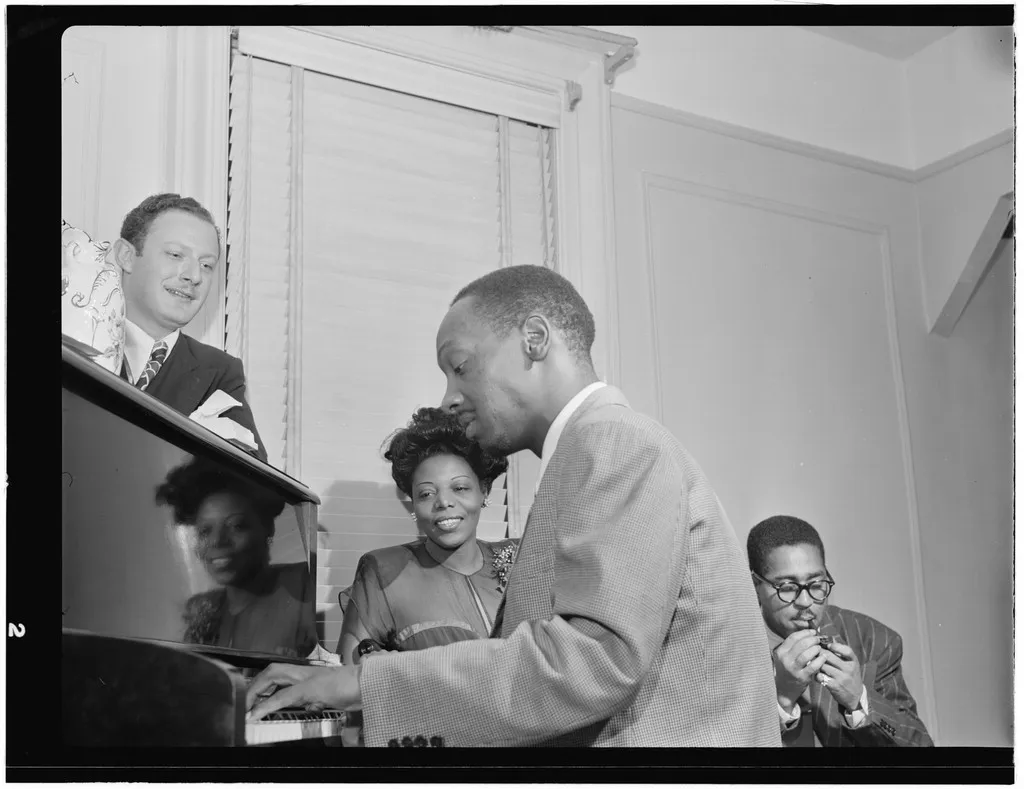
After leaving Kirk, Williams led a small group, returned briefly to Pittsburgh, and moved to New York. Her apartment became a meeting place for musicians working through the emerging language of bebop. Tadd Dameron and Dizzy Gillespie appear with her in a 1947 photograph by William P. Gottlieb. The image is domestic, but the gathering is professional: composers and players exchanging knowledge.
Williams was older than many of the bebop musicians, yet she did not treat the new harmonic and rhythmic vocabulary as a rebellion to be dismissed. She listened, advised, and wrote within it. In turn, younger musicians encountered someone whose experience connected stride, Kansas City swing, big-band orchestration, and current experiment.
The story is sometimes told as maternal generosity, which risks turning expertise into care work. Williams did help musicians personally, but her apartment was valuable because she was a formidable composer and analyst. Advice about a passage came from someone who understood how a voicing behaved under the hands and inside an ensemble.
Twelve signs, several ensembles
Williams composed Zodiac Suite in the mid-1940s, assigning a movement to each astrological sign and to musicians born under it. She first recorded the suite with a piano trio, then expanded parts for chamber forces. A Town Hall performance took place at the end of 1945; three movements were later presented with a large orchestra at Carnegie Hall. 2
The suite crosses an industry boundary: extended composition by a jazz musician, built from improvisational knowledge and conceived for changing instrumentation. Calling it an attempt to enter classical respectability would misstate the direction. Williams was enlarging the space available to her own musical language.
The project was difficult to mount. Rehearsal time, copying, personnel, and concert presentation all required resources beyond a small recording session. Imperfect performances are part of the evidence, not an embarrassment to edit out. They reveal the gap between compositional ambition and the institutions available to support a Black woman writing large-scale work in 1945.
Europe and a break in performance
Williams traveled to Europe in 1952 for what became an extended stay. She performed widely, then stopped playing publicly for a period after returning to the United States. Her conversion to Catholicism and commitment to charitable work redirected time and attention. The interruption is often framed as disappearance followed by return; her compositional thinking did not stop at the edge of a stage.
Religious practice eventually entered the music directly. Williams wrote hymns, masses, and extended sacred works while continuing to use blues, jazz rhythm, and improvisation. The repertory did not paste church language onto a secular style. It asked whether jazz could carry liturgical purpose without surrendering its history.
The Smithsonian Folkways reissue of recordings made in 1962 and 1963 places standards and original sacred material together. That sequence is characteristic: Williams did not accept that spiritual purpose required stylistic retreat. 4
The tree is an argument
Williams worked with artist David Stone Martin on an illustrated “History of Jazz” shaped as a tree. Its roots descend into Black suffering; spirituals, ragtime, Kansas City swing, and bebop rise through the trunk; the blues runs up both sides. Some branches thrive and others are cut off. The diagram argues for continuity, origin, and musical health instead of offering a neutral chronology.
She developed the idea further in lectures and on The History of Jazz, an album that combines speech with performances. A listener hears her move from explanation to example. “Night Life” appears not because the 1930 recording was quaint, but because the piece could demonstrate a technique and a historical relation at once. 3
The tree also rejects a parade of replacements. Bebop does not kill swing; modern music remains accountable to blues roots. Williams could criticize developments she thought lost that connection. Her map judged change by whether it retained human and historical weight.
Sacred work without a clean divide
Black Christ of the Andes, first recorded in the early 1960s, joins choral writing, solo voice, and jazz ensemble around the life of Peruvian saint Martín de Porres. Other works brought jazz into Catholic worship. These projects challenged both religious institutions that treated jazz as unsuitable and jazz institutions that treated sacred composition as an eccentric detour.
Williams’s faith also shaped practical work. She supported musicians dealing with addiction and maintained charitable projects. Again, biography can too easily assign her a service role while reserving musical innovation for men around her. The sacred compositions are not background to the assistance. They are rigorous answers to the same question that drove her arrangements: how can different forces be made to speak within one structure?
The Smithsonian’s account presents her as both musical and social change agent. The phrase is useful when the two terms remain connected. Williams changed rooms partly because she could demonstrate the musical case at the piano. 1
Teaching the whole line
In the late 1970s Williams became artist-in-residence at Duke University. She taught jazz history as someone who had written and performed inside much of the history under discussion. Her method could place a recording, explain a harmonic device, and then demonstrate the relationship immediately.
That authority did not depend on pretending memory was infallible. Personal witness is one source among contracts, recordings, photographs, and other musicians’ accounts. Its special value lies in practice. Williams knew how an arrangement felt under touring conditions and how a stride pattern changed when transferred from a solo record to a lecture hall decades later.
She also continued performing, including encounters that refused age-based categories. Concerts with Cecil Taylor and Benny Goodman placed radically different piano and swing languages beside her own. Williams did not need a single late style to certify consistency. Consistency lay in active listening to the whole field.
Beyond the exceptional woman
Williams died in 1981. Histories regularly describe her as the woman who succeeded in a male field. The fact of gendered exclusion is essential, but the exceptional-woman frame can isolate her again. It makes every achievement a personal victory over bias instead of evidence about bands, labels, churches, schools, and archives that depended on women’s labor while limiting their authority.
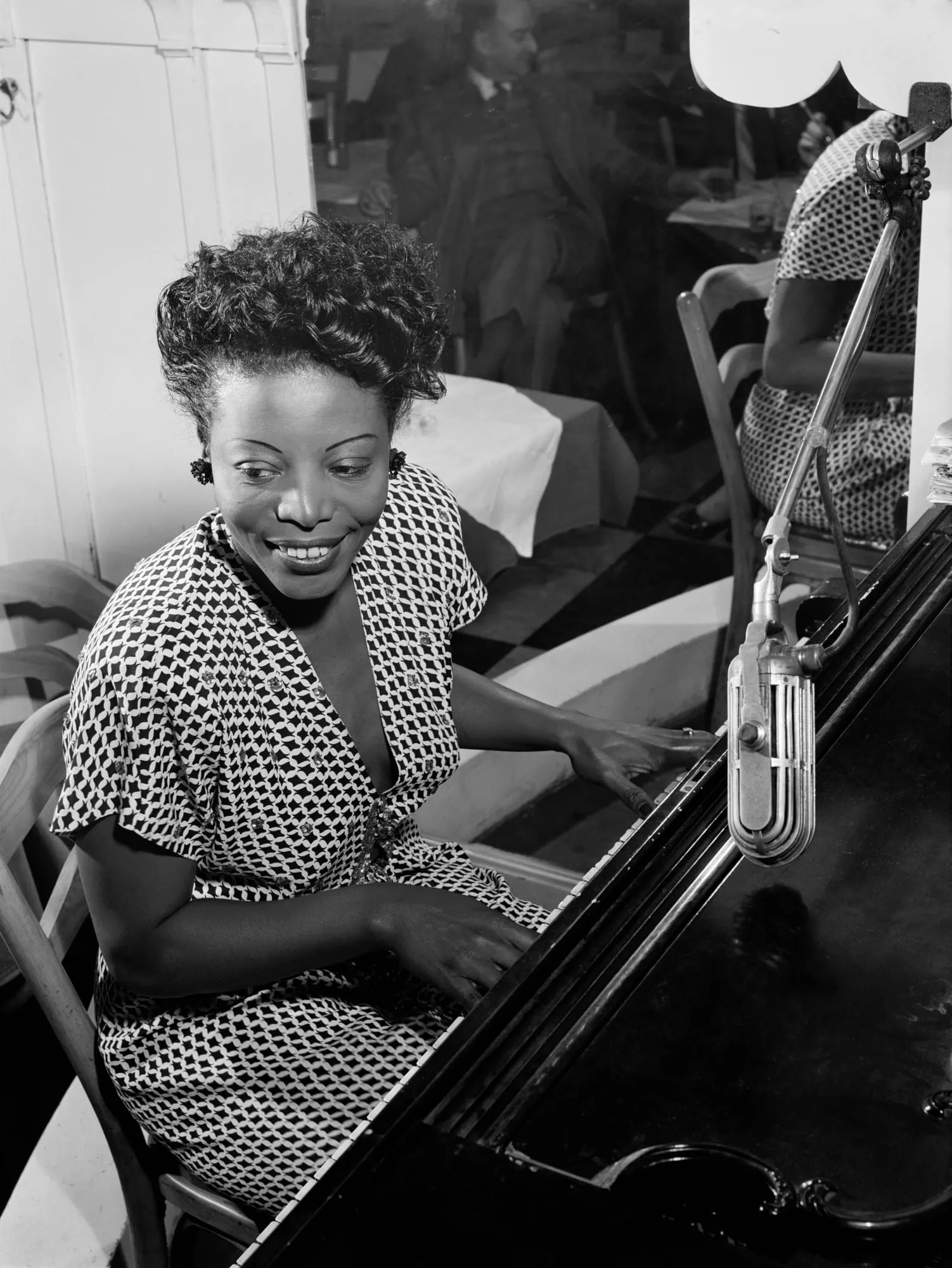
The surviving photographs offer a correction. At the piano, Williams is working. In the apartment group, she is a colleague among composers. The images do not need to make her symbolic before they make her visible. The National Museum of African American History and Culture’s piano portrait preserves that occupational fact. 6
Arranging for Kirk changes how we hear the solo piano; the bebop workshops change how we hear the suite; the sacred pieces change how we hear the history lectures. These were not separate entries on a résumé. They were problems solved by the same musician.
Mary Lou Williams’s jazz tree keeps the blues visible along the trunk. Her keyboard work does something similar. However far the harmony moves, the time, touch, and historical memory remain audible underneath it. That continuity was made at rehearsals, recording dates, apartments, churches, classrooms, and the piano bench.
![Archive image: Gottlieb, William P., 1917-, photographer. [Portrait of Mary Lou Williams, New York, N.Y., ca. 1946] 1 negative : b&w ; 3 1/4 x 4 1/4 in. Notes: Gottlieb Collection Assignment No. 335 Reference print available in Music Division, Library of Congress. Purchase William P. Gottlieb Forms part of: Willia](/assets/a-jazz-history-at-the-keyboard-archive-1.BuqrE56X_1c2PHe.webp)
![Archive image: Gottlieb, William P., 1917-, photographer. [Portrait of Dizzy Gillespie, Mary Lou Williams, Tadd Dameron, Hank Jones, Milt Orent, Dixie Bailey, and Jack Teagarden, Mary Lou Williams' apartment, New York, N.Y., ca. Aug. 1947] 1 negative : b&w ; 3 1/4 x 4 1/4 in. Caption from Down Beat: Mary Lou Willi](/assets/a-jazz-history-at-the-keyboard-archive-2.BKJasZj8_ZAXIFh.webp)
![Archive image: Gottlieb, William P., 1917-, photographer. [Portrait of Mary Lou Williams and Roger Barnet, Waldorf-Astoria, Suite 4-B, New York, N.Y., ca. Mar. 1947] 1 negative : b&w ; 2 1/4 x 2 1/4 in. Caption from Down Beat: Mary Lou Williams and Roger Notes: Gottlieb Collection Assignment No. 341 Purchase Willi](/assets/a-jazz-history-at-the-keyboard-archive-3.BVa02NyP_2lc7bk.webp)
.jpg)
.jpg)
_(LOC)_(4843149309).jpg)
_(LOC)_(4843764330).jpg)
_(LOC)_(5476588488).jpg)