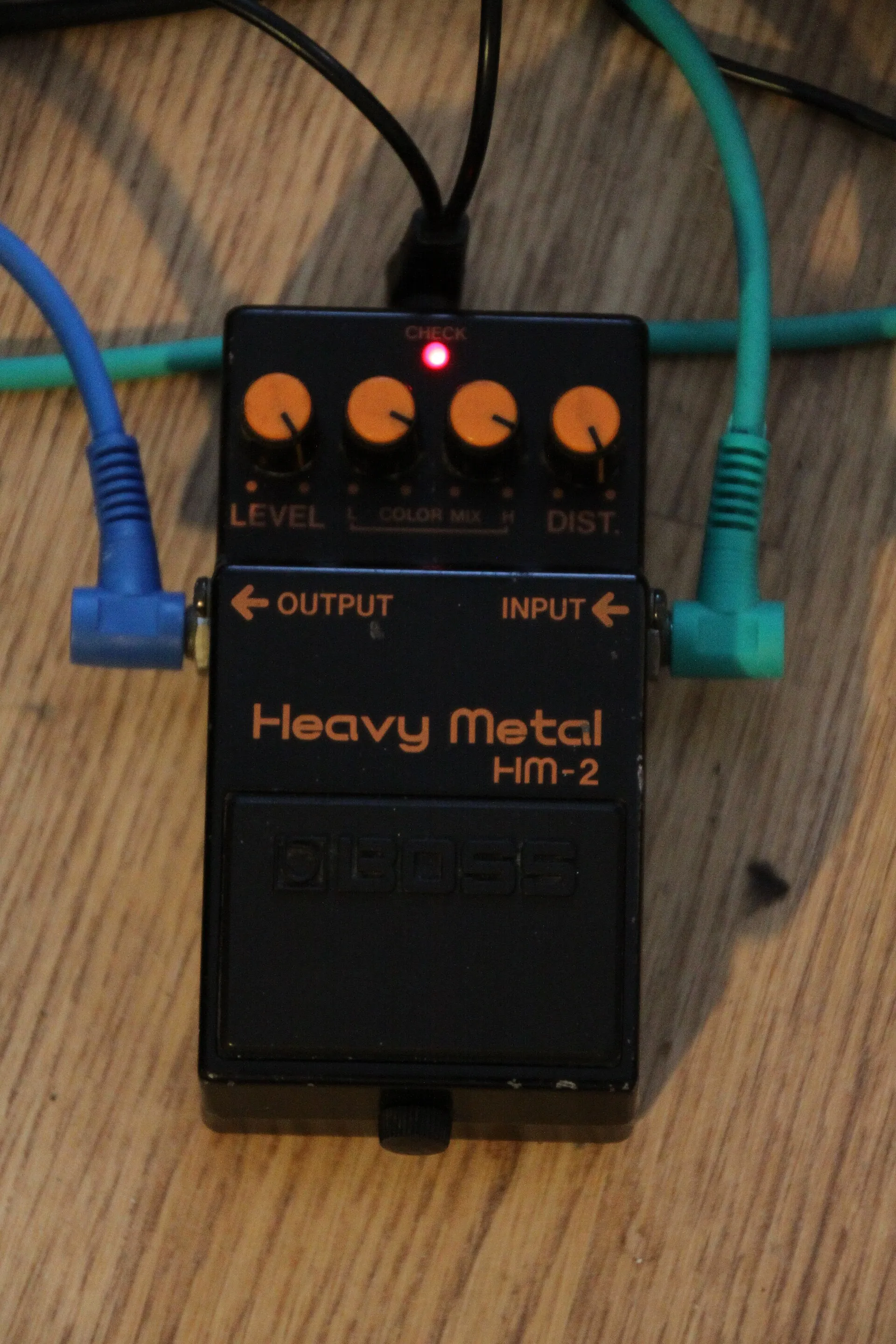
The BOSS HM-2 offers no control labeled “Stockholm.” Its four knobs read Level, Color Mix Low, Color Mix High, and Distortion. BOSS introduced the pedal in 1983 as a compact route toward the sound of a loud British amplifier stack. Players in Sweden later discovered that turning every control clockwise produced something less representational: a compressed, abrasive band of lows, high mids, and fizz that could fill the width of a mix. The setting became so identifiable that a mass-produced Japanese pedal now serves as shorthand for a regional death-metal sound. 1
A stack model that did not stay a model
Compact distortion pedals translate several jobs into a low-voltage circuit. They raise signal level, clip the waveform, filter frequencies, and provide an output that can drive an amplifier. The HM-2 was designed during an early-1980s market for hard-rock and metal equipment, when “amp in a box” meant approximating the density of a British stack without requiring its stage volume. BOSS manufactured the original from 1983 to 1991, first in Japan and later in Taiwan. 2
The enclosure follows BOSS’s durable standard: a hinged footswitch, recessed controls, battery access under the treadle, buffered bypass, and color coding that lets a player identify the model on a floor. The HM-2’s orange lettering and knob caps are visual information, not decoration alone. Among similar black boxes, the color tells a technician which circuit is about to enter the chain.
The control layout separates two frequency bands. “Color Mix” is not a conventional three-band amplifier equalizer. Its low and high controls apply strong shaping at different points in the spectrum, and their ranges overlap with the pedal’s clipping character. Level sets output; Distortion changes gain. At moderate positions the HM-2 can produce overdrive, mid-heavy distortion, or a thick bass response. The famous setting ignores moderation.
Inside the circuit, buffered input and output stages surround gain, diode clipping, and active filtering. The buffer controls how a guitar signal is presented to the rest of a chain even when long cables and several pedals are present. Silicon diodes constrain waveform peaks in a predictable range; filtering before and after clipping determines which frequencies hit that limit hardest and which are emphasized afterward. The order matters. Boosting a frequency into clipping does not produce the same result as boosting it only at the output.
Original units also belong to an older BOSS power standard. Many were designed around the ACA adapter system rather than today’s PSA nine-volt convention. Used alone on an incorrect supply, an old pedal may receive less effective voltage and behave differently; in a daisy chain with other grounded pedals, the result can change again. That practical wrinkle is one reason comparisons between vintage pedals require more than matching knob photographs.
What “all knobs up” actually does
Turning Level fully clockwise sends a strong signal onward. Maximum Distortion drives the clipping stages hard. Maximum Low and High do not create a neutral full-range boost; they emphasize the pedal’s chosen bands, leaving the middle shaped by the interaction of filters and clipping. The output is dense and noisy, with a pronounced upper-mid grind and substantial low-frequency energy.
Descriptions such as “chainsaw” and “buzzsaw” capture texture but conceal frequency. A saw metaphor suggests treble alone. The HM-2 setting feels large because low content survives beneath the rasp. Multiple guitar tracks increase that spread. Pick attack becomes a brief edge inside a more continuous block, especially at fast tempos.
The pedal is only one stage. Guitar pickups, tuning, strings, the receiving amplifier, speaker, microphone, performance, and mix determine the record. Two musicians can put four knobs at the same position and produce clearly different results. The setting is a repeatable condition, not a finished sound.
Microphone choice and placement decide how much of the abrasive top survives. A close dynamic microphone can focus the speaker’s midrange and reject part of the room; a second microphone or guitar layer can restore body or attack. Engineers can filter low frequencies that conflict with bass guitar and kick drum, then place the recognizable grind above them. The finished “all knobs up” record may contain substantial subtraction after the pedal’s maximum boosts.
This makes isolated demonstrations misleading in both directions. A single HM-2 into a clean practice amplifier may sound thinner or harsher than a Sunlight record. A carefully mixed modern clone can sound larger than an original pedal in a rehearsal room. Neither test establishes which circuit is authentic. It establishes what the rest of that test chain allowed.
Nihilist brings the box into Sunlight
The route to Stockholm death metal ran through Nihilist, the band that preceded Entombed. In BOSS’s interview history, Sunlight Studio producer Tomas Skogsberg recalls that guitarist and bassist Leif Cuzner brought an HM-2 into the studio. Uffe Cederlund and Alex Hellid continued developing the guitar arrangement, and Skogsberg treated the pedal as part of a layered recording method. 3
This account is more useful than a discovery myth. No one uncovered a secret switch inside the HM-2. A player arrived with commercially available equipment, a group recognized an extreme setting’s use, and a producer learned how to record it. Sunlight Studio then gave connected bands a place where that knowledge could accumulate.
For Entombed’s Left Hand Path, the chainsaw layer did not stand alone. Skogsberg has described a small Peavey Studio Pro 40 receiving the HM-2, with another guitar sound made through a Marshall combo and a BOSS DS-1. Combining a heavily filtered layer with a more conventional distortion helped preserve definition. If every audible guitar frequency came from the HM-2 alone, the mix could lose attack and space. 4
The arrangement also depended on performance. Tremolo-picked passages turn the pedal’s sustained grind into continuous motion. Palm-muted rhythms make its low response pulse. Open chords allow adjacent pitches and distortion products to rub together. The same setting reacts differently to each.
Dismember makes consistency a method
Dismember’s recordings established a related but distinct use of the circuit. Guitarist David Blomqvist has described the HM-2 as consistent across the band’s work and central to its signature. The group’s first album, Like an Ever Flowing Stream, was recorded at Sunlight with Skogsberg, placing personnel, room, and equipment inside the same regional exchange that shaped Entombed. 5
Consistency does not mean every record has one preset stamped onto it. Production changes, guitars change, and arrangements create different spectral demands. Dismember’s melodic lines often need to remain readable above dense rhythm tracks. The HM-2’s high-mid emphasis can help a lead cut, while its low band can compete with bass and kick drum if left unmanaged. Recording the pedal therefore creates mixing work as well as identity.
Entombed eventually widened its sound toward what was called death ’n’ roll. Dismember maintained a different balance of melody, speed, and chainsaw density. Other Swedish groups used the pedal selectively or not at all. “The Swedish sound” was never one circuit shared without variation. It is better understood as a studio practice that became available to a cluster of musicians.
Sunlight itself was not a fixed preset. Skogsberg recorded bands with different budgets and ambitions, while the room and equipment changed. Repeated collaboration made fast communication possible: a musician could ask for a known density, the producer could establish a starting chain, and the session could spend scarce time on performance and arrangement. That efficiency helped a local method become consistent without making every album identical.
The academic mapping of recorded heaviness identifies the HM-2 and Sunlight layer as one strand among several 1980s and 1990s developments. That wider view prevents Stockholm’s method from becoming the sole origin of death-metal guitar. Florida, Britain, Brazil, and other scenes were building different forms of density at the same time. 6
A cheap used pedal becomes expensive evidence
After BOSS ended production in 1991, used HM-2 units remained ordinary objects for a time. Their later association with collectible early death-metal records changed demand. A pedal designed for broad metal use became valuable because one unintended setting had acquired historical specificity. Japanese-made examples attracted particular attention, though the musical importance of a unit still depends on condition and use rather than country label alone.
Boutique builders and larger companies responded with clones, modified circuits, and pedals that isolate or extend the HM-2 equalizer. Some add clean blends, extra mid controls, quieter operation, or switchable clipping. These changes address practical problems musicians met when fitting the characteristic curve into modern rigs. They also demonstrate that “accurate” can mean two conflicting things: reproduce the original circuit, or reproduce the remembered record after studio layering.
Reverb’s technical history traces the pedal from its initial stack-emulation goal through Sunlight’s use and the later clone market. The story is not a failure of design corrected by users. The original range made the extreme possible. Musicians selected one boundary condition and gave it a context BOSS had not advertised. 7
Clones expose which parts listeners think define the family. Some reproduce component values closely. Others retain the two-band curve while changing gain, noise, or clean blend. A parallel blend can keep pick attack beside the saturated signal; a mid control can create room for vocals; internal voltage changes can add headroom. Each feature weakens the claim that there is one sacred HM-2 sound while confirming that the original equalization remains a useful reference.
BOSS reissues its unintended legacy
In 2021 BOSS released the HM-2W under its Waza Craft line. Standard mode reproduces the original voice; Custom mode increases drive and adjusts low and mid response. The company retained the orange-and-black appearance and explicitly marketed the all-controls-maximum association with Swedish death metal. A once-unofficial use had become the product’s central documented history. 8
The reissue changes the practical status of the sound. Players no longer need a thirty-year-old pedal with aging components, a nonstandard power expectation, or collector pricing. They can buy a supported production device. At the same time, countless clones mean no company owns the general idea of boosting those frequency regions into heavy clipping. The HM-2 name remains specific; the chainsaw vocabulary has become a category.
The Waza version also shows what preservation means for electronics. Exact vintage components may be unavailable or inconsistent, so engineers preserve measured behavior with current parts and production methods. Standard mode promises continuity at the connections a player can hear and operate; Custom mode openly departs from it. The reissue is a working interpretation, not an untouched artifact. Its value is practical only when musicians can still put it on a floor, step on it, and change the surrounding chain.
That availability can flatten history into a recipe: tune down, turn four knobs right, and receive Stockholm. The records refuse the shortcut. Cuzner brought the pedal; other musicians recognized its possibilities; Skogsberg layered and filtered it; bands wrote parts that made its compression useful. The box supplied an extreme transfer curve. A scene turned that curve into musical grammar.