
The unusual thing about the Quintette du Hot Club de France was audible before Django Reinhardt began a solo. No drummer marked the pulse. No piano filled the harmony. A double bass and rhythm guitars built the floor while Stéphane Grappelli’s violin and Reinhardt’s guitar moved above it. The arrangement made a string band carry the drive of jazz without imitating a brass orchestra. Its economy was the invention. 1
Reinhardt is often introduced through virtuosity and injury: a player with two damaged fingers who achieved the impossible. That outline is true but insufficient. It makes the hand an obstacle in a triumph story and leaves out the working environments that formed the music—Romani family life, Paris dance halls, musette accompaniment, recording sessions, and a network of musicians and enthusiasts who helped the Quintette exist.
Rhythm before the solo
Jean-Baptiste “Django” Reinhardt was born in 1910 and grew up in a Manouche, or French Romani, family. He learned string instruments in a community where music was work, social knowledge, and entertainment rather than a conservatory sequence. In the eastern districts of Paris, he played banjo-guitar in bals musette, accompanying accordionists for dances whose success depended on a firm, flexible beat. 2
That employment left a durable mark. The rhythm style later associated with the Quintette—short, regular chords with a springing accent—did more than replace drums. It joined harmonic information to physical propulsion. A rhythm guitarist had to state the chord, clear the space, and place the next attack with enough consistency for dancers and soloists to trust it.
Reinhardt’s lead playing retained that knowledge. His runs can accelerate across the bar, but their impact depends on a sharply felt return to the pulse. Chords appear as structural events alongside their role as accompaniment between single-note displays. The most spectacular passages work because the player always knows where the floor is.
The fire and the rebuilt hand
In 1928, a fire in Reinhardt’s caravan badly injured his left hand and body. Two fingers remained severely limited. Accounts tend to pause over the fact that he continued playing, as if determination alone explains the result. The musical change was more specific. Reinhardt reorganized fingering around the index and middle fingers for many single-note lines while using the damaged fingers where possible in chord shapes. 3
That method did not simply restore an earlier technique. It produced new routes across the fretboard. Arpeggios, position shifts, repeated figures, and compact chord voicings became part of a personal grammar. Physical adaptation and musical choice cannot be cleanly separated.
The injury should not be made into proof that disability disappears under genius. Reinhardt worked with a changed hand for the rest of his career. Nor should his Roma background be reduced to a romantic idea of instinctive freedom. Both simplifications turn material conditions into legend. The useful evidence is in the playing: a technique rebuilt for an actual body and then refined through professional work.
A quintet assembled between sets
Reinhardt and violinist Stéphane Grappelli were both employed at the Hôtel Claridge in Paris in 1934. During breaks, they improvised together. Supporters associated with the Hot Club de France encouraged the partnership, sponsored concerts, and financed early demonstration recordings. The eventual ensemble added Louis Vola on bass and rhythm guitarists, creating a five-piece group made entirely of strings. 4
The instrumentation solved several problems at once. Grappelli could sustain, bend, and decorate a line differently from the guitar. Reinhardt could attack with unusual clarity. The rhythm guitars supplied chordal weight, and the bass grounded movement without making the texture heavy. Each part remained exposed.
The group’s first advertised concert, on December 2, 1934, described it as a new kind of hot-jazz orchestra. That claim named a real difference. American jazz records provided repertory and models of improvisation, while the Quintette’s sound came through instruments and labor already available in Paris. The players transformed their models instead of copying them or sealing them inside a national style.
Imported records, local machinery
French jazz advocates used “hot” to distinguish improvised, rhythmically forceful jazz from commercial dance arrangements they considered diluted. The Hot Club published, organized concerts, and built audiences. Its judgments could be doctrinaire, but its infrastructure gave Reinhardt opportunities to record and perform as a featured soloist.
Paris also brought Black American musicians into Reinhardt’s professional world. Coleman Hawkins, Benny Carter, Bill Coleman, and members of Duke Ellington’s circle worked or recorded in Europe. Sessions across those networks make a simple Europe-versus-America story impossible. Musicians heard one another directly, not only through imported discs. 5
Reinhardt’s guitar entered jazz through this exchange while carrying musette rhythm and Manouche musical knowledge with it. “Jazz manouche” now names a broad performance tradition, but the historical Quintette was not born as a museum style with fixed costume and repertory. These musicians built contemporary dance music in response to modern records, microphones, touring, and the available room.
The recorded balance
Early Quintette recordings reveal how carefully the ensemble managed density. Rhythm guitars do not ring indefinitely; their chords are released so the next attack remains clear. The bass is felt as direction rather than mass. Grappelli can write a long arc over that grid, while Reinhardt often breaks a phrase into contrasting units: a clipped answer, a fast ascent, a chord, then a silence that resets the ear.
The microphone made those differences legible. A guitar did not need to defeat a big band acoustically when the recording balance could bring its attack forward. Yet amplification did not erase ensemble discipline. Too much sustained rhythm would blur the solo; too little would make the music lose its lift.
Copying Reinhardt’s fastest passages reproduces only the outer edge of the style. The method includes how an accompanist shortens a chord, how a solo begins without announcing itself too heavily, and how two lead voices exchange authority. The Quintette’s innovation was collective even when Reinhardt was its unmistakable center.
Occupation without a clean legend
The Second World War separated Reinhardt and Grappelli. Grappelli remained in Britain while Reinhardt returned to France and continued working during the German occupation. For a Romani musician, that period carried extreme danger: Nazi racial policy persecuted Roma across occupied Europe. Reinhardt’s survival has generated stories of escapes, protection, and official admiration, not all equally documented.
A responsible account leaves uncertainty visible. He recorded and performed in occupied Paris; he also belonged to a people targeted for deportation and murder. Success did not make the political conditions benign. Nor can the elegance of a wartime composition stand in for a complete statement about the occupation.
The music changed. Reinhardt worked with a new quintet that included clarinet rather than violin and wrote material that moved beyond the prewar string-band formula. The familiar sound remained available, but it was no longer his only frame. Treating Reinhardt as the keeper of one timeless style misses his appetite for altered instrumentation and current jazz language.
New York, 1946
In 1946 Reinhardt toured the United States with Duke Ellington’s orchestra. The trip carried obvious symbolic weight: the European guitarist entering the country whose records had helped form his jazz practice. The working arrangement was difficult. He appeared as a guest rather than as the leader of his own rhythm section and played in front of a large ensemble with different expectations.
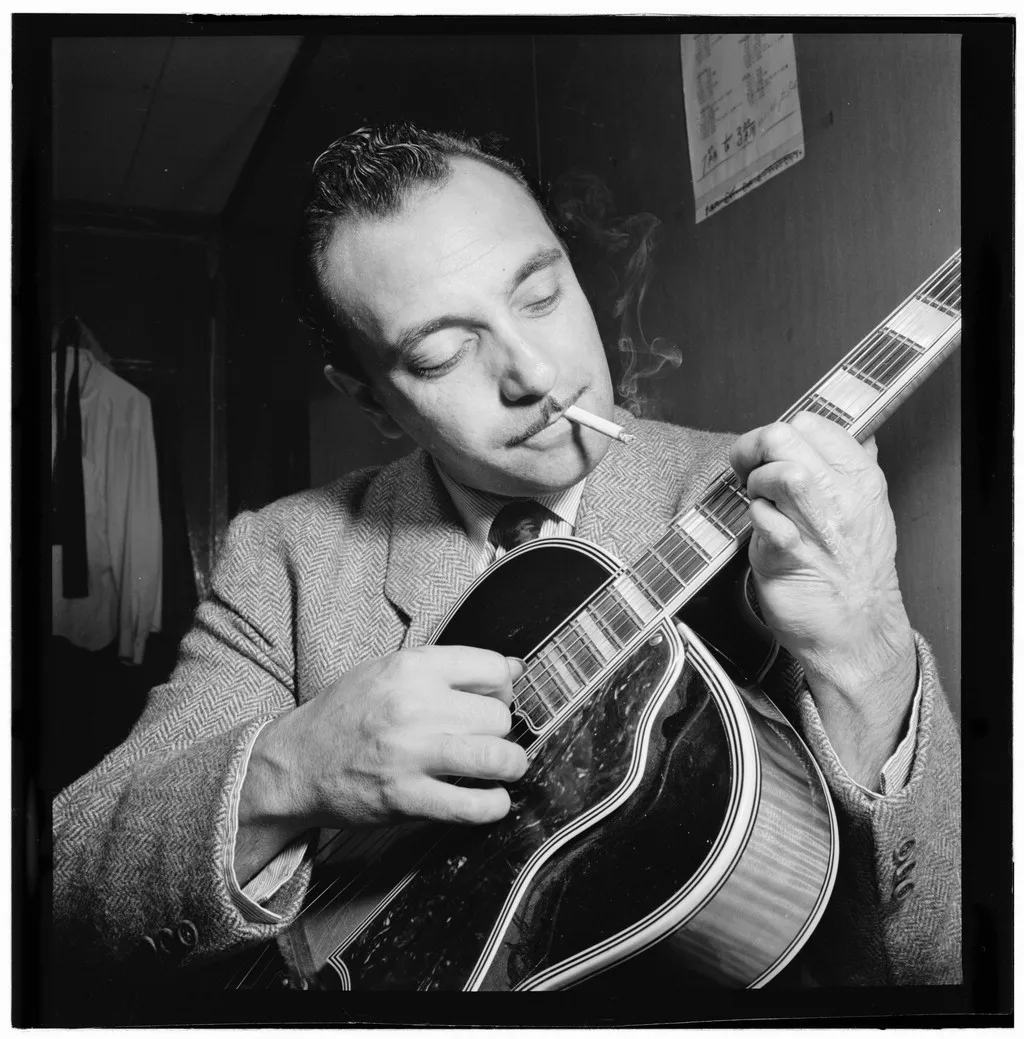
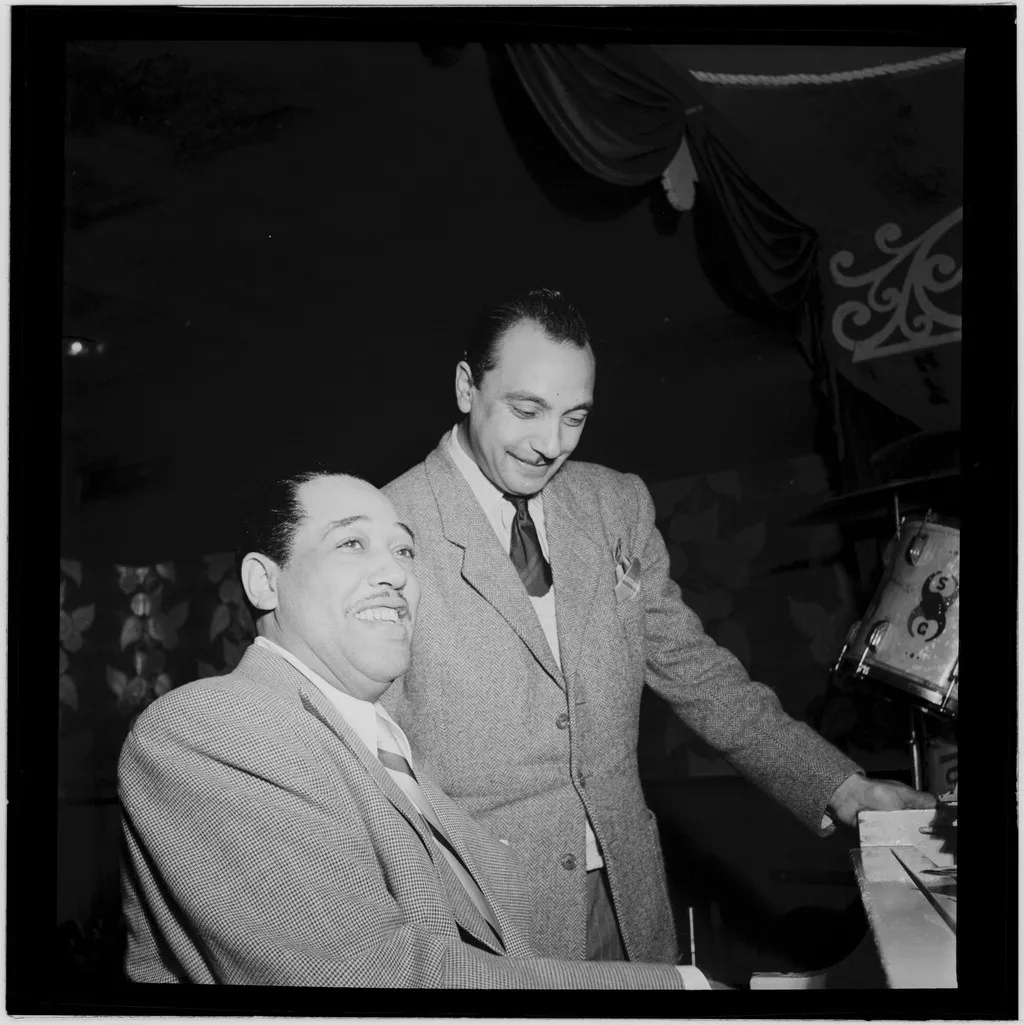
William P. Gottlieb photographed Reinhardt in New York during the visit. In one image he sits alone, looking directly toward the camera; in another he stands beside Ellington. The photographs document proximity without pretending to explain the relationship. They belong to Gottlieb’s larger archive of jazz workers in clubs, backstage rooms, streets, and studios. 6
The tour did not produce a simple conquest of America. Reinhardt faced language difficulties, unfamiliar logistics, and mixed notices. He returned to France without the permanent American breakthrough later retellings might expect. The visit mattered because it put him inside Ellington’s touring machine and exposed the difference between admiration at a distance and the practical demands of collaboration.
Electric guitar and bebop
After the war, Reinhardt increasingly used electric guitar and listened toward bebop. The change can surprise listeners who know him primarily through acoustic Selmer-style instruments. It should not. His career had always involved technical adaptation: different ensembles, recording conditions, a rebuilt left-hand method, and changing rooms.
Postwar recordings place the thicker electric tone against clarinet, rhythm section, and newer harmonic movement. His attack, arpeggiated construction, and command of pulse remain audible, but the surface is less attached to the prewar Quintette. Cataloged recordings from 1946 through 1949 show the old string format continuing alongside repertory that reflects a musician still testing possibilities. 7
This period resists revivalist neatness. Reinhardt did not spend his final years protecting the exact sound for which audiences now recognize him. He was interested in what the guitar could do next.
The instrument carries the arrangement
The guitars associated with Reinhardt’s mature acoustic sound were built to project. Selmer-Maccaferri designs used a large internal resonator in early versions and distinctive sound holes across later models. Construction details changed, but the practical goal remained clear: a guitar needed enough focused attack to lead and enough definition for several rhythm players to strike together without turning the ensemble to mud.
Instrument mythology can become another shortcut. Owning the correct body shape does not supply the balance heard on Quintette records. Pick angle, left-hand release, seating, microphone distance, and the judgment of every accompanist shape the result. Reinhardt’s tone was a relation between hardware and touch.
That relation also explains the postwar electric turn. Amplification offered sustain, weight, and a different response to single-note lines. It did not betray an authentic acoustic instrument. Reinhardt had always treated the guitar as equipment for a particular musical job, and the job had changed.
The name attached to a style
Reinhardt died in 1953. Since then, festivals, schools, builders, and working groups have carried his name and methods across the world. The repertory offers a shared language, and the all-string ensemble remains remarkably portable. It can be assembled without drums or amplification and still produce a complete rhythmic environment.
The afterlife also creates a risk of removing the music from Roma history while using Roma imagery as atmosphere. Reinhardt’s Manouche identity was not stage scenery. It shaped family networks, musical learning, public reception, and vulnerability under racial persecution. Respecting that history requires more than repeating a genre label.
It also requires hearing the other musicians. Grappelli’s sustained line, Vola’s bass, and the rhythm guitarists’ exacting pulse made Reinhardt’s freedom possible. The Quintette was designed so that nothing disappeared into orchestral mass. Every player had to maintain the mechanism.
The enduring lesson is therefore smaller and more practical than genius mythology. Five string players found a way to make jazz move without a drummer. Reinhardt stood at the front, but the whole machine is present in every beat beneath him.
.jpg)