In 1988 Pauline Oliveros, trombonist Stuart Dempster, vocalist Panaiotis, and engineer Albert Swanson entered an unused water cistern at Fort Worden in Washington State. The room was reached through a manhole. Its low frequencies could continue reverberating for roughly 45 seconds. A note did not end when the player released it; the concrete kept the sound in circulation. 1
The recording made there later supplied a name—Deep Listening—for a practice Oliveros had been developing through composition, improvisation, electronics, and group exercises. The cistern is the memorable image, but it is not the whole idea. Deep Listening does not require an extraordinary room. It asks what happens when attention expands beyond the sound a musician intended to make.
Hearing is not the assignment
The Center for Deep Listening distinguishes hearing, an ongoing physiological process, from listening, an active direction of attention. The distinction is simple enough to state and difficult enough to practice. A person can hear ventilation, traffic, a neighbor, and their own breath without deciding that any of it deserves musical attention. Listening changes the selection. 2
Oliveros did not use expanded attention as a demand for solemnity. Her work includes play, social exchange, memory, movement, and mistakes. A listener might focus tightly on one sound, open outward to the whole field, or move between those positions. The practice concerns flexibility rather than permanent hypervigilance.
That flexibility has consequences for performance. If every participant attends only to their own planned line, an improvisation becomes simultaneous monologue. If they listen only by following others, the music loses initiative. Oliveros’s exercises create situations in which people negotiate those competing demands without a conductor supplying every answer.
Tape as a way to inspect attention
Born in Houston in 1932, Oliveros studied composition and worked in the experimental music community that developed around San Francisco in the 1950s and 1960s. Tape technology allowed composers to cut, loop, layer, slow, reverse, and filter recorded sound. The machine preserved performance while making duration and timbre available as physical material for later manipulation.
Oliveros’s electronic pieces use those operations without hiding their seams. A sound can appear, return altered, and collide with its own residue. The listener is asked to track changes that do not behave like a conventional instrumental theme. Tape also reveals how quickly the ear invents sources: a transformed sound is interpreted as a voice, an animal, a motor, then something else.
Her archive at Rensselaer includes scores, recordings, correspondence, teaching materials, and records of the organizations she created. That range is significant. The work was never only a catalog of pieces. It included building technical resources, publishing instructions, organizing workshops, and maintaining conditions in which other people could experiment. 3
An accordion inside the circuit
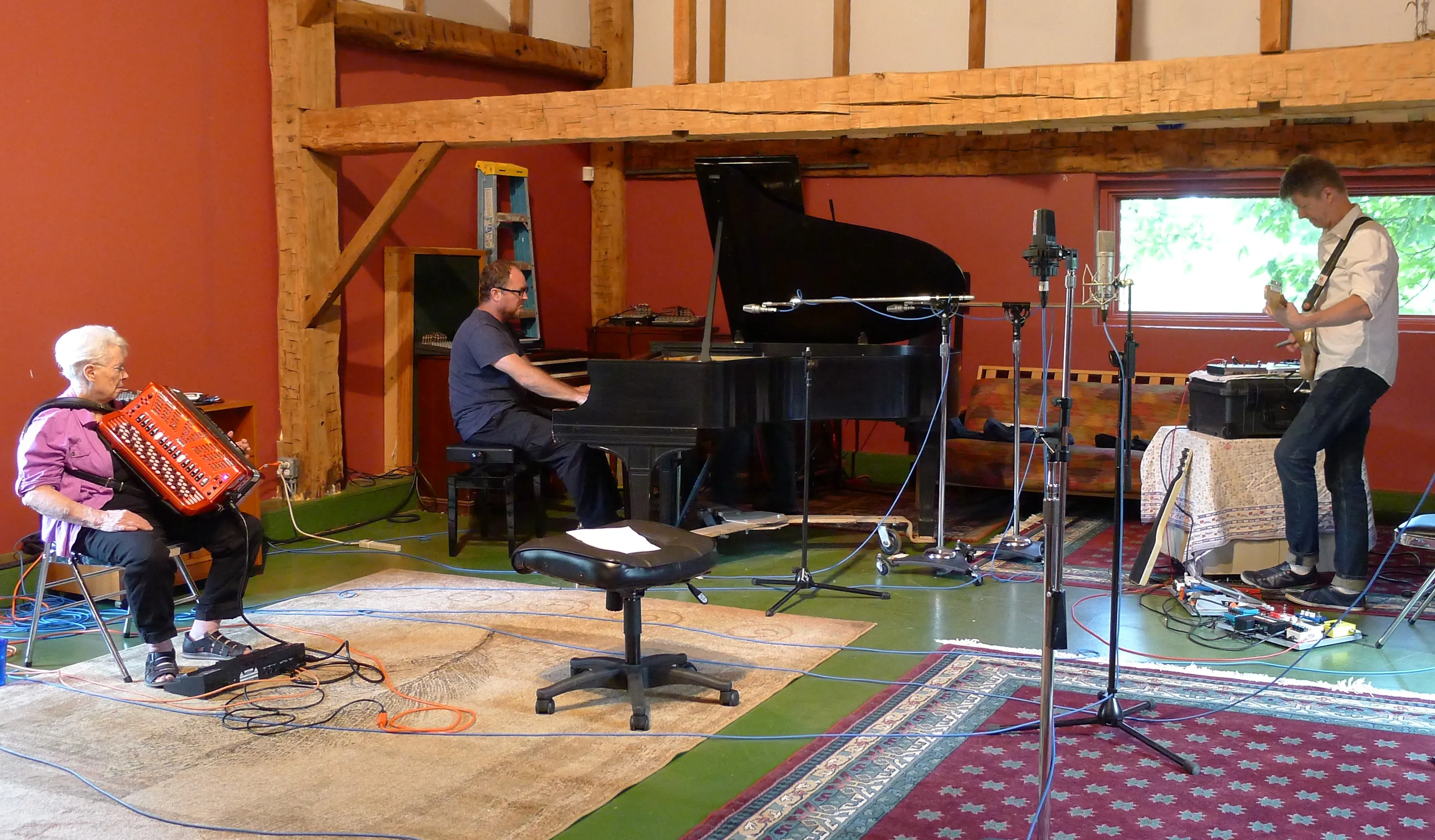
Oliveros kept returning to the accordion, an instrument with a familiar social history and an unusually useful electronic one. Its bellows make breath and pressure visible. Buttons and keys can hold clusters, articulate melody, or sustain a tone long enough for electronic processing to change its surroundings. The instrument is both portable and physically demanding.
In her hands, the accordion avoids the opposition between folk instrument and new technology. It can send sound into delays, interact with software, or enter an acoustic space without amplification. The bellows impose a material limit even when electronics extend the result. A sustained note still begins with a body opening and closing an air reservoir.
That fact becomes especially clear in reverberant performance. The musician must decide whether to add sound while an earlier gesture remains audible. Silence is not empty; it may contain a chord that has changed color while traveling through the room. The accordion’s capacity to sustain therefore becomes a capacity to wait.
Scores made of instructions
In the early 1970s, Oliveros developed Sonic Meditations in work with a female-identified ensemble. Many of these scores use words rather than conventional notation. They propose an action, a focus, or a rule for responding. The published instruction is concise because the performance supplies its detail. 4
A text score changes who can participate. Reading staff notation may not be required, but attention and accountability are. An open instruction is not an absence of structure. Performers must decide how to begin, how literally to interpret a verb, when to leave space, and whether a response serves the group or merely displays the individual.
The social setting matters. Oliveros’s scores emerged during feminist organizing that challenged the institutions and language of experimental composition. Participation did not automatically eliminate hierarchy, but it made the rules available for inspection. Who speaks first? Whose sound is followed? What kind of confidence is rewarded? Listening becomes a way to notice power operating inside a room.
Down the manhole
The Fort Worden cistern was built in 1907 to hold two million gallons of water. Its reinforced-concrete cylinder is about 186 feet in diameter and crowded with supporting columns. By 1988 it was empty. The musicians entered a space designed for storage, not performance, and found an acoustic system too long and smooth to treat as a normal hall. 5
Forty-five seconds of low-frequency reverberation changes basic musical judgment. Fast, dense playing can accumulate until individual attacks are difficult to separate. A pitch may continue under a new harmony and create an interval no player directly struck. The room edits by addition: it keeps earlier material available.
The group could not dominate that behavior. They could test it, wait for it, or feed it another sound. Dempster’s trombone, Panaiotis’s voice, and Oliveros’s accordion each entered the same long decay with different attacks and overtones. Swanson’s engineering had to document a location whose defining feature was the distance between sound and silence.
A recording named after a method
The cistern session was released by New Albion in 1989 as Deep Listening. The title then became attached to the band, an institute, courses, writings, and a broader practice. That sequence can make the album seem like a sudden origin. Oliveros had already spent decades on attention, electronics, improvisation, and text scores. The cistern made those concerns unusually audible.
The recording also carries a productive contradiction. It lets a listener encounter the room elsewhere, but domestic playback cannot reproduce the physical scale of standing inside it. Speakers deliver a document of reverberation within another room that has its own reflections. Headphones remove much of that second acoustic layer but place the sound directly around the head.
There is no neutral replay. The album turns one environment into material for many others. Deep Listening works through that difference: it does not ask the listener to imagine perfect transport, only to notice the conditions under which sound is arriving now.
The engineer’s role belongs inside that practice. Microphone position determined how much direct attack and reflected sound entered the recording. A conventional attempt to improve clarity could have shortened the listener’s sense of the room; too much ambient pickup could have obscured the musicians’ first gestures. Swanson had to make the cistern audible without pretending that a recording could contain it.
Playback adds another decision. At low volume, the long decay can seem like a faint halo. At higher volume, overlapping tones occupy the room and make waiting feel structural. The same master therefore teaches different lessons through headphones, small speakers, and a full-range system. Listening includes noticing that apparatus, not treating it as transparent.
Simulating the impossible venue
The cistern is poorly suited to ordinary concerts. Access is narrow, and even a small audience would absorb sound and change the reverberation. In 2012, researchers at Rensselaer developed a digital model intended to bring its acoustic behavior into a concert hall. Oliveros and collaborators performed with the system at EMPAC. 6
Simulation did not replace the original room. It made the room’s measured response available as an instrument. A performer could play in a hall while software extended the sound according to data gathered from the cistern. The project joined architecture, acoustics, computation, and improvisation—the same refusal of tidy boundaries that marked Oliveros’s earlier work with accordion and electronics.
It also changed access. The 1988 space could hold only the musicians and engineer; the modeled cistern could be heard by an audience. The technology shared an otherwise inaccessible constraint instead of trying to conquer the original acoustics.
Attention is not withdrawal
Meditative language can make Deep Listening sound like a retreat from political life. Oliveros treated listening as a social capacity. Attending to a group means noticing whose contributions are covered, who has been assigned the role of support, and how quickly a familiar vocabulary excludes unfamiliar sound.
That does not turn every exercise into a policy program. It gives participants a practice for recognizing relations that abstraction can hide. Listening closely does not require agreement; it requires hearing the other person’s contribution before replacing it with an expectation.
Oliveros also insisted on humor and pleasure. Attention without generosity can become surveillance; discipline without play can harden into another hierarchy. Her workshops and performances repeatedly joined focused exercises to communal invention. The aim was not to produce one correct state of consciousness but to increase the range of available response.
An institution after the artist
Oliveros died in 2016. The Center for Deep Listening at Rensselaer continues courses, events, publications, and archival work. In 2025 it published A Year of Deep Listening, a collection of 365 text scores by more than 300 contributors, developed from a yearlong project marking what would have been Oliveros’s ninetieth birthday. 7
That continuation suits a practice built for use. Scores travel because other people enact them under new conditions. Accountability comes from taking the instruction, the group, and the present acoustic situation seriously, not from imitating Oliveros’s mannerisms.
The archive preserves her materials, but the practice remains active in bodies and rooms the archive cannot predict. A ventilation system, a delayed video call, a street corner, or a classroom can each expose a different limit of attention.
After the note
The cistern’s 45-second decay offers a concrete lesson. Every new sound enters a field already occupied by what came before. Musicians usually learn to control resonance through damping, articulation, and room choice. Oliveros and her collaborators chose to hear excess resonance as information.
A dry room reveals attack. A noisy room tests selection. A digital connection exposes latency. Each can support Deep Listening without pretending to be a cathedral. The task is to find out what the environment is doing before assuming that music exists apart from it.
Oliveros’s work makes attention sound less like a private virtue than a compositional tool. It can alter timing, distribute authority, and turn an architectural problem into a collaborator. In Fort Worden, the room continued for 45 seconds, long enough to change every player’s next decision. The musicians’ most consequential choice was to let it finish speaking.