
Black Sabbath’s weight does not sit in one instrument. Isolate Tony Iommi’s guitar and the riffs are leaner than their reputation. Follow Geezer Butler and the bass often refuses to act as a shadow. Listen past both and Bill Ward is moving rather than hammering, while Ozzy Osbourne gives angular guitar figures a melody that a crowd can retain. The four parts reinforce and disturb each other. That is why the early records can feel enormous without remaining slow, and why telling the story as one singer’s prehistory gives up the most interesting evidence. Black Sabbath was an ensemble before it became a set of individual legends. 1
Four musicians from Aston
Iommi, Butler, Ward, and Osbourne formed the group that became Black Sabbath in Birmingham in 1968. All four came from Aston, a working-class district shaped by postwar housing, traffic, bomb damage, workshops, and large manufacturers. The local context matters materially: money was limited, jobs could be dangerous, rehearsal space had to be found, and the members brought direct experience of manual work and class hierarchy. It does not mean a factory simply turned into a guitar sound. 2
The automatic version of the Birmingham story treats industry as an acoustic machine: presses stamp, furnaces roar, and heavy metal supposedly emerges as a literal copy. That explanation is satisfying because the genre name seems to confirm it. It also removes the musicians’ choices. Sabbath listened to blues, jazz, rock, popular song, and the changing bands around them. Birmingham’s industrial economy conditioned their lives; it did not compose “War Pigs.”
The group first worked as Polka Tulk Blues Band and then Earth, playing extended sets on the club circuit. Those hours supplied a practical education. A band filling an evening needs dynamics, cues, and enough common material to recover when an improvisation fails. The musicians developed the ability to follow a riff at short notice. When they narrowed their sound and adopted the name Black Sabbath, they did so with a working rhythm section and a shared performance language already in place.
Iommi builds a usable riff
Tony Iommi’s factory accident is central to his technique but often told as a miracle with the engineering removed. On his last day at a sheet-metal job, a machine severed the tips of two fingers on his fretting hand. He made protective fingertips and eventually used lighter strings and lower tunings to reduce resistance. These adaptations helped him continue playing, but they did not dictate the notes he chose. The achievement lies in rebuilding technique around changed touch. 3
Iommi’s riffs make efficient use of shape. A short figure can state a tonal center, move by a small interval, and leave a gap large enough for the drums and voice to alter its meaning. The opening title track on the first album is a clear case. Its three-note relation is commonly reduced to the tritone and its old “devil’s interval” nickname. The record’s force depends on more than the interval. Duration, repetition, rain, bells, Butler’s entry, Ward’s spacing, and Osbourne’s held melody make the riff feel like an environment rather than a theory example.
Lower tunings on later records changed tension and register. They gave Iommi physical relief and let guitar and bass occupy a darker area, but low pitch alone is not heaviness. His right hand controls whether a chord rings, stops, or becomes a percussive block. The riffs have edges. Those edges give the other musicians somewhere to act.
Butler refuses to disappear
Geezer Butler’s bass can double Iommi for mass, then separate to preserve motion. He uses fills at the end of phrases, connects chord changes with runs, and sometimes maintains activity beneath a sustained guitar. The result is not a stack of identical lines. It is a low-register conversation in which unison is one available effect.
Butler also became the principal lyricist during the classic period. Birmingham Museums emphasizes his reading and his ability to turn that material toward songs. His subjects included war, political manipulation, mental distress, narcotics, and religious fear. Horror imagery was present, but it was not the whole brief. “War Pigs” addresses leaders who send others to die; “Hand of Doom” follows addiction; “Children of the Grave” imagines youth refusing a violent inheritance. The words gave the band’s darkness an object. 4
This division of labor complicates the image of Osbourne as a confessional frontman singing his own dark visions. Butler often supplied the language, while Osbourne made it vocal. Authorship in the band moved across roles: an instrumental idea could begin with Iommi, lyrics with Butler, rhythmic character with Ward, and the line listeners remember with Osbourne. Credits on a sleeve cannot fully describe that circulation.
Ward makes weight move
Bill Ward’s drumming draws as much from swing and jazz-inflected rock as from the straight, hard backbeat later metal drummers standardized. He uses cymbal figures, tom movement, ghosted details, and changes of density to keep a riff from becoming a fixed block. On “Fairies Wear Boots,” the band can sound loose and exact at once because Ward phrases around the guitar instead of marking every boundary in advance.
His playing is especially important at slow tempos. A drummer can make slowness feel empty by counting it too plainly, or obscure the riff by filling every opening. Ward balances both risks. Small anticipations and cymbal movement keep time alive while the main pulse remains legible. When the band accelerates, as it does within “Black Sabbath” or “Hand of Doom,” the change feels collective because his earlier playing has stored momentum.
Calling Sabbath “crushing” can hide this flexibility. The early quartet breathes, rushes, and pulls. Studio editing did not align every transient to a grid. The musicians’ shared time includes slight disagreement, and that friction contributes to the scale listeners perceive. Weight is produced by bodies negotiating a pulse.
Osbourne turns riffs into songs
Ozzy Osbourne’s early vocal method is direct enough to be underestimated. He often tracks the general contour or rhythm of an Iommi riff, placing a singable line over material that might otherwise remain instrumental. His tone cuts through distorted guitar without requiring ornate phrasing. Long notes hold a point while the rhythm section moves underneath; doubled vocal tracks make a narrow melody feel uncanny.
That approach helps explain the songs’ durability. A complex riff may be difficult for a listener to reproduce, but a vocal that follows its landmarks can be remembered after one chorus. Osbourne does not float above the band as a separate theatrical character. On the records, he is another organizing instrument. His entrances tell the listener where the riff begins again. His limited vibrato and exposed pitch give the music vulnerability that a more conventionally powerful hard-rock voice might erase.
The singer’s later celebrity has made it tempting to read every early song through his persona. Birmingham Museums’ 2025–26 exhibition explicitly celebrated his solo career and the original lineup’s imagery, while the broader Home of Metal project has collected fan objects and regional histories around the genre. Both frames are useful if kept distinct. Osbourne’s life is not a substitute for the band’s musical labor. 5 6
Arrangement is the fifth instrument
The first six albums repeatedly use contrast as construction. Quiet sections prepare loud returns. Acoustic interludes change the listener’s sense of register. A riff may vanish beneath a vocal and return after the words have altered its meaning. Multi-part songs such as “Wheels of Confusion” or “Sabbath Bloody Sabbath” do not merely add more riffs; they arrange differences in tempo, density, and emotional temperature.
This is where the four-person account becomes most useful. Iommi could generate a sequence of riffs, but the band decided how long each should last and what would connect it to the next. Butler could double, answer, or destabilize. Ward could make a transition feel inevitable or dangerous. Osbourne could turn one section into the song’s remembered center. Arrangement converts individual material into collective weight.
The recording schedule increased the value of that shared memory. The first album was captured quickly in late 1969, with the group largely performing live in the studio and adding limited overdubs. A band that depended on detailed assembly after the fact could not have worked that way. Club arrangements, eye contact, and practiced cues became production resources. The recordings retain leakage and movement because separation was not the primary goal; presenting the functioning quartet was.
Rapid output then put the system under pressure. Black Sabbath and Paranoid appeared in 1970, Master of Reality in 1971, and Vol. 4 in 1972. Touring ran between sessions. Under those conditions, a portable method mattered more than one studio trick. Iommi could arrive with a riff, the band could test its duration, Butler could shape a bass relation and words, Ward could find its internal motion, and Osbourne could locate a vocal line. The process did not eliminate disagreement or exhaustion. It let the quartet turn limited time into arrangements that sounded deliberate.
Production changed across those records: tuning dropped, multitracking increased, acoustic and keyboard colors expanded, and the later albums became more layered. The ensemble principle remained audible beneath the additions. Even “Changes,” built around piano and Mellotron rather than a guitar riff, depends on contrast with the band listeners expect to return. Heaviness became clearer because Sabbath knew when to remove it.
The records also resist a clean division between heavy metal and everything before it. Blues structures, jazz movement, folk-like acoustic passages, psychedelic studio effects, and hard-rock volume remain audible. The Rock & Roll Hall of Fame describes Sabbath as foundational to heavy metal, but “foundation” should not imply a finished genre plan. The quartet found a set of working solutions; later bands selected, regularized, and intensified different parts. 7
Birmingham without destiny
In June 2025, Birmingham granted all four original members the Freedom of the City. The civic honor joined a long process in which a band once treated as disreputable became official local history. Butler used the occasion to identify the group with a working-class city and Aston. That recognition is meaningful precisely because success was not prewritten into the district. 8
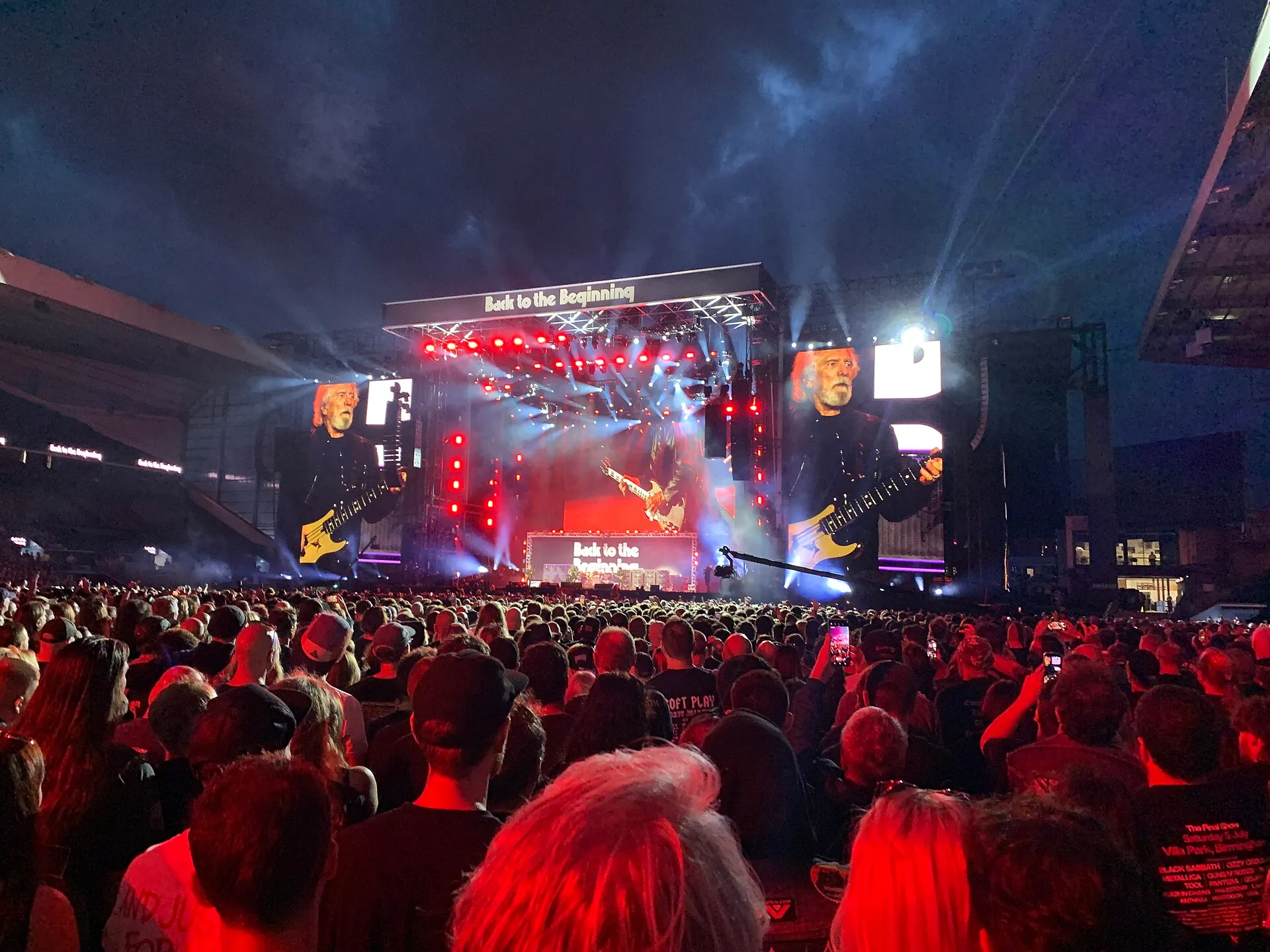
The final original-lineup performance at Villa Park in July 2025 made the four bodies visible together once more. A reunion photograph cannot recover the club band of 1969, and commemoration can smooth old conflicts. It can still correct the proportions of the story. Iommi, Butler, Ward, and Osbourne are on the same stage because the sound required all four.
Black Sabbath’s early work is heavy through relation: guitar against fingers altered by injury, bass against guitar, drums against the apparent tempo, melody against a riff, working-class experience against the entertainment business that sold it. Birmingham supplies conditions and memory, not a mechanical cause. The band supplies the decisions. Listen for any one member and the other three keep changing what that member means.