

On Absolutego, a guitar chord does not simply arrive and leave. It hangs long enough for its edges to fray. Harmonics swell above it; the low end seems to alter the air around the speakers; a strike that first registered as an event becomes an environment. The original 1996 release presented one piece across roughly an hour. That duration was not decoration applied to a metal riff. It changed what a riff could do. The listener had time to hear volume as movement rather than as a fixed setting. 1 4
Boris has spent three decades revising that proposition. The Tokyo group formed in 1992 and took its name from a Melvins song, but a lineage is not a method. Takeshi, Wata, and Atsuo learned to make records whose differences are structural: a single sustained composition, a suite that behaves like weather, a compact hard-rock album, or a sequence where shoegaze blur collides with punk velocity. Calling all of it “heavy” is accurate only if the word remains unsettled.
Genre explains less here than the job assigned to heaviness on a particular record. Sometimes it is the pressure of amplitude. Sometimes it is waiting. Sometimes it is a drum entrance withheld until the ear has recalibrated. Sometimes it is the speed with which a bright riff burns through. The band’s catalog does not trace a clean progression from drone to rock or from obscurity to access. Its forms overlap, recur, and acquire new functions.
A chord long enough to become a room
The scale of Absolutego can make the piece sound immovable in description. In practice, its slowness exposes change. Feedback gathers around a central mass. Atsuo’s percussion marks distances rather than supplying a continuous beat. Wata and Takeshi do not treat distortion as a curtain hiding the notes; fluctuations inside the distortion become the detail. A small adjustment in density matters because the surrounding time is so extended.
That approach made amplification compositional. An amplifier is normally described as equipment that makes an already formed signal louder. Boris uses the whole chain—instrument, pedals, speaker cabinet, room, microphones, and returning feedback—as a system that produces events of its own. Atsuo later told Pitchfork that the band might hang microphones from a ceiling or place them around the drums, then work with incidental sounds and mistakes instead of pursuing one repeatable studio signature. 1
The point is not romantic accident. An uncontrolled sound becomes useful only when players can recognize and shape it. The trio’s patience allows feedback to develop, but their decisions determine whether it opens space, obscures a pulse, or forces a transition. Absolutego established a method in which duration magnifies those decisions. It also established a problem: once an album-length drone had made scale audible, repeating the same scale would reduce the discovery to a format.
Amplifier worship, not amplifier obedience
The title Amplifier Worship can be read as a manifesto, yet the 1998 album is less doctrinaire than that sounds. Its pieces retain massive low frequencies and extended pacing, but they make room for quiet guitar, irregular grooves, psychedelic drift, and vocals that seem to emerge from inside the sound. The album does not abandon the amplifier wall. It cuts doors into it.
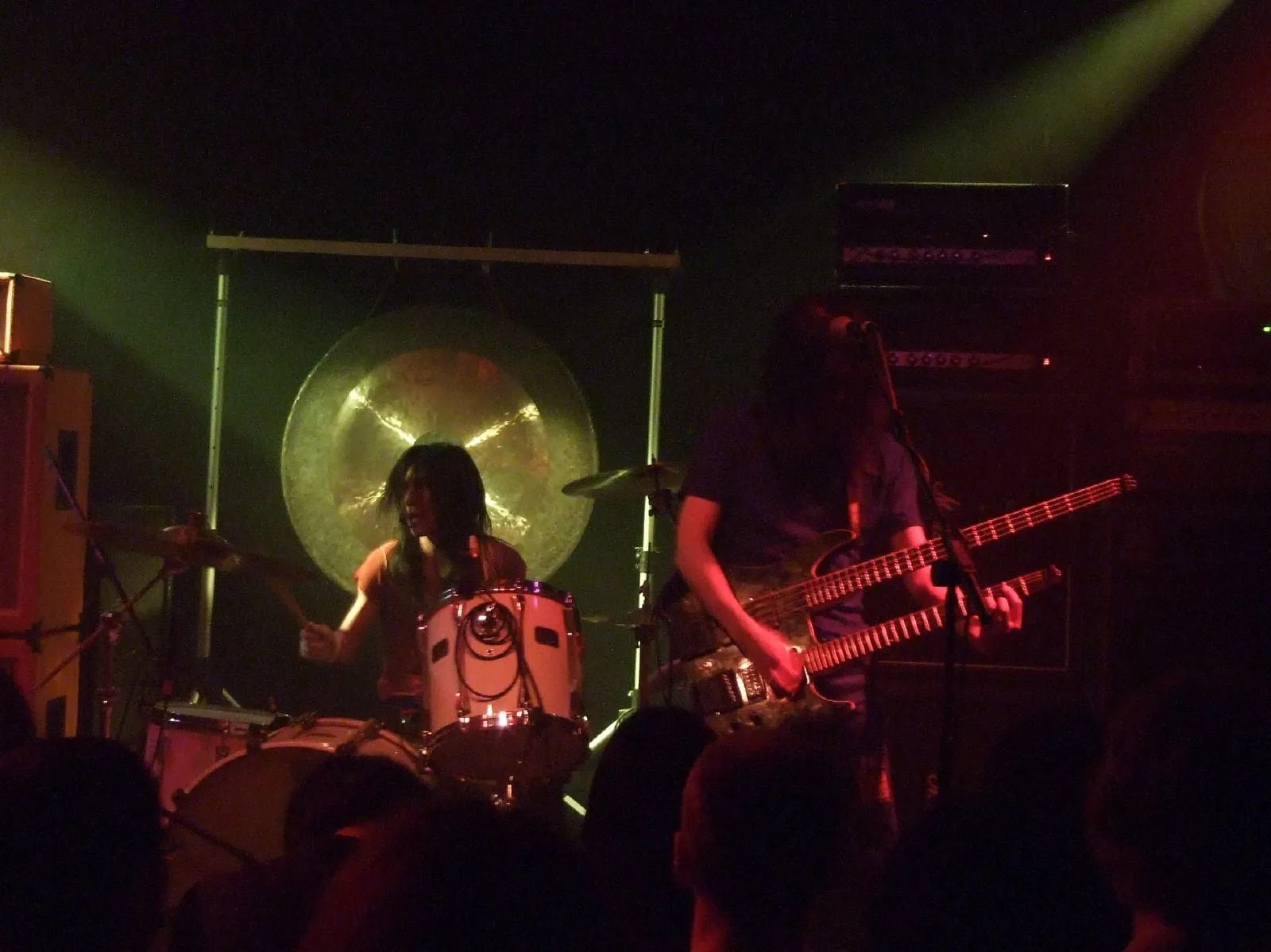
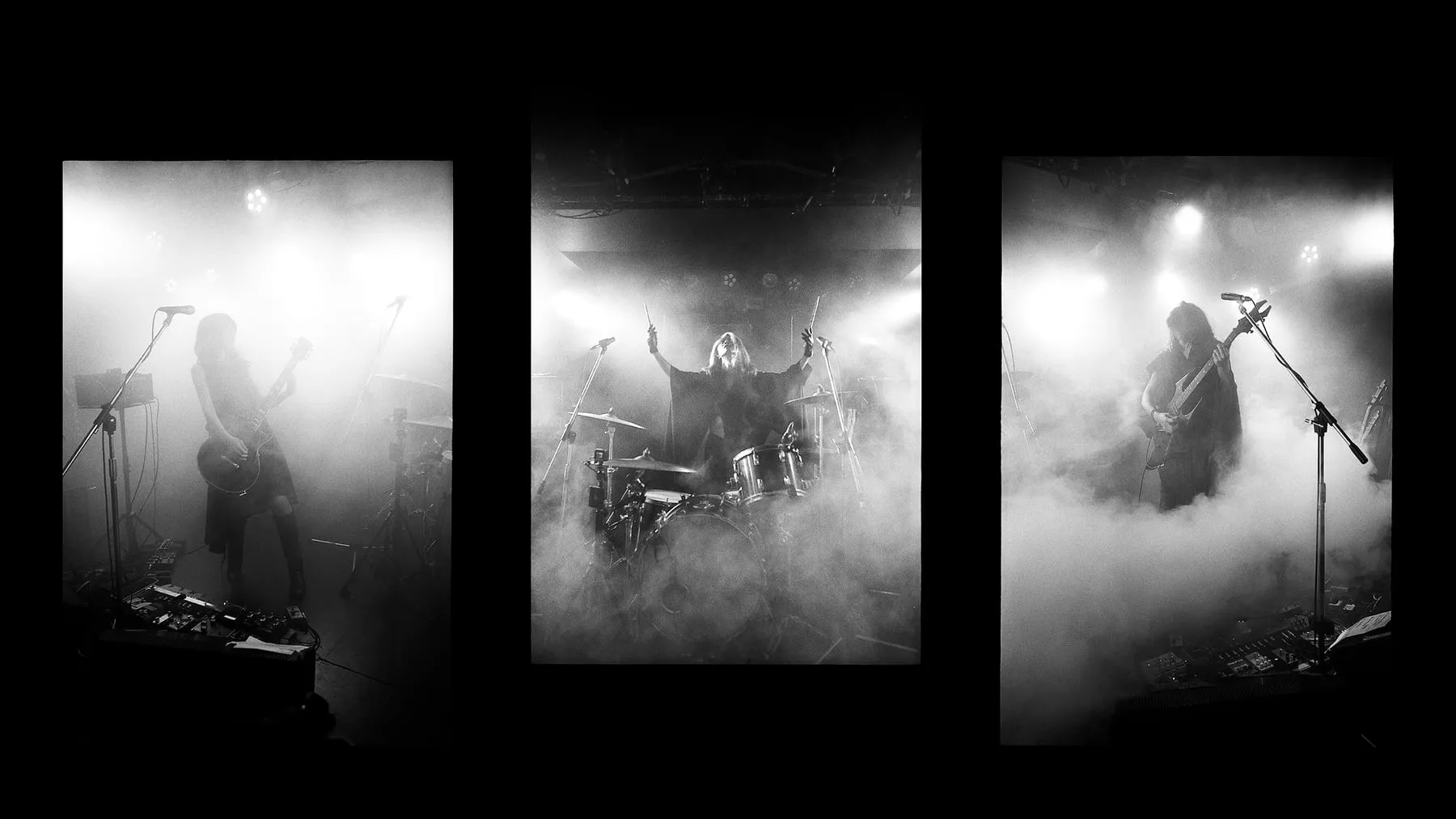
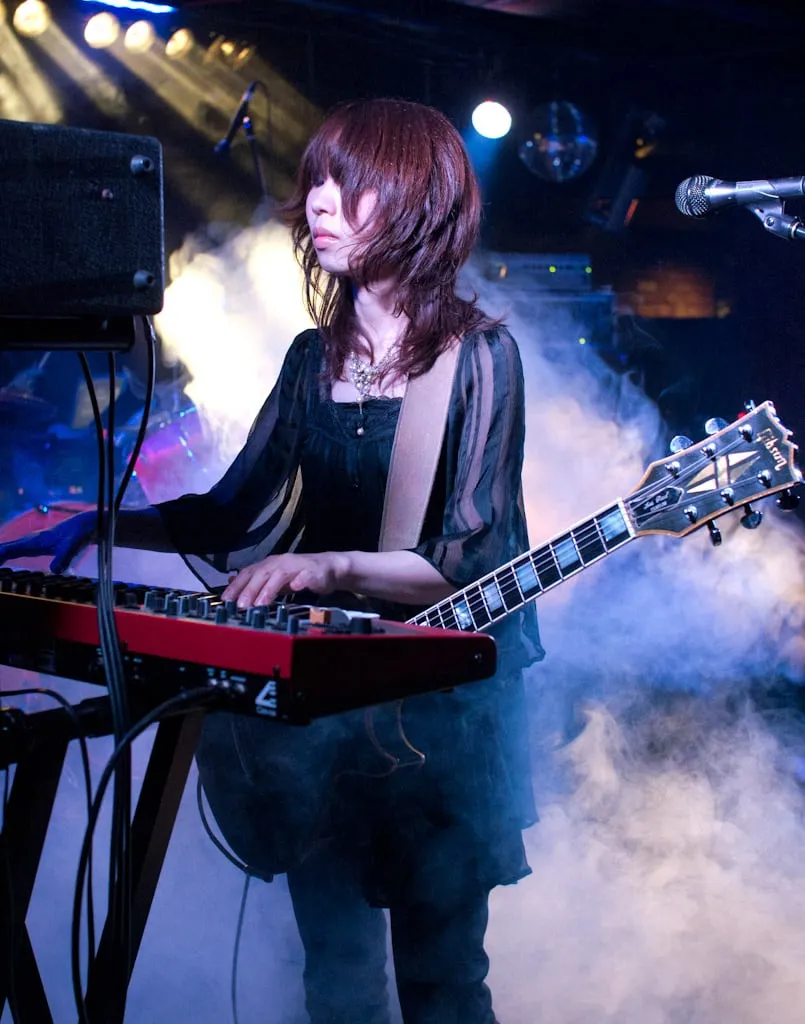
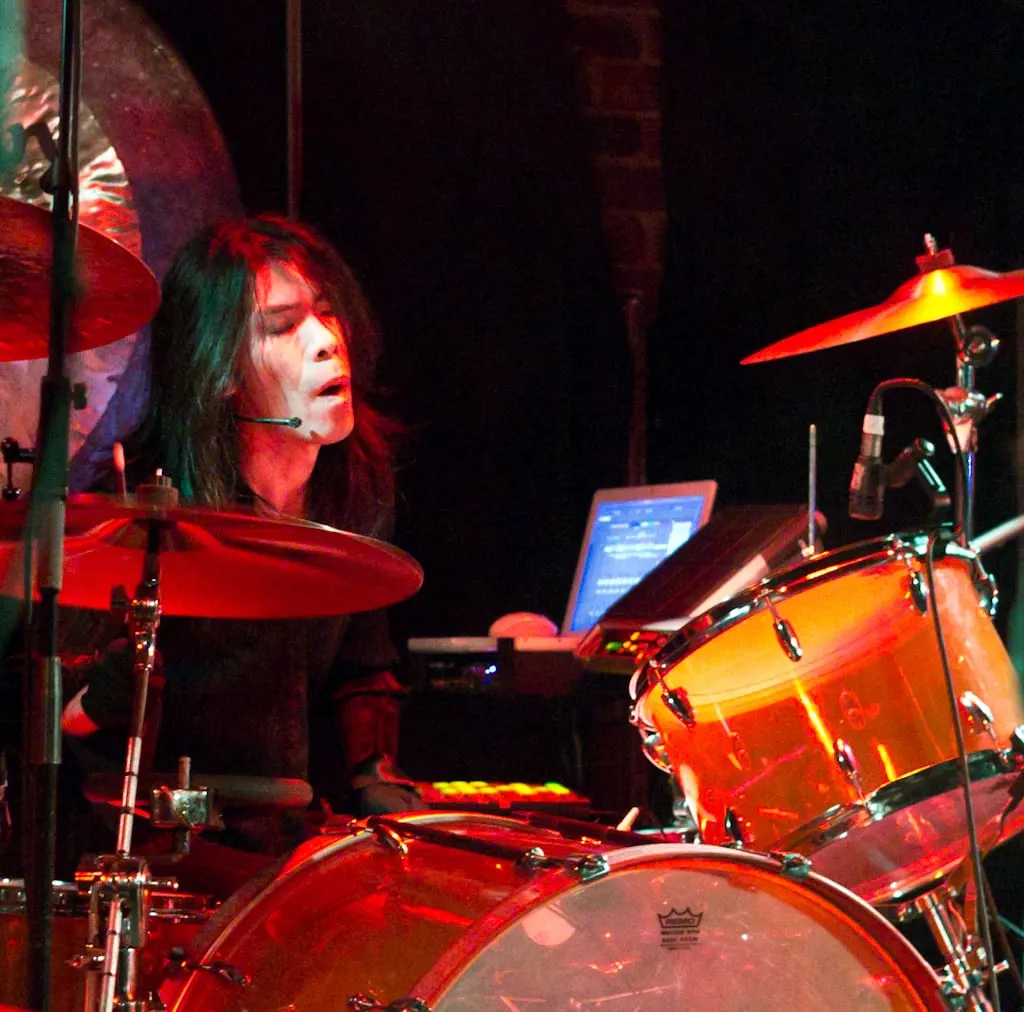
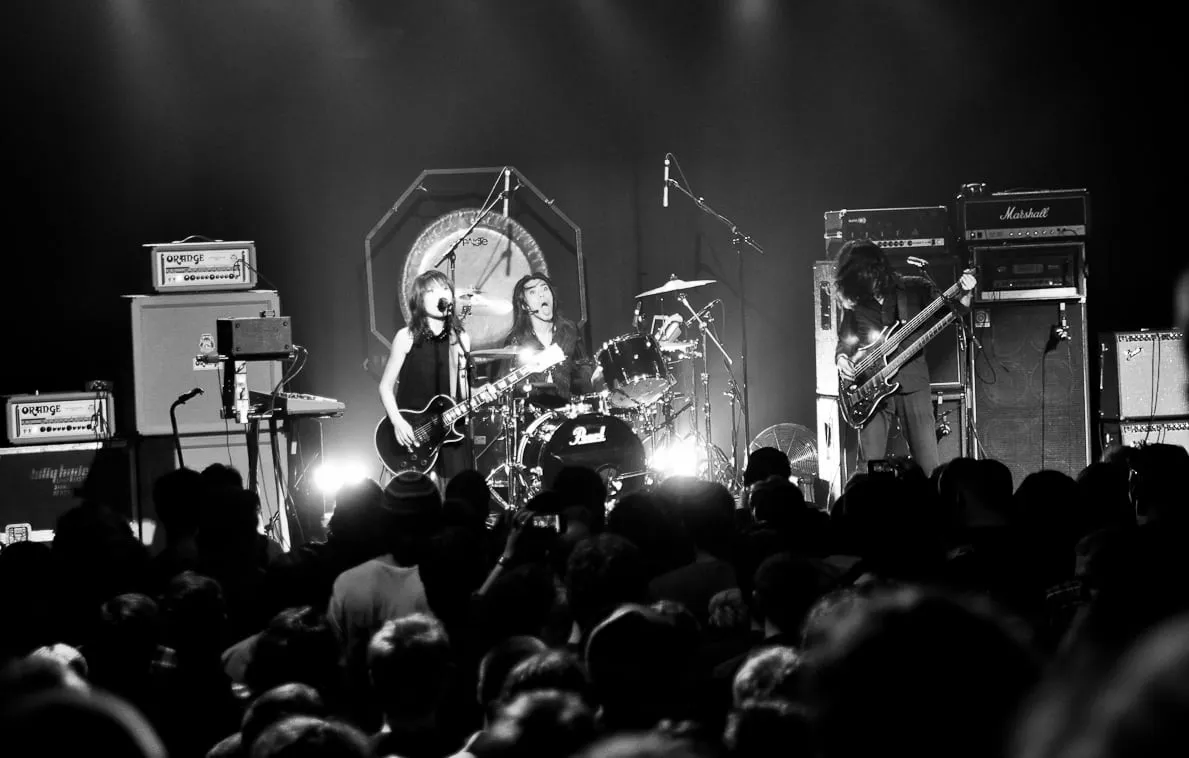
The trio format makes those shifts easy to hear. Boris can sound enormous without pretending that each player has one stable job. Takeshi’s double-neck instrument moves between bass weight and guitar register. Wata can supply a riff, a melody, a sheet of noise, or the nearly empty interval between them. Atsuo acts as drummer, vocalist, and visible conductor of energy. The roles are legible enough for a listener to feel them change.
In a 2014 interview, the band resisted the idea that its many styles were separate costumes. The discussion ranged across collaborations, noise, feedback, and the physical experience of performance; the recurring emphasis was connection rather than genre tourism. 2 That claim is most convincing in the records themselves. The quiet passages on Amplifier Worship do not apologize for the loud ones. They establish the sensitivity required to hear loudness return differently.
Flood measures the rise
Flood, recorded around the turn of the millennium and first issued in 2000, turns contrast into a four-part arc. Its opening guitar figure is lucid and circular. Repetition does not pin it in place; minute variations make the figure feel as if it is reflecting different light. A fuller band gradually appears, withdraws, and leaves behind a broad suspended field. The final movement brings weight back with enough force to make the earlier restraint part of the impact. 5
The album’s title invites a simple image of accumulation, but its pacing matters more than the metaphor. A flood is not represented by continuous maximum volume. Boris makes the listener register levels: sparse notes, flowing pulse, saturation, recession. Heavy music often advertises impact at the first available second. Flood asks impact to remember what preceded it.
The group’s archive complicates any assumption that drums are indispensable to this architecture. In 2020 Boris released recordings from two 1997 “drumless shows,” explaining that the performances took place when Atsuo could not play because of illness. Wata and Takeshi performed as a duo, with one concert built around material connected to Absolutego. 3 The document matters because it shows the band adapting its mass rather than simulating the missing member. Sustained tone, silence, and the room had to carry a different distribution of weight.
Heavy Rocks changes the unit
The orange-covered Heavy Rocks of 2002 makes a sharp turn if the early catalog is heard chronologically. Songs arrive as songs. Riffs move with garage-rock impatience; saxophone and guest parts widen the attack; drums push forward rather than measuring an expanse. The title is blunt and almost generic, as though Boris were testing the phrase found on a record-shop divider.
Yet the album does not reveal the band’s “real” rock identity beneath experimental excess. It changes the unit of construction. Instead of asking how a chord can occupy an hour, the record asks how much color and acceleration can fit inside several minutes. Distortion remains tactile, but it is propelled. Repetition becomes a hook or a launch mechanism. The heavy quality lies partly in momentum.
Boris reused the title Heavy Rocks in 2011 and again in 2022. The records are not remakes, and the repeated name refuses the normal archival convenience by which one title identifies one definitive object. It operates more like a recurring workshop label. Each version can examine contemporary hard rock without promising the same songs or production. That practice makes the catalog mildly difficult to sort and exact to its subject: “heavy rocks” is material, not a settled style.
Feedbacker draws one line through several states
Boris at Last -Feedbacker- returned in 2003 to an album-length composition, but it did not return to the same hour. Often indexed in separate parts, the work behaves as one sequence: a clean, slowly repeated guitar phrase; a widening halo; a crushing central riff; an eruption of feedback; and a final melodic passage that seems marked by everything it has crossed. 6
The piece makes continuity more dramatic than consistency. Its sections do not merely alternate soft and loud. Sounds retain consequences. The clean motif teaches the ear a contour that can survive distortion. The central riff feels immense because the opening withheld that kind of rhythmic certainty. The feedback passage is not an interlude placed between compositions; it erodes the composition’s surface until another shape can be heard.
This way of building also resists a common shorthand about drone: that it suspends time. Boris makes sustained sound reveal time. A held frequency beats against another frequency. Amplifier noise shifts. The body notices fatigue and then a second attention beyond fatigue. On Feedbacker, duration is neither an endurance stunt nor an ambient wash. It is the medium through which one state becomes another.
Pink makes collision audible
Pink, first released in Japan in 2005 and issued internationally by Southern Lord in 2006, brought Boris to a wider rock audience. Its accessibility is real but easy to misdescribe. The record does not simplify the band into concise songs. It puts previously separated kinds of force next to one another: charging rock, blown-out punk, bright melody, shoegaze density, and the long dissolution of “Just Abandoned Myself.” The sequence makes speed and suspension mutually explanatory.
The title track compresses the band’s amplifier knowledge into a rapid form. “Farewell” lets melody float inside a luminous, overdriven field. “Just Abandoned Myself” begins with song form and eventually remains inside a vast sustained tail. The album can offer immediate surfaces without treating immediacy as the opposite of depth. Its last section ensures that a listener who arrived for short impact still encounters altered time.
Touring after Pink intensified the relation between record and performance. Atsuo described the cycle as physically exhausting and creatively productive: shows, travel, and recording ran into one another, while each audience created a one-time situation. 1 The remark guards against hearing the albums as sealed studio theories. Boris’s forms are tested against rooms, bodies, equipment, and the practical duration of a set.
The twentieth-anniversary edition of Pink makes its historical position visible without turning it into a conclusion. In 2025 Boris announced a Relapse reissue with previously unreleased session and live material. 7 An anniversary can freeze an album as a masterpiece. Boris’s subsequent catalog makes that difficult. They continued issuing pop-facing work, noise records, collaborations, ambient drift, crust-punk compression, and further versions of heavy rock.
No final form
A prolific catalog invites selective listening. One listener may celebrate variety by itself; another may preserve a small canon and dismiss the rest as detours. Neither approach explains how techniques carry between records. The ear trained by Absolutego to notice variation inside saturation can hear Pink compress that knowledge. Flood’s dynamic arc clarifies the transitions inside Feedbacker; Heavy Rocks shows repetition producing velocity as well as stasis.
That continuity is clearest when forms are compared as techniques rather than genres: a sustained tone, a rapid riff, and a melodic wash each organize density, attack, and decay at a different scale.
Some experiments do not resolve, and abundance can obscure chronology. Different editions, labels, mixes, and identically titled albums resist a single reliable map. No mystique is needed: this is a working band recording often, collaborating widely, and allowing each release to represent a moment rather than a permanent identity.
Across all those changes, Boris keeps listening to material. Volume earns its place when it exposes texture or reorganizes a room. Duration matters when a change needs time to register; speed can expose another property of the same distorted sound. Each form places a fresh demand on “heavy.” Boris makes an answer audible, lets it decay, and begins again.
.jpg)


))_%26_Boris_perform_Altar_%40_ATP_NY.jpg)