
Factory did not begin as a record label with a clean business plan. It began as a Friday night that needed a poster. In May 1978, Tony Wilson and Alan Erasmus organized events at the Russell Club on Royce Road in Hulme. Peter Saville, then a Manchester Polytechnic student, designed the announcement. The poster arrived too late to perform its ordinary job, but it received an extraordinary afterlife: FAC 1, the first item in the Factory catalog. A missed deadline became an origin object. 3
That story can sound like a perfectly scripted beginning, especially when told through the numbered objects that followed. The surviving record is less neat. Manchester in the late 1970s contained overlapping punk, reggae, experimental, art-school, and working-club circuits. Musicians rehearsed where space was available. Promoters used borrowed rooms. Designers worked alongside television staff, record-shop owners, printers, and people with day jobs. Factory became visible because it gave part of that activity a name and a graphic system. It did not create the whole scene around it.
Royce Road, not a blank canvas
The Russell Club stood in Hulme, an area reshaped by postwar clearance and the troubled modernist housing of the Hulme Crescents. By the time Factory used the club, residents and cultural groups had already made lives inside conditions that outsiders often described only as urban failure. A scene report has to resist the temptation to use damaged buildings as atmospheric scenery. Hulme was not an empty industrial backdrop waiting for post-punk to give it meaning. It was a neighborhood, and the club’s audiences arrived within a local history of housing policy, migration, community organization, racism, and uneven investment.
The Factory nights placed bands such as Joy Division and the Durutti Column alongside other acts that did not fit a single house style. The Manchester Digital Music Archive preserves posters, flyers, photographs, and memories from the Russell Club, including Saville’s FAC 1 design and later monthly listings. Those items show a schedule more varied than the narrow canon built afterward. Reggae groups, punk bands, spoken-word performers, and touring acts shared dates. A surviving poster is evidence of a planned bill, not proof of exactly how the night unfolded. 3
Wilson brought regional television experience and a talent for public framing. Erasmus provided management and space. Saville developed the visual language. Producer Martin Hannett shaped recordings. Rob Gretton managed Joy Division and later New Order, while dealing with the daily labor that turns a group into a touring and recording business. The University of Manchester’s Gretton archive contains about 1,600 items, including correspondence, invoices, artwork, promotional material, recordings, and personal objects. Its inventory is a useful correction to myths of spontaneous genius. Scenes run on letters, bills, vehicles, phone calls, and decisions about who gets paid. 1
The catalog as an argument
FAC numbers did more than track releases. They attached one system to records, posters, stationery, films, events, buildings, and jokes. That move made Factory legible as a cultural project rather than a conventional label. It also allowed later histories to walk from FAC 1 toward FAC 51 as if each number were a step in a planned ascent. The catalog was not a strict chronology. Numbers could be assigned out of sequence, reused, or attached to objects whose status was deliberately ambiguous.
The first vinyl release, A Factory Sample, carried FAC 2 and appeared in late 1978. Its two seven-inch records brought together Joy Division, the Durutti Column, Cabaret Voltaire, and comedian John Dowie. The package made collaboration visible: recordings, Hannett’s production, Saville’s material decisions, label organization, and the bands’ different sounds. It was a sampler in the commercial sense, but also a test of how far the catalog idea could stretch.
The Science and Industry Museum later built its Use Hearing Protection exhibition around the first fifty numbered objects. That curatorial limit reveals both the strength and danger of the scheme. Fifty objects provide a concrete route through paper, vinyl, film, and design. They can also make a network appear more orderly than it was. Women and workers outside the familiar group of male directors are easier to lose when the story follows only official catalog entries. The museum addressed that problem by adding street context and accounts beyond the objects themselves. 4
The road to Stockport
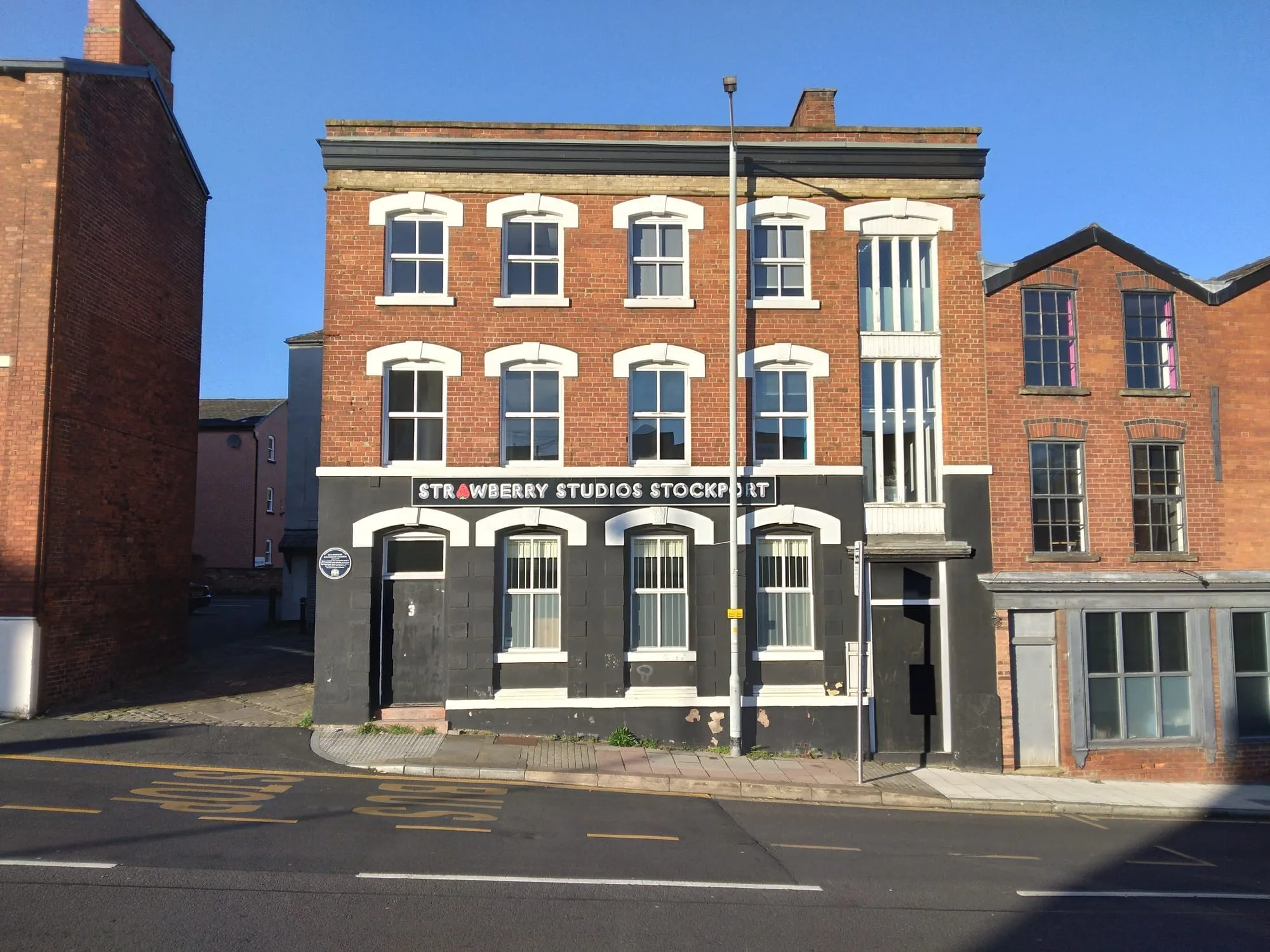
Some of Factory’s most important work happened outside Manchester city proper. Strawberry Recording Studios operated on Waterloo Road in Stockport. Its history began with Inter-City Studios in 1967, when Peter Tattersall bought a small recording setup above a shop. Eric Stewart later became a partner, and the operation moved into the Waterloo Road building. By the 1970s, Strawberry was associated with 10cc, but its facilities also became central to a younger group of regional artists and producers. 7
Hannett’s relationship with Strawberry connected the studio to Joy Division, the Durutti Column, A Certain Ratio, and other Factory work. The building matters because records do not emerge from a citywide mood. They emerge from rooms with particular machines, acoustic problems, available hours, and engineers. At Strawberry, Hannett could separate instruments, manipulate ambience, and use the studio as part of the composition. His productions often make space feel active: a drum placed at an improbable distance, a guitar stripped of familiar warmth, a noise allowed to sit by itself.
This was not simply the cold sound of industrial Manchester translated into audio. That explanation confuses a later metaphor with a production process. Hannett worked with tape, microphones, delays, digital devices as they became available, and detailed performance choices. Musicians could value the recordings and still argue with his methods. The studio redistributed authority. A producer could transform what a band thought it had played, while a manager and label had to decide whether the time and expense were justified.
Delay manufactured nearby
One machine makes the regional chain unusually concrete. Hannett used the AMS DMX 15-80 digital delay, developed by engineers in Burnley. The Science and Industry Museum describes it as the first microprocessor-controlled 15-bit digital delay. It accepted an analog signal, converted that signal to digital information, and let the engineer set the delay that returned as echo or simulated reverberation. This replaced the physical loop of tape used by earlier delay systems with adjustable electronic processing. 5
The device did not produce a “Factory sound” by itself. Hannett used it with a Marshall time modulator, microphones, room acoustics, and decisions made at the mixing desk. For Unknown Pleasures, he had access to the stereo DMX 15-80S soon after AMS developed it. A drum could be recorded in Stockport, converted and delayed by a machine built in Burnley, then returned to the mix with a sense of space that listeners often mistook for the natural character of the room. The geography was embedded in the equipment supply as well as in the musicians’ addresses.
The bands were experimenting on a smaller budget. Bernard Sumner assembled a PowerTran Transcendent 2000 monophonic synthesizer from a kit while working at Cosgrove Hall Films. The kit supplied a printed circuit board and schematic diagrams; the instrument depended on the buyer making the soldered connections. Stephen Morris chose a mail-order Synare 3 percussion synthesizer listed at £170 after seeing that an earlier Synare model cost £1,000. These were practical routes into electronic sound: workbench assembly, mail order, advice from colleagues, and the risk of wiring something incorrectly.
The machines entered Factory recordings through specific routes, not through a citywide industrial mood. Regional engineering supplied tools. Chemistry training at UMIST informed Hannett’s interest in the physical behavior of sound. Musicians found, borrowed, built, or bought what they could afford, then brought homemade and mail-order instruments to Strawberry’s recording room.
Joy Division recorded Unknown Pleasures at Strawberry in April 1979. The album’s release gave Factory international reach without giving it a conventional corporate structure. Its success also intensified the tension between artistic control and financial capacity. A small organization could make an object look complete while the people behind it negotiated contracts, manufacturing, distribution, and cash flow in less polished conditions.
The people inside the paperwork
The Anthony Wilson archive at the John Rylands Library contains roughly 2,000 items across his education, broadcasting, Factory work, the Haçienda, and later projects. The Gretton archive follows management, correspondence, invoices, and the development of Joy Division and New Order. Read together, the collections weaken the idea that Factory spoke with one voice. They document overlapping responsibilities and competing ideas about what the organization should become. 2
Wilson was exceptionally good at making an event sound like a theory. Saville could give a release visual authority while withholding the usual sales information. Hannett pursued control in the studio. Gretton dealt with bands and business realities. Erasmus often worked away from the public narrative. These roles were neither fixed nor equal. Friendship, taste, status, and money moved through them. The absence of formal contracts in parts of Factory’s history has often been romanticized as trust. It could also mean uncertainty about rights, obligations, and who carried the risk.
Ian Curtis’s death in May 1980 changed the network irreversibly. Joy Division ended, and the remaining members formed New Order. The label lost a singer and gained a new set of practical questions: how to support a group under grief, how to release existing work, and how to let the new band develop without turning it into a memorial act. Archive descriptions can list the letters and recordings. They cannot make that period administratively clean or emotionally transparent.
A studio or a club
By 1981, Factory’s partners were considering a permanent venue. The decision exposed a clear conflict over capital. Hannett wanted to develop a recording studio around the Fairlight Computer Musical Instrument, an expensive digital sampler and workstation. Other partners preferred to put money into a club. The Science and Industry Museum’s account gives the dispute a material scale: early Fairlight systems cost tens of thousands of pounds, while the club demanded a different kind of continuing expense. 5
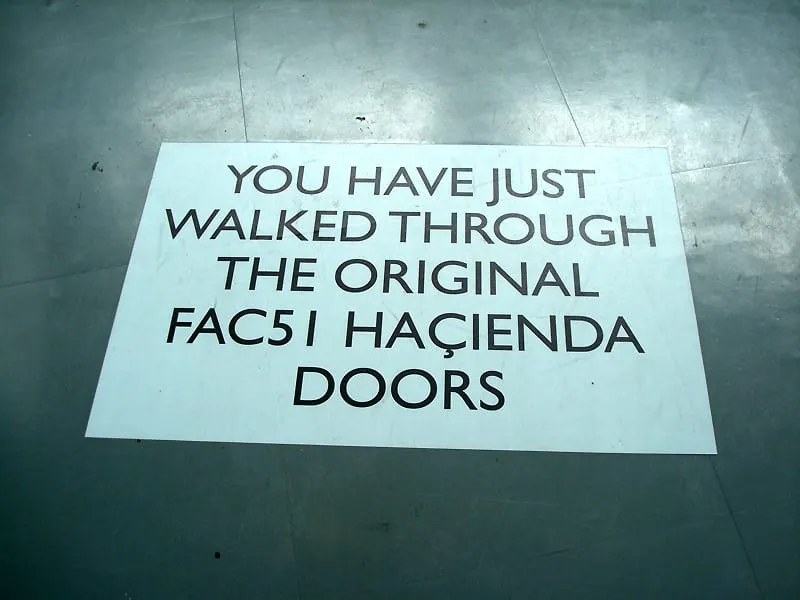
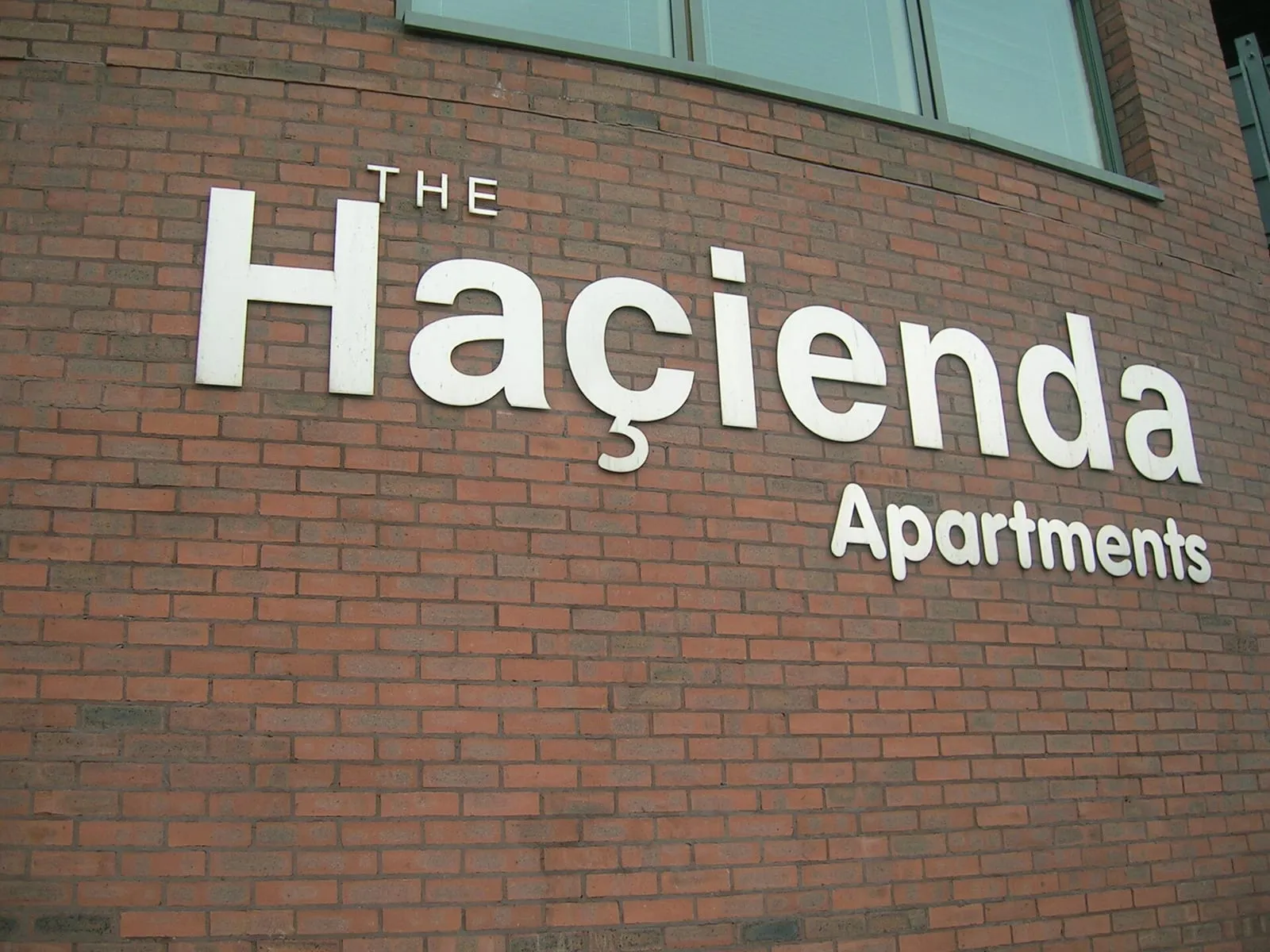
The organization chose the club. A former yacht showroom on Whitworth Street became the Haçienda, catalog number FAC 51. Ben Kelly designed the interior with industrial materials, bold hazard stripes, exposed structure, and a layout that treated the room as a total environment. The club opened in May 1982. Its early attendance was weak, and the costs of operating a large venue created pressure. Later fame can make the empty nights disappear from memory.
The Science Museum Group’s Factory history links the club decision to friction with Hannett, who resigned as a director; Saville followed soon afterward. The move from records into architecture was not smooth. FAC 51 redirected money, attention, and authority. It also shifted the label’s relation to its city. A monthly club night uses an existing room for a limited event. A permanent venue takes responsibility for staff, licenses, security, maintenance, programming, and the behavior of a crowd night after night. 6
The first year of FAC 51
The Haçienda that opened in 1982 was not yet the dance-music institution remembered from the later decade. It booked live acts, tested different nights, and struggled to fill its capacity. Its design was visually coherent before its audience was secure. That imbalance is central to the Factory story. The organization repeatedly produced finished-looking cultural objects before it had established a stable way to pay for them.
By 1983, New Order’s “Blue Monday” connected club experience, electronic production, and Saville’s coded sleeve design in ways that later looked inevitable. They were not. The twelve-inch single sold at extraordinary scale, but its elaborate packaging and Factory’s economics complicated the idea that sales automatically meant profit. The club still required subsidy. The scene’s creative feedback loop and its financial weakness could exist at the same time.
FAC 1 and FAC 51 do not mark a simple rise from small poster to legendary club. The route between them passes through different kinds of infrastructure. The Russell Club offered a night and an audience. The catalog supplied identity. Strawberry provided technical capacity. Archives show management labor and disagreement. The Haçienda turned a label’s ideas into a building with bills.
What the city keeps
Factory’s afterlife is unusually visible because objects survived in public and personal collections. The Manchester Digital Music Archive allows contributors to add flyers, photographs, tickets, and memories. The British Pop Archive brings Wilson, Gretton, Curtis, and other collections into an institutional reading room. Museums catalog sleeves and rebuild exhibition spaces. Each method preserves something different. A community caption may contain the detail an official record missed. A business letter may contradict a polished anniversary story.
Those sources also require restraint. A photograph of a packed room cannot represent every night. A poster proves what was advertised, not who arrived. An invoice can show a cost without explaining the argument around it. Nostalgia tends to make scenes frictionless because participants and later fans know which names endured. The archive restores contingency: canceled plans, empty floors, late artwork, unpaid obligations, and projects chosen over other possible futures.
Manchester did not become culturally alive when Factory numbered a poster. Factory made one network unusually good at leaving marks. FAC 1 and FAC 51 remain useful coordinates because the distance between them passes through real places and disputed choices. The scene is clearest when those choices stay visible, along with the city that exceeded the catalog.