
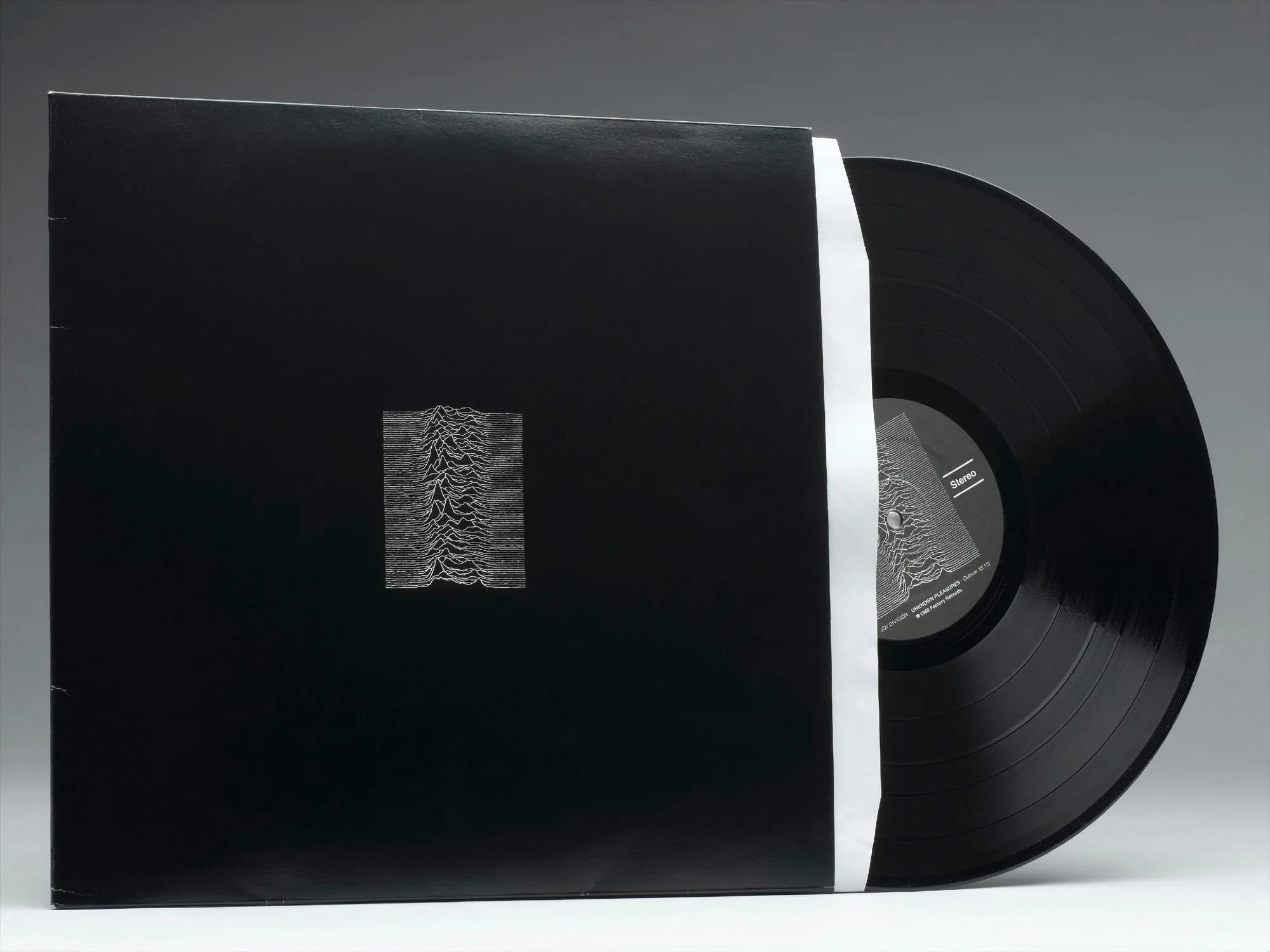
The front of Unknown Pleasures does not tell a record shopper what it is. A compact field of white lines sits on black. There is no band name, album title, photograph, or sales phrase. The sleeve withholds the information normally used to move an unfamiliar debut across a counter. It asks the object to be recognized by one image and by the confidence of its refusal.
That refusal is now so familiar that it can be hard to recover its original risk. The white traces have appeared on shirts, shoes, mugs, tattoos, data visualizations, and parodies. In many reproductions, the name Joy Division is unnecessary. The mark works without it. The cultural success of the image can therefore make the 1979 sleeve look like an obvious solution. It was a chain of specific transfers: from a pulsar to radio data, from data to a doctoral plot, from the plot to books, from a library image to a band, and from Peter Saville’s layout to a manufactured record. 2
The museum object
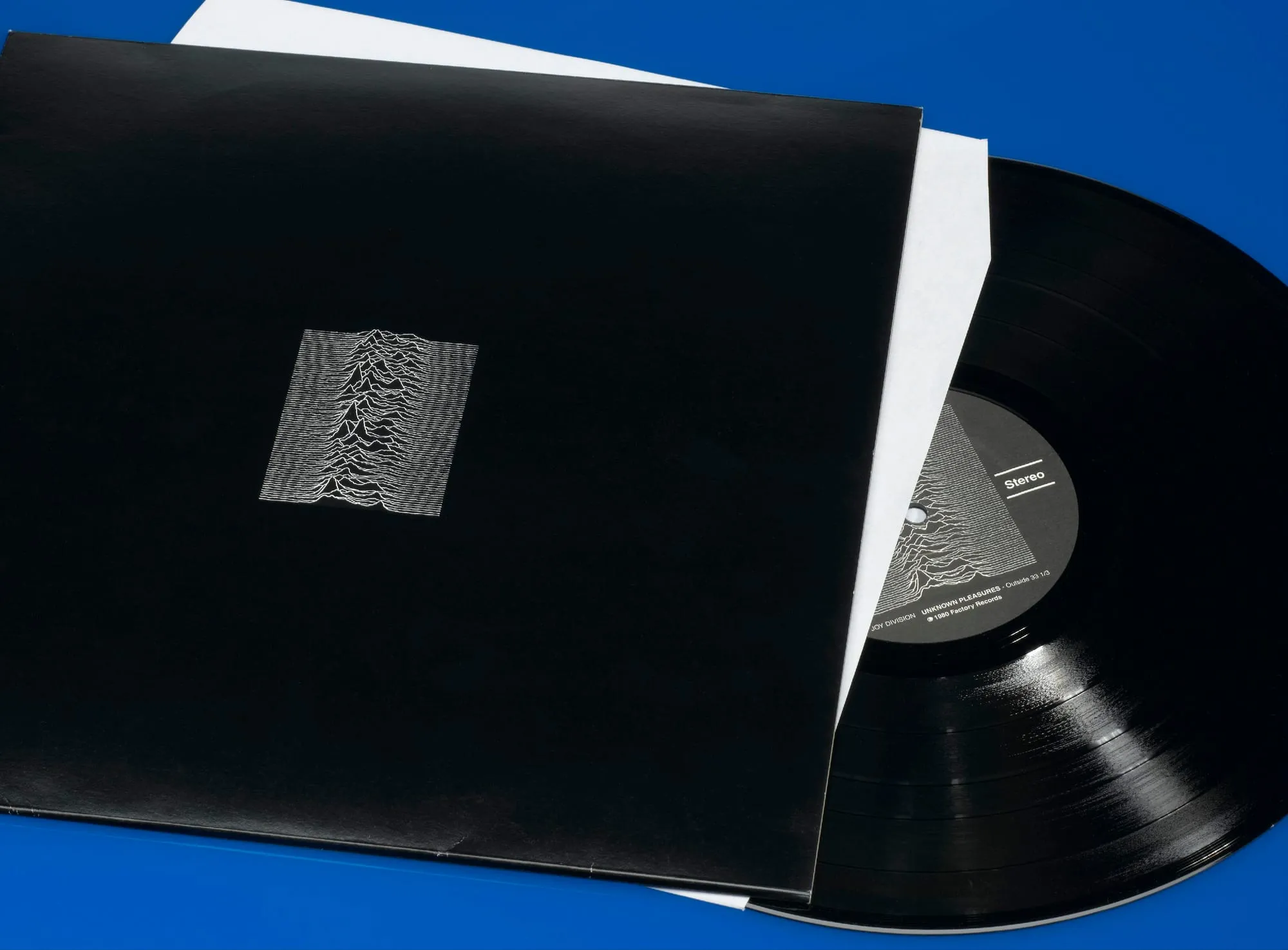
The Science Museum Group catalogs its copy as object 2006-112, a cardboard-and-vinyl record cover made in Manchester in 1979. Its listed dimensions are 305 by 305 millimeters, with a depth of four millimeters. These ordinary measurements are useful. The image is usually encountered as a flat square on a screen, but the catalog record returns it to scale. It is an object held in two hands, opened at one edge, rubbed, stacked, and stored. 1
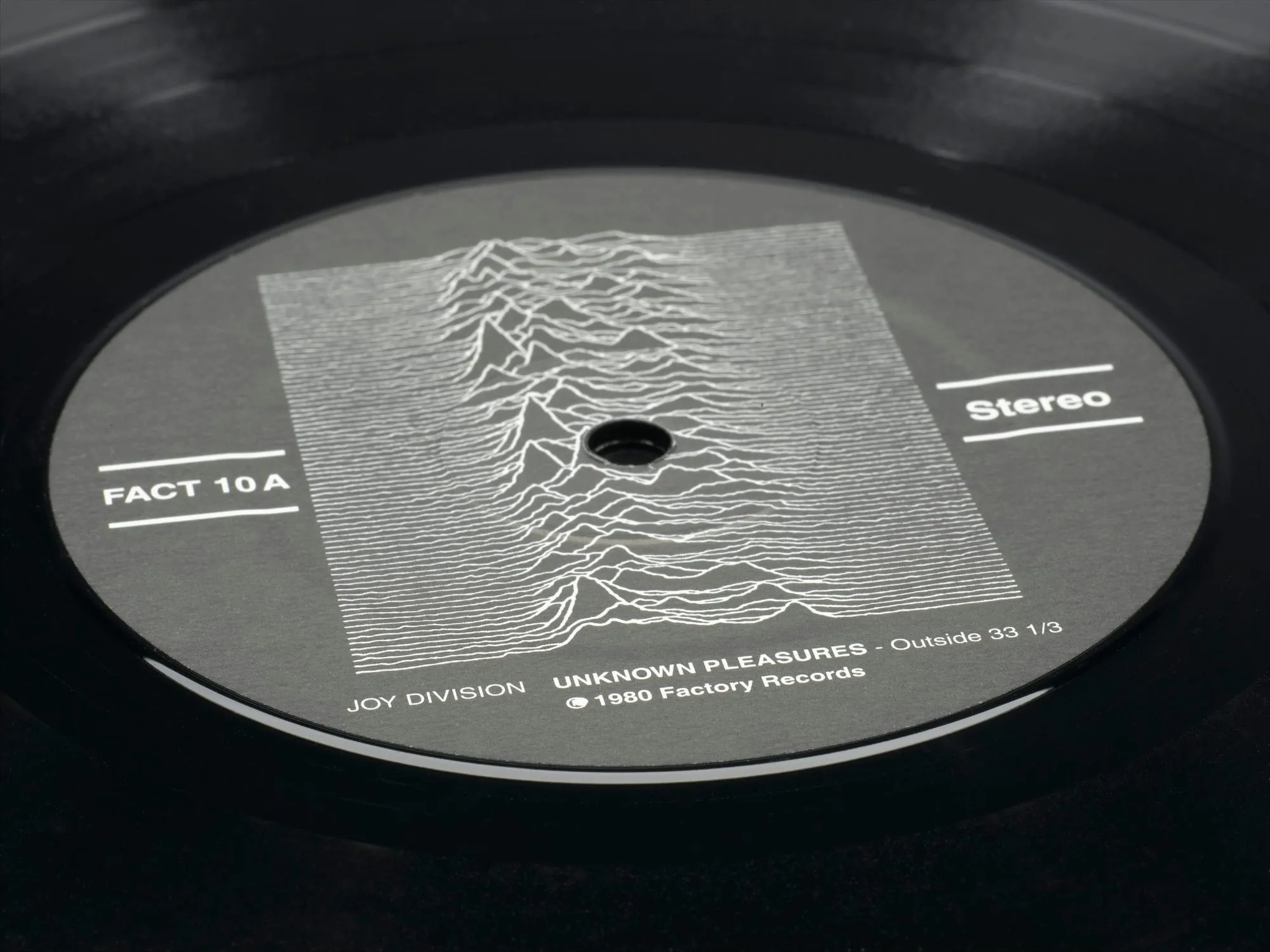
Museum photographs show the black outer sleeve, white inner sleeve, and vinyl disc. The record label repeats the pulse image while adding FACT 10A, stereo information, the band name, album title, side, duration, and copyright line. Information was not abolished. It was moved. The front creates distance; the inner layers perform the ordinary work of identifying and operating a record.
The physical copy also carries wear, edge thickness, paper tone, and reflections that do not appear in a clean vector redraw. Those details separate a surviving pressing from the endlessly reproducible symbol it later became.
That sequence matters because a sleeve is read through handling. The buyer sees the front, turns it, pulls out the inner sleeve, and places the disc on a turntable. Saville’s restraint belongs to that choreography. A standalone JPEG of the cover keeps the black field and plot but loses the transition from silence to specification.
The museum credits the maker as Peter Saville and Joy Division and the object to Clampdown Records. Its image is released under CC BY-NC-SA 4.0, with the Board of Trustees of the Science Museum identified as copyright holder. The license permits noncommercial reuse with attribution, the same license for adaptations, a link, and a record of changes. Rights information is not separate from looking. It explains why the object can appear here and under what limits. 4
A star reduced to repeated lines
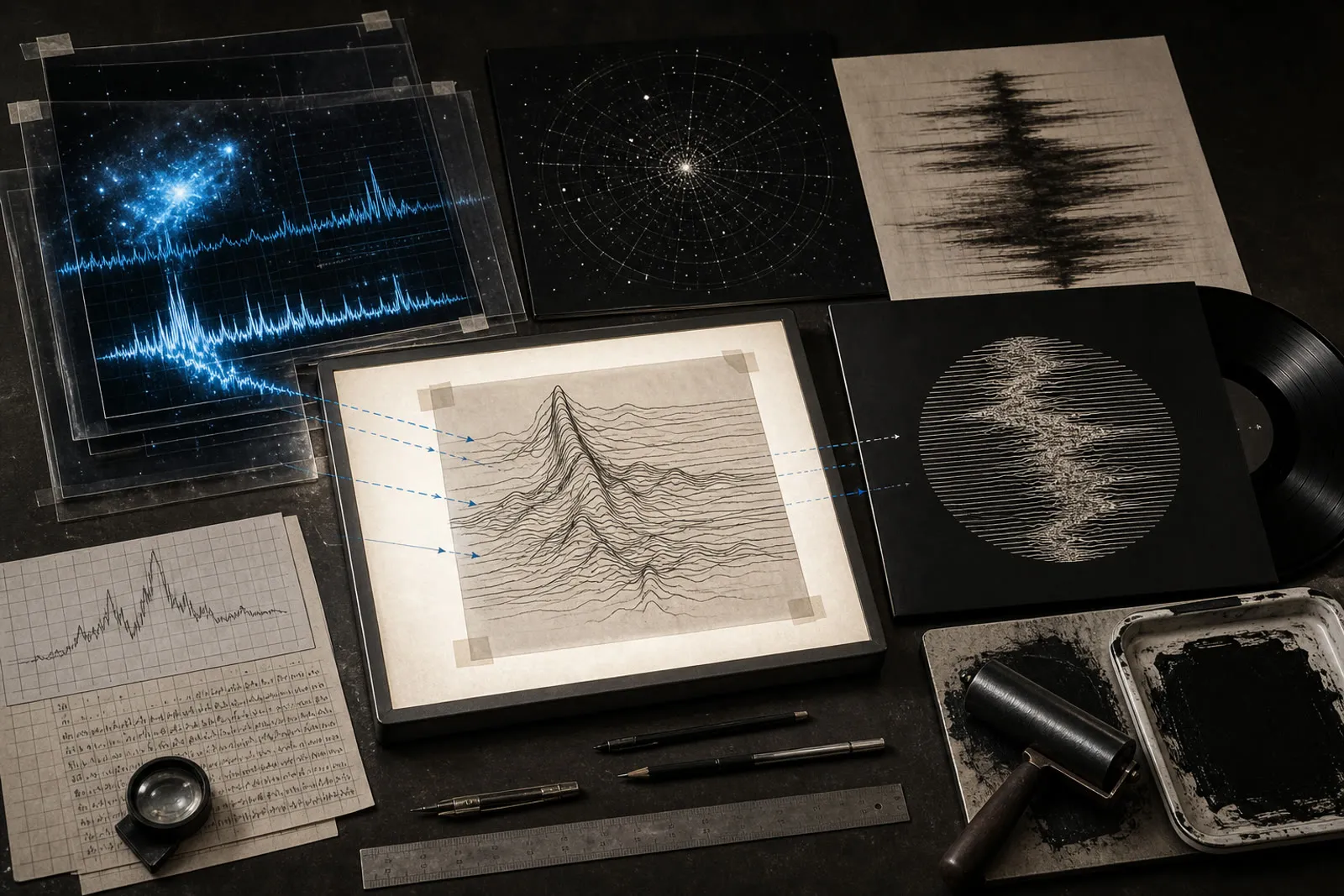
The source is radio astronomy. CP1919, now known as PSR B1919+21, was the first pulsar identified through radio observation. A pulsar is a rapidly rotating neutron star whose beam can be detected at regular intervals when its geometry aligns with Earth. The famous plot does not show a mountain range or a sound waveform, though it can resemble both. It stacks observations so changes across successive pulses can be compared.
Harold D. Craft Jr. produced the plot while completing his 1970 Cornell doctoral thesis, Radio Observations of the Pulse Profiles and Dispersion Measures of Twelve Pulsars. The Science Museum Group traces the image from that thesis to a January 1971 Scientific American article and then to the 1977 Cambridge Encyclopaedia of Astronomy. Bernard Sumner found the diagram in the encyclopedia and thought it could work as sleeve art. The image reached Saville as selected material, not as a commission from an astronomer. 2
Authorship becomes layered at this point. Craft made the plot from observational data and a method of display. The pulsar had been identified through work led by Jocelyn Bell Burnell as a postgraduate researcher at Cambridge. An encyclopedia reproduced the diagram. Sumner selected it. Saville determined how it would live on the sleeve. Printers turned that decision into thousands of objects. Saying that Saville designed the cover is correct, but it is incomplete if design is mistaken for creating every line from nothing.
The transfer also changed the plot’s purpose. In a thesis, labels, surrounding text, and sequence place a figure inside an argument. On the cover, the axes and explanatory frame disappear. The traces become an autonomous image. Scientific information still produces the form, but a record buyer is not given enough information to read it as a chart. Ambiguity is not in the data itself. It is created by removing the apparatus that explains the data.
Eighty lines, one hundred pulses
Even a celebrated image can accumulate conflicting metadata. The Science Museum Group’s object description says the cover shows a drawing of 100 consecutive pulses. The University of Manchester’s 2019 account of a Jodrell Bank re-observation describes the original cover as 80 wiggly lines and says its anniversary team recorded the same number of pulses from the same pulsar at the same frequency. Both are institutional sources. They do not give the same count. 3
The museum’s count gives the image its familiar “100 pulses” description, but the disagreement remains unresolved. A plotted trace may not map simply onto a reader’s count of visible lines, and reproductions can make fine divisions hard to distinguish. The discrepancy also shows how catalog descriptions travel. Once a number enters a museum record or anniversary article, later summaries may repeat it without returning to Craft’s original figure.
The University team used the 40th anniversary to observe PSR B1919+21 again from Jodrell Bank, about 23 kilometers from Strawberry Studios, where the album was recorded. Their updated plot preserved the historical parameters but revealed a diagonal pattern associated with modern equipment and analysis. Repetition did not recover an untouched original. It produced a comparison across instruments, time, and location.
The decision to invert
The source diagram circulated in scientific publications before Saville’s sleeve, but the cover changed its visual conditions. White lines emerge from black. The inversion does more than make the image dramatic. It changes what the eye treats as substance. The signal appears luminous while the page becomes space. The plot can be read as emission, relief, or an object seen at a distance.
Saville also kept the image small. It occupies the central region rather than filling the square. Large areas of black slow down recognition and make the buyer approach the fine lines. The choice rejects the usual assumption that more cover area should be used to announce more content. It is strict, but not neutral. Black ink, white print, scale, centering, and texture all create an atmosphere.
The Design Museum describes Saville’s broader practice through his ability to select images that captured a moment. Selection is the operative skill here. The plot already had formal power. The design gave it isolation, inversion, material, and a commercial context. It also withheld a verbal explanation that might have reduced its range of associations. 5
That restraint belonged to Factory’s wider visual culture. FAC numbers, unusual materials, delayed or absent artist names, and references to art and design history made releases feel connected without requiring a fixed logo on every front. Factory could treat a record as one cataloged object among posters, films, stationery, and event spaces. Unknown Pleasures carried FACT 10, identifying an album within that system even though the number did not appear as a front-cover sales badge.
The first pressing was a set of surfaces
The Science Museum Group’s archive record dates the first pressing to May 1979 and identifies Garrod & Lofthouse as the printer. It describes a twelve-inch record in a textured picture sleeve with a white printed inner sleeve. Those production details are easy to lose when the cover is reduced to a black square in a design survey. FACT 10 was made from several surfaces that had to agree while performing different jobs. 2
Texture changes the black before any line is read. Light catches on paper rather than disappearing into a screen. Handling adds fingerprints, rubbed edges, and small creases. The white plot has to remain fine enough to feel measured but clear enough to survive printing and repeated use. Its small scale therefore works with the stock and print, not simply with a pair of digital coordinates. A later vector copy can preserve the outline while removing the resistance of the object.
The inner sleeve carries another part of the system. White replaces black, and printed information returns after the front has withheld it. The record label repeats the plot at a different scale beside the practical data needed to identify a side and play it correctly. Front, inner, and label do not offer three competing designs. They stage an order: image first, specification later, then sound.
That order depended on manufacturing. Someone had to prepare artwork, print the outer and inner components, press labels onto vinyl, assemble the package, and distribute copies without a conventional title block on the front. The finished sleeve looks quiet because production noise has been resolved before it reaches the buyer. Restraint is visible; coordination is not.
The archive and object records preserve different parts of that work. One names the printer and first-pressing format. The other measures a surviving copy and photographs its wear, inner sleeve, and label. Read together, they prevent “the cover” from collapsing into one downloadable image. Saville’s layout was a plan for an object, and the first pressing is the point at which that plan acquired paper, ink, thickness, and sequence.
What the sleeve does to the music
Joy Division recorded the album at Strawberry Studios in Stockport in April 1979, with Martin Hannett producing. The cover is often treated as a perfect visual equivalent of the recording: dark ground, isolated signals, repeated pulses, and controlled space. The fit is persuasive, but it should remain interpretation. The astronomy diagram was not generated from the album audio, and the music was not composed to illustrate a pulsar. 6
What the sleeve does provide is a way of approaching the record. Its lack of portrait keeps the musicians physically absent. Its lack of title prevents a phrase from directing the first impression. Repetition in the plot prepares the eye for pattern and variation. Black space suggests separation. Listeners can carry those cues into the sound, especially Hannett’s treatment of drums, ambience, and gaps between instruments.
The process can work in reverse after repeated listening. A drum pattern begins to look like a line in the stack; a bass phrase seems to occupy the black around it. That exchange is part of the cover’s durability. It is specific enough to be recognizable and open enough to absorb associations the original scientific figure did not state.
From record sleeve to free-floating mark
The cover’s afterlife depends on detachment. Removed from a twelve-inch sleeve, the plot becomes a compact emblem that scales easily. It remains identifiable in one color, survives rough printing, and can be placed on almost any product. Each reuse weakens some context. Craft’s thesis disappears first. The band and album may follow. What remains is a white-on-black pattern associated with a generalized idea of post-punk seriousness.
Parody confirms recognition. Designers replace the traces with cats, skylines, mountains, hand gestures, or other data. The joke works only because viewers know the arrangement being interrupted. Such copies can be affectionate, commercial, critical, or merely automatic. Their volume makes the image culturally large while often making its source history small.
The contrast with the original sleeve is awkward. A design famous for withholding sales language became a highly marketable sign. That change is not a failure in Saville’s work. It shows what happens when a controlled object enters mass visual memory. The front cover could move information to the inner layers because the record remained a package. A shirt or social image may have no inner layer where context can return.
Keep the object open
The image carries several histories at once. The plot documents radio observations. Craft shaped those observations into a comparative figure. Bell Burnell’s research history sits behind the pulsar’s identification. Sumner found the image. Saville transformed its presentation. Factory manufactured it as FACT 10. Hannett and Joy Division made the album it came to represent. Museums now preserve copies and set conditions for their reuse.
Those layers make the cover’s achievement more exact. The design does not need a myth of creation from nothing. Its force comes from moving an existing image into a new material and informational system with unusual discipline.
The blank front is therefore not empty. It contains decisions about attribution, sequence, scale, commerce, and trust in an audience. The little field of pulses asks to be approached without a band name. The complete object, once opened, gives the names back.