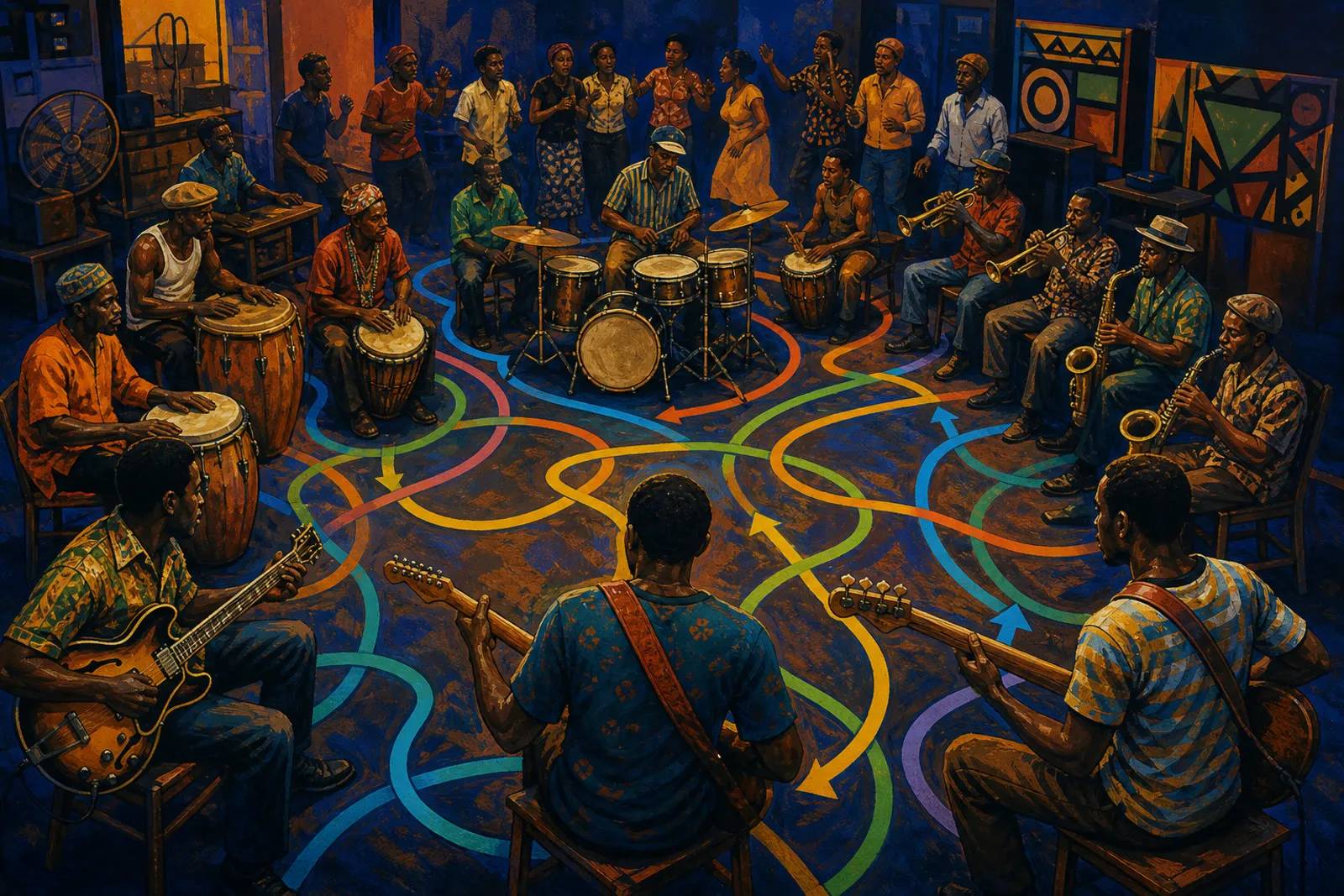


The first mistake is to listen only for Fela Kuti. His tenor saxophone, electric piano, and voice command attention, but the music does not begin with a solitary figure waiting for accompaniment. It begins with a group learning how to hold several short parts at once. A guitar repeats one dry phrase. Another guitar answers from a different point in the bar. Bass refuses to decorate the harmony and instead makes a small pattern feel permanent. Percussion divides the pulse again. Tony Allen’s drum kit moves among those lines without flattening them into a single backbeat.
When the horns finally enter, they do not rescue an empty arrangement. They strike across a machine already in motion. That is the practical achievement of Africa 70: the band made repetition sound less like stasis than collective concentration. Fela could extend a piece past ten minutes because the arrangement was not a verse waiting for a chorus. It was a set of relationships that could absorb speech, solos, choral answers, and political pressure without losing its center. 6
Before the name settled
Fela Ransome-Kuti studied music in London, where he formed Koola Lobitos and worked within jazz and highlife. After returning to Nigeria, he rebuilt the group. The names changed—Koola Lobitos, Nigeria 70, Africa 70, and later Afrika 70—but the important continuity was rehearsal. The music that came to be called Afrobeat was not produced by placing a ready-made African rhythm under American funk. It developed through a Lagos band testing how highlife, jazz improvisation, Yoruba rhythmic knowledge, soul, and funk could occupy the same long form. 1
The group’s 1969 tour of the United States sharpened Fela’s political language. His encounters with Black Power thought, including conversations with Sandra Izsadore, changed the subjects and directness of his writing. The musical change was already a collective problem. A new lyric needed a form that could speak in public without turning the band into background. Call and response offered one answer; an ensemble that could build tension for minutes before the vocal arrived offered another.
Afrobeat’s familiar ingredients can be listed quickly. The list explains little. The sound depends on allocation: which instrument owns which subdivision, which phrase is allowed to repeat, and who signals the next layer. A large band works only if each musician accepts that a small part can carry structural weight.
One drummer, several directions
Tony Allen had played jazz and highlife before becoming the drummer at the center of Fela’s bands. His kit did not copy the percussion section. Hands and feet maintained different lines, leaving openings where a conventional rock or funk drummer might place a heavy statement. Snare accents could converse with guitar rather than merely confirm beats two and four. The bass drum did not have to shadow every bass-guitar attack. Hi-hat and cymbal patterns supplied motion without turning the groove into a straight grid.
Allen described Fela’s compositions as challenges. On “Question Jam Answer,” he heard the writing as an invitation to find a drum pattern that was neither common nor easy to replace. When illness kept him away, substitute drummers struggled to make the band function. The anecdote is not proof that one musician invented the whole style. It shows how deeply a personal drum language had entered the arrangement. Fela later said Allen played like four drummers; the official archive identifies his patterns as signature ingredients across fourteen years of collaboration. 3
This complexity did not require constant display. Allen’s playing often sounds calm because independence is distributed across limbs. No single gesture has to announce the difficulty. The listener hears continuity while the band hears several reference points. That difference helped Fela write music whose scale could grow without a constant increase in volume.
Guitar as measured labor
The guitars supply another lesson in restraint. In many Africa 70 recordings, two players repeat different single-note or lightly voiced figures. Their parts interlock, but they are not interchangeable. One may stress the offbeat while the other places a short answer around it. Together they create a rhythmic surface with no obvious seam.
This work is easy to undervalue because the phrases rarely develop like featured solos. Repetition makes every uneven attack audible. The player has to maintain tone, placement, and length while drums, percussion, and voices alter the surrounding weight. A slightly longer note can crowd another part. A stronger accent can make the whole bar lean incorrectly.
Fela’s authorship included assigning and policing these cells. That authority should not erase the musicians who gave them feel. Africa 70 was both a band and an organization with a demanding leader. Its sound came from disciplined collective labor, while credit and money remained sources of tension. Allen’s eventual departure cannot be reduced to one clean dispute; his own accounts describe exhaustion, production delays, and the need for room beyond Fela’s organization.
The horns do not float above the rhythm
Africa 70’s horn lines often arrive as blocks: compact riffs, held notes, or short responses to Fela’s call. Jazz training remains audible in the voicings and solos, but the section’s main structural job is rhythmic. Horns can announce a threshold, tighten the groove, or withdraw so that the next entrance carries force.
Fela frequently delayed his own vocal. An instrumental opening could establish each layer before the song declared its argument. This changed the meaning of length. The record was not extended because nobody edited it. Duration let the audience learn the system bodily. By the time Fela introduced a subject, the band had already established the terms of attention.
Allen resisted radio edits because, in his view, repeated cutting killed the music. Afrobeat needed time to take hold. His comment is more precise than the romantic idea of an endless African groove. These pieces are arranged. Entrances, breaks, horn responses, solos, and vocal sections happen in a controlled order. Length makes those changes legible against a stable field. 3
The Shrine as a testing room
Fela’s club in Lagos, known as the Afrika Shrine, was not simply a venue where finished records were reproduced. Regular performances let the band live with new material in front of an audience. A composition could change between its first rehearsals and its studio version. The room joined musical work to Fela’s public speech, dance, ritual, and confrontation with state authority.
Nightly repetition let the band alter weight without rewriting the chart. A horn cue could arrive later. A guitar figure could grow drier. A vocal call could wait until the crowd understood its answer. The Shrine made arrangement an ongoing practice rather than a document completed at the desk.
It also concentrated risk. Police harassment, arrests, and raids followed Fela’s provocations and open criticism of Nigeria’s military governments. The club and the Kalakuta Republic compound made his politics materially visible. Musicians, dancers, family members, workers, and residents lived with consequences that a heroic portrait focused on Fela alone can obscure. 1
The answer changes the speaker
The chorus did more than reinforce a hook. Fela often delivered a line in Nigerian Pidgin and received a compact sung answer. That exchange redistributed the song’s argument. A statement from the bandleader became something a group could confirm, mock, or return. Onstage, dancers and singers made the response visible as well as audible, joining movement to the rhythm section’s repeated cells.
The women around Fela have often been collapsed into his image. They were performers and workers whose voices, choreography, clothes, and presence helped define the Shrine, while their individual histories received less documentation than his. Calling the ensemble collective cannot erase that imbalance. The records nevertheless show a precise musical fact: remove the answer and Fela’s call changes character. It becomes a speech delivered at the band rather than a phrase whose timing depends on other voices.
Call and response also helped long texts remain musical. Fela could move from a specific accusation into a recurring phrase that listeners already knew how to enter. The chorus did not summarize the verse. It supplied a return point, as structural as a horn riff or bass pattern.
Recording without shrinking the band
Studio work presented a different problem: how to keep the band’s internal depth when microphones and tape could turn a large room into a crowded signal. Fela usually produced his own albums and preferred to record in Lagos. The official archive notes only a small number of outside producers, among them Jeff Jarratt, Ginger Baker, Dennis Bovell, and Wally Badarou. This was control, not isolation. Engineers and producers still shaped sessions, but they entered an aesthetic whose balance Fela guarded closely. 2
The best recordings allow the rhythm section to remain separable. Bass is firm without swallowing guitar. Allen’s kit has detail across snare, cymbal, toms, and bass drum. Horns can be thick without making the percussion disappear. Studio Oral History accounts emphasize preparation: material changed between composition, rehearsal, and recording as parts were added or removed. Tape captured the result of that process, not an untouched live instinct. 5
“Zombie” demonstrates the method’s economy. The band locks into a severe march-like figure, while Fela’s commands and the chorus’s answers parody military obedience. The arrangement does not illustrate the lyric from outside; its repetitions make the discipline under attack physically present. Horn punches and vocal orders become part of the same mechanism.
A system with unequal power
Calling Africa 70 a system must not make its people sound like components. Fela held unusual control as composer, bandleader, employer, producer, political figure, and owner of the public narrative. The musicians supplied individual knowledge that could not simply be replaced. Those facts coexisted uneasily.
Fela recognized Allen’s value by producing records led by the drummer, including Jealousy, Progress, and No Accommodation for Lagos. Allen recalled the final of those sessions taking months while Fela reconsidered solos and mixes. By late 1978 he left the organization. Fela then used two drummers to cover parts that Allen had held within one body. 2
The split clarifies authorship without settling it. Fela wrote, directed, and defined Afrobeat’s public purpose. Allen’s drum language made that purpose move. Guitarists, bassists, percussionists, horn players, and singers maintained the network between them. Bandleader and band remain inseparable in the sound.
Hear the part before the monument
Fela’s image has become monumental: raised fist, saxophone, briefs, smoke, speeches, and defiance. The image carries real history, including violence inflicted by the state. It can also reduce the records to a soundtrack for biography.
A different way into the work is to choose one short passage and follow one player. Listen to the rhythm guitar without waiting for a solo. Notice whether its phrase begins before or after the bass. Follow the hi-hat while the snare seems to argue with it. Count how long the band plays before the first extended lyric, then notice what has already changed. The arrangement becomes visible as labor.
Africa 70 could sound enormous because its members did not all make enormous gestures. They accepted exact, repeated responsibilities and kept enough air between them for Fela to redirect the form. The politics mattered because the words were dangerous and public. The music carried them because a band had built a structure strong enough to hold attention before a single slogan arrived.