

The first sensation is often that the count has broken. A guitar phrase strikes in short, dry bursts, leaves a pocket of silence, then returns somewhere the ear did not expect. Kick drum follows its contour. Cymbals continue to mark a broader pulse. After several repetitions, the riff arrives back at its starting point as if an enormous gear has completed one turn.
Meshuggah’s rhythmic language is difficult because it invites the wrong first question. Listeners ask which unusual time signature contains the riff. Much of the music is more clearly heard as tension inside a stable frame: a repeating pattern with its own length moves across measures whose bar lines remain dependable. Music-theory studies describe this relationship through displacement, grouping, and metric dissonance rather than treating every accent as a new meter. 2 The ground stays still. The machinery on top changes where it places its weight.
Hear the cymbal before counting the guitar
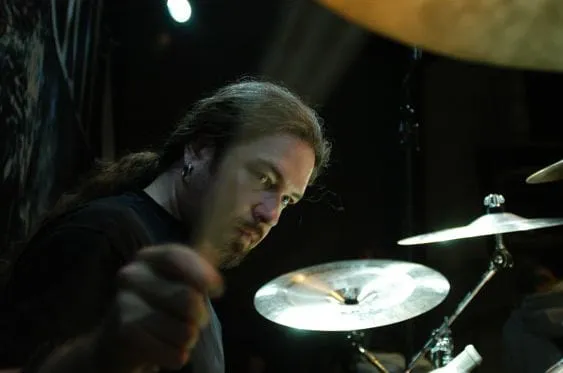
Tomas Haake often gives the listener an entrance. A cymbal pulse or backbeat preserves the large-scale meter while kick drums and hands articulate the guitar grouping. The layers coordinate: one part tells the body where the bar continues; another makes that bar feel temporarily inadequate.
Try following only the guitar and the phrase may sound like a chain of unrelated numbers. Follow the cymbal and the same phrase becomes a shape moving against four. This does not make the performance simple. Haake must embody both readings at once, keeping the anchor sufficiently clear while matching the attacks that give the riff its character.
Analysts have used the term “metric dissonance” for this coexistence of competing cues. 3 The phrase is useful because it describes perception, not merely notation. Two organizations of time occupy the same passage. Neither needs to disappear. The pleasure comes from maintaining their disagreement long enough that a return feels earned.
A cycle longer than the bar
Consider a pattern whose accents occupy a length that does not divide evenly into a four-beat measure. Repeat it without correcting its first note to match each bar. On the page, the pattern crosses bar lines. To the ear, its beginning appears at a different point in successive measures. Eventually the accumulated lengths align with the larger frame.
Meshuggah turns that elementary principle into composition by controlling every detail inside the cycle. A phrase is not simply “in” a number. It has a sequence of attacks, rests, pitches, and articulations. Change one silence and the listener’s sense of the pattern changes. Repeat the whole sequence with precision and even a long cycle acquires identity.
Casual imitation often sounds random because the band does not scatter accents until complexity appears. Its players repeat a designed object. The object may be asymmetrical, but its internal proportions remain stable. Repetition teaches the ear what it is; displacement lets the ear hear that known object from changing angles.
The riff is also percussion
Meshuggah’s guitars do more than supply low notes. Palm muting shortens sustain, making an attack and its following silence equally important. Distortion adds density, but the performance avoids the wash associated with a ringing chord. The pick becomes a trigger. Fretting-hand release closes the sound.
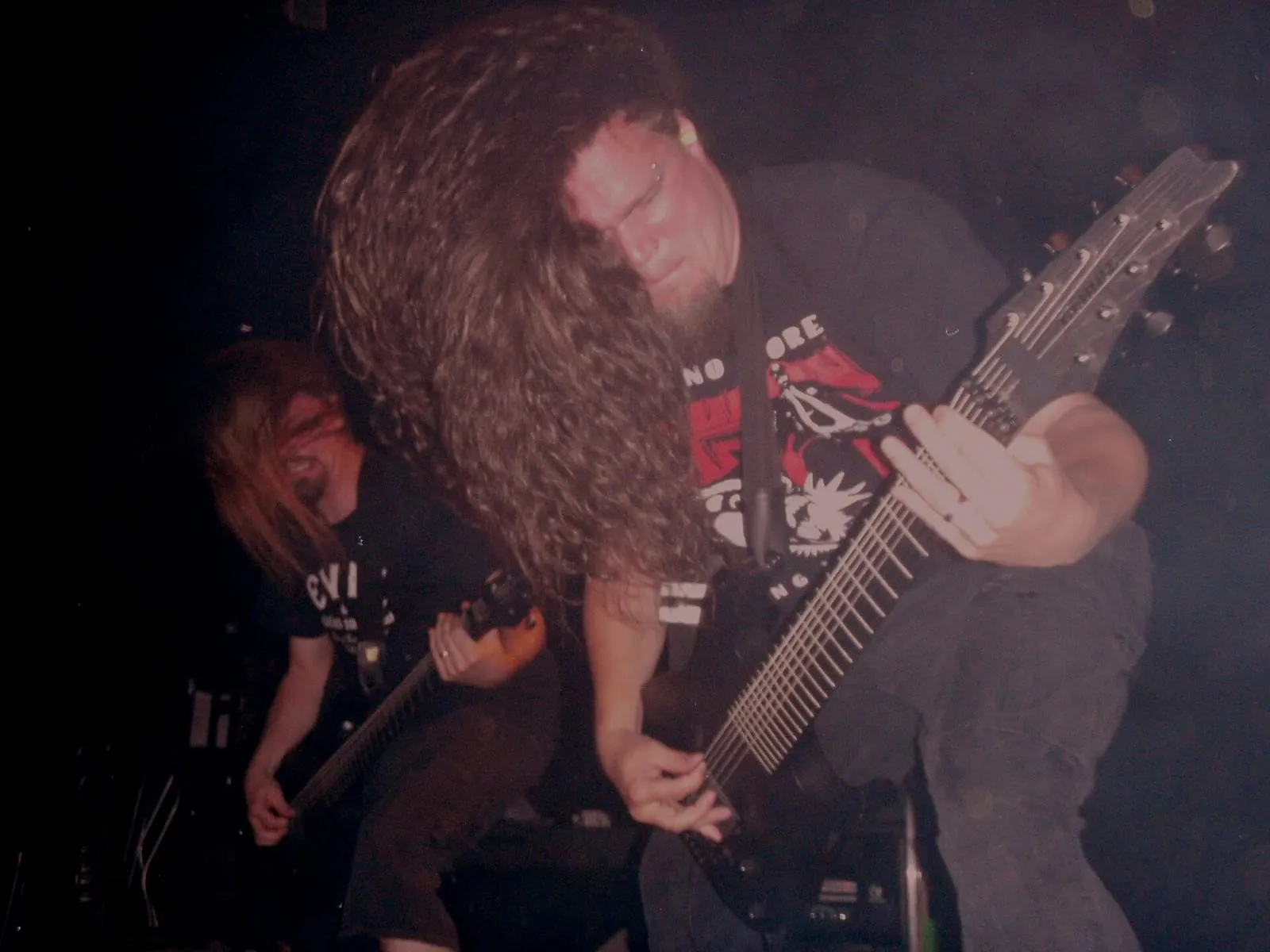
Fredrik Thordendal and Marten Hagstrom therefore need agreement at the level of duration. If one guitar lets a note extend, the pattern loses a boundary. Bass and kick drum reinforce selected attacks, turning several instruments into a composite percussion voice. The listener may register a single heavy event even though it contains strings, amplifier, drumhead, and room.
Hagstrom has described the band’s writing in terms that resist a purely technical contest. In discussing Koloss, he emphasized feel and the desire for material to work as songs rather than demonstrations. 4 That priority is audible in the restraint of many riffs. Their pitch content can be narrow. What develops is placement, orchestration, and the friction between cycle and meter.
What the eighth string changed
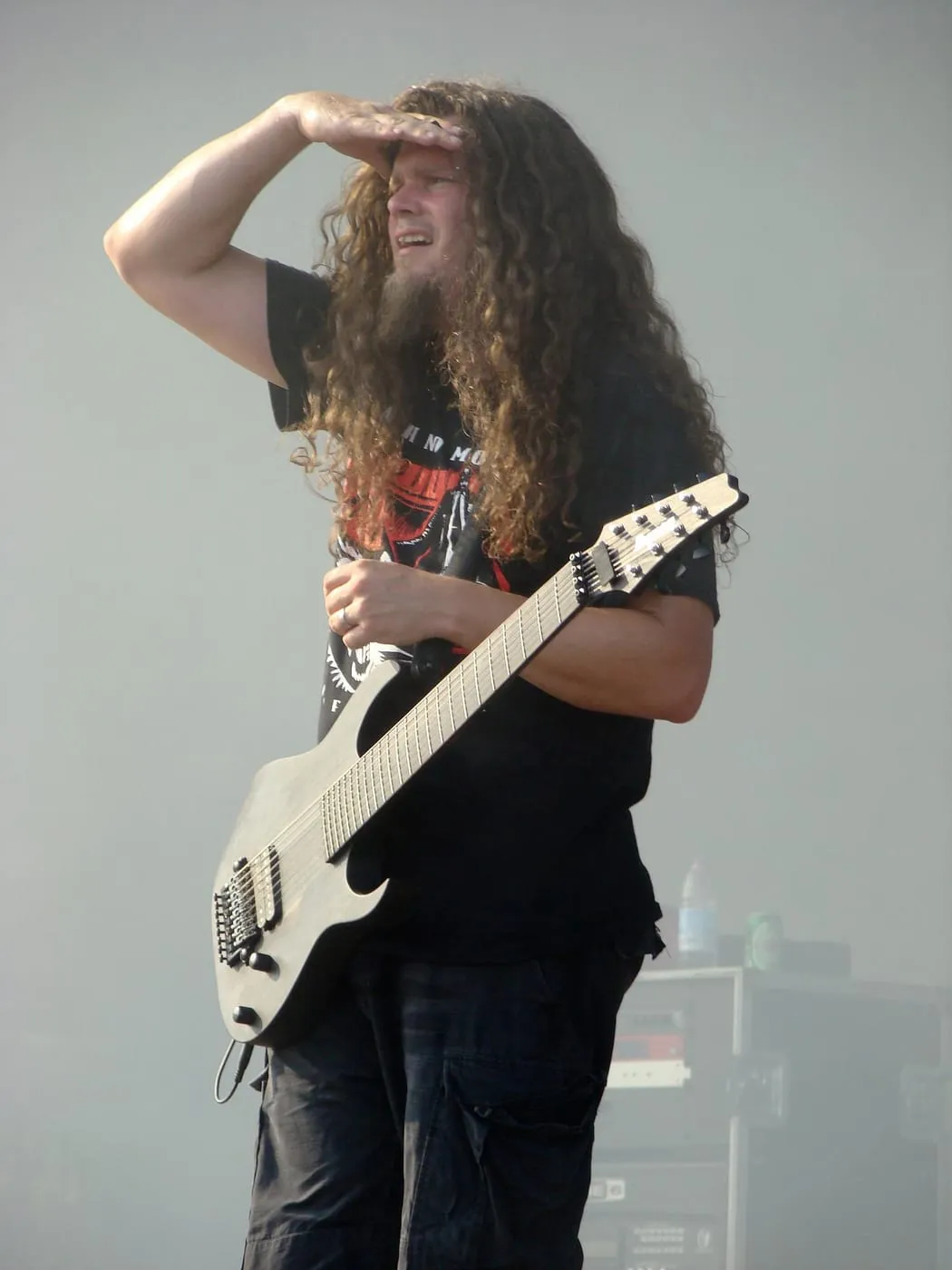
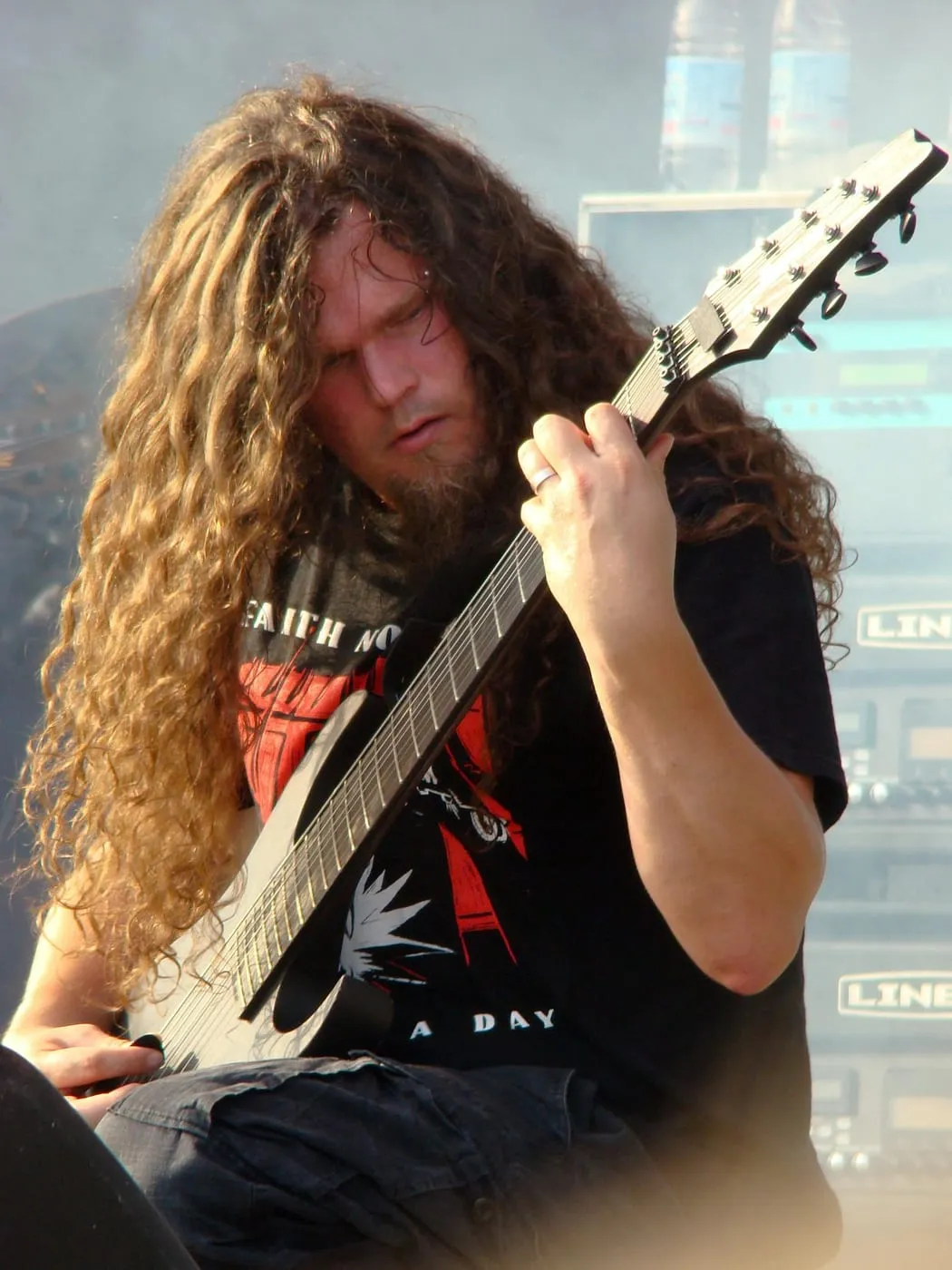
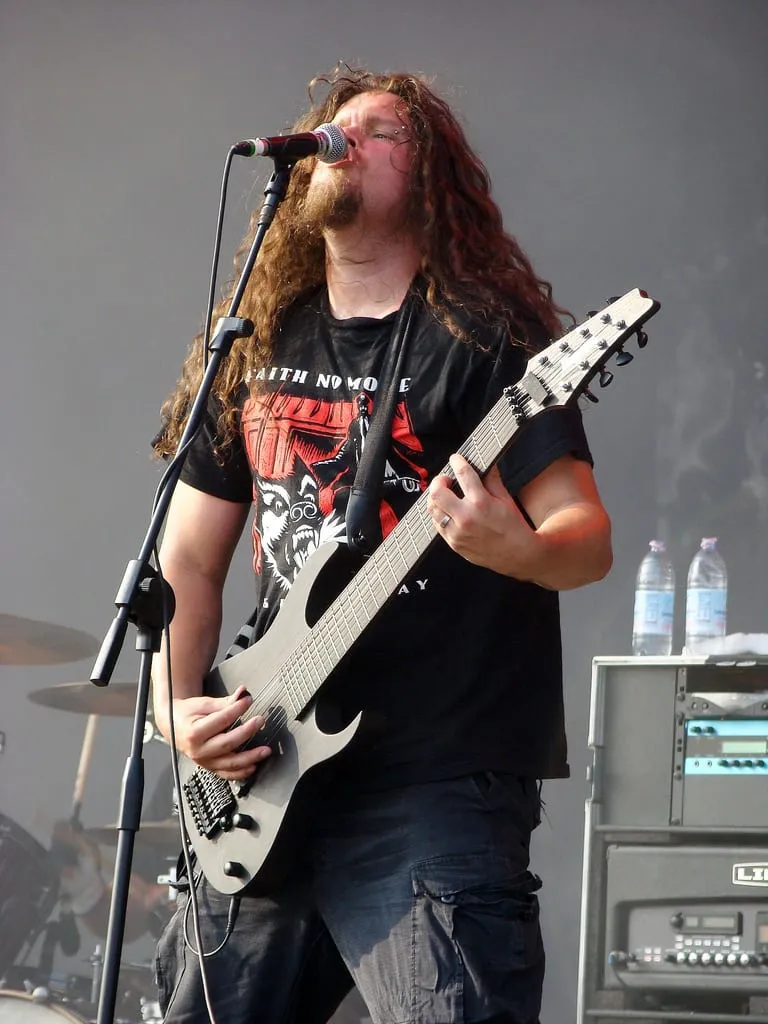
The eight-string guitar is an obvious visual symbol of Meshuggah, and an incomplete explanation. Its lower register extends the instrument toward bass territory and allows tightly voiced shapes under heavy tension. The band’s custom instruments, pickups, and amplification help those notes remain defined. 1 Without clarity, a displaced pattern in that register would collapse into undifferentiated impact.
The extra strings also alter physical geography. A player can move between low pedal tones and higher shapes without abandoning the instrument’s central position. Scale length, string gauge, setup, and picking technique become compositional matters because they determine whether rapid low attacks speak evenly. Ibanez’s artist documentation identifies Hagstrom with the company’s extended-range instruments, a relationship that helped make the format visible far beyond the band. 7
Yet the eight-string did not write the rhythms. Similar organizing ideas can be expressed on drums, sequencers, lower-tuned six-strings, or a single repeated pitch. Interviews about the instrument’s wider possibilities show how quickly a practical tool became a genre marker. 6 Meshuggah’s more consequential move was to make register serve temporal clarity: low notes carry maximum physical force, while exact muting preserves the outline of the cycle.
Precision without smoothness
Machine-like is a common description, but machines do not have to negotiate ensemble time. Meshuggah’s precision remains performed. Tiny decisions about attack, tempo, and dynamic weight determine whether a phrase lurches, swings, or merely sits on a grid.
Haake’s role is especially revealing. If every limb simply doubled the guitar, the listener would lose the larger reference. If the drums ignored the riff, its internal accents would lose force. He divides the task. Feet may lock to low attacks; cymbals preserve a regular subdivision; snare placements clarify the frame or interrupt it. The kit explains the composition while intensifying it.
This balance also distinguishes rhythmic exactness from lifeless editing. A perfectly aligned transient can still communicate nothing about hierarchy. Meshuggah makes certain attacks feel structural and others transitional. The pattern breathes through rests, and the band controls how much anticipation gathers before the next low note.
Songs, not permanent equations
The method changes across the catalog. Destroy Erase Improve set rapid technical movement beside abrupt rhythmic blocks. Chaosphere made repetition harsher and more concentrated. Nothing gave extended-range guitars a defining role. The continuous suite Catch Thirtythree used programmed drums and recurring material to explore transitions on an album scale. Later records adjusted tempo, production, and looseness without abandoning the conflict between cycle and frame.
On Koloss, weight often comes from allowing patterns more space. On Immutable, the band again considered how familiar tools could support a different record rather than merely increasing difficulty. Hagstrom’s comments around the album stress process, tone, and the long duration of the group’s shared language. 5
A successful technique can harden into a template. Once listeners know to expect low guitars and displaced accents, surprise cannot depend on those elements alone. Meshuggah builds songs through contrast: sustained tones against clipped riffs, quiet entrances against full-band force, solos that float over strict structures, and vocal lines whose emphases may cut across both guitar and cymbal.
The voice cuts another path
Jens Kidman’s vocal does not merely follow the low guitar. His phrasing can reinforce a crucial attack, occupy the spaces between attacks, or sustain a line while the instrumental grouping turns beneath it. Because the delivery is so forceful, small changes in placement become structural. A syllable landing with the band feels like a locked door; one arriving across the riff adds another edge.
The voice also limits abstraction. However intricate the instrumental cycle becomes, the song still contains breath, consonants, and language. Phrases must be deliverable at tempo. Their recurrence gives listeners another form of memory, less exact than the guitar pattern but often easier to recognize. The music does not require a listener who can transcribe it.
Thordendal’s leads create a different kind of independence. Their bent notes and liquid, sometimes jazz-inflected contours can seem detached from the grid below. That apparent freedom is framed by an unusually strict accompaniment. The solo does not dissolve the rhythmic design; it reveals how much expressive space the design can support.
Recording the impossible room
Production makes the interlocking parts readable. Low frequencies accumulate quickly when two guitars, bass, and kick drum share related attacks. The mix must preserve impact without allowing every event to smear into the next. Controlled guitar sustain, precise editing, and carefully shaped drum sounds help the listener distinguish the front edge of each note.
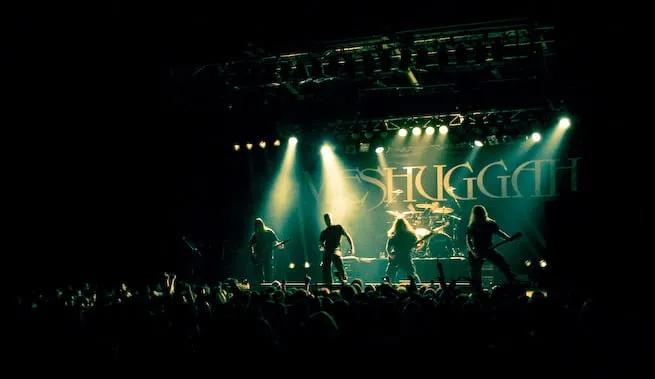
This clarity can make the record seem less human than a concert. Onstage, air moves, reflections overlap, and the body receives low frequencies before the ear has analyzed the grouping. Yet the live arrangement restores visible labor. Haake’s limbs divide their tasks; guitarists repeat the cycle; heads in the audience often keep a simpler pulse. The supposed machine appears as several people holding incompatible demands together.
Studio precision and live force reveal different parts of the same work. The recording exposes the design; the concert demonstrates that the design can be inhabited. Each corrects a misunderstanding of the other. The record is not merely assembled geometry, and the stage sound is not uncontrolled impact. Both depend on musicians knowing exactly where the shared frame continues when their individual parts appear to leave it.
The label that followed
“Djent” began as an imitation of a guitar sound and grew into a broad category. It helped players communicate about tight, extended-range metal, and it connected a generation of bands. It also encouraged a narrow reading of Meshuggah as the source of a tone plus a set of numbers.
Tone is part of the achievement. So is influence. But the transferable equipment is less valuable than the compositional question: what happens when a listener can feel two temporal structures without either being cancelled? Bands that borrow only the low register reproduce the surface. Bands that borrow constant irregularity may miss the anchor that makes irregularity perceptible.
The most characteristic Meshuggah passages are generous in this respect. They give the audience enough information to become oriented. The pulse is available. The riff repeats. Confusion gradually becomes recognition, and recognition does not remove the tension. It makes the tension physical.
Return as release
At the end of a long cycle, guitar and bar line meet again. Nothing supernatural has happened. The durations have completed their common span. Still, the arrival can feel enormous because the band has maintained two expectations and satisfied both at once.
This is the human center of music sometimes described as mathematical. Counting can map the design, but the design exists to shape anticipation. Haake’s cymbal lets a shoulder or foot continue moving. The guitars challenge that movement with another grouping. Repetition turns the grouping into memory. The eventual alignment feels like recognition at full volume.
The bar line stayed put all along. Meshuggah’s innovation was to make stability sound active: not a cage around the riff, but the fixed edge against which every displacement gains meaning. The band did not remove the floor. It taught heavy music how far a pattern could travel before landing on it again.

_Thordendal_(left)_2008_Prague.jpg)


