
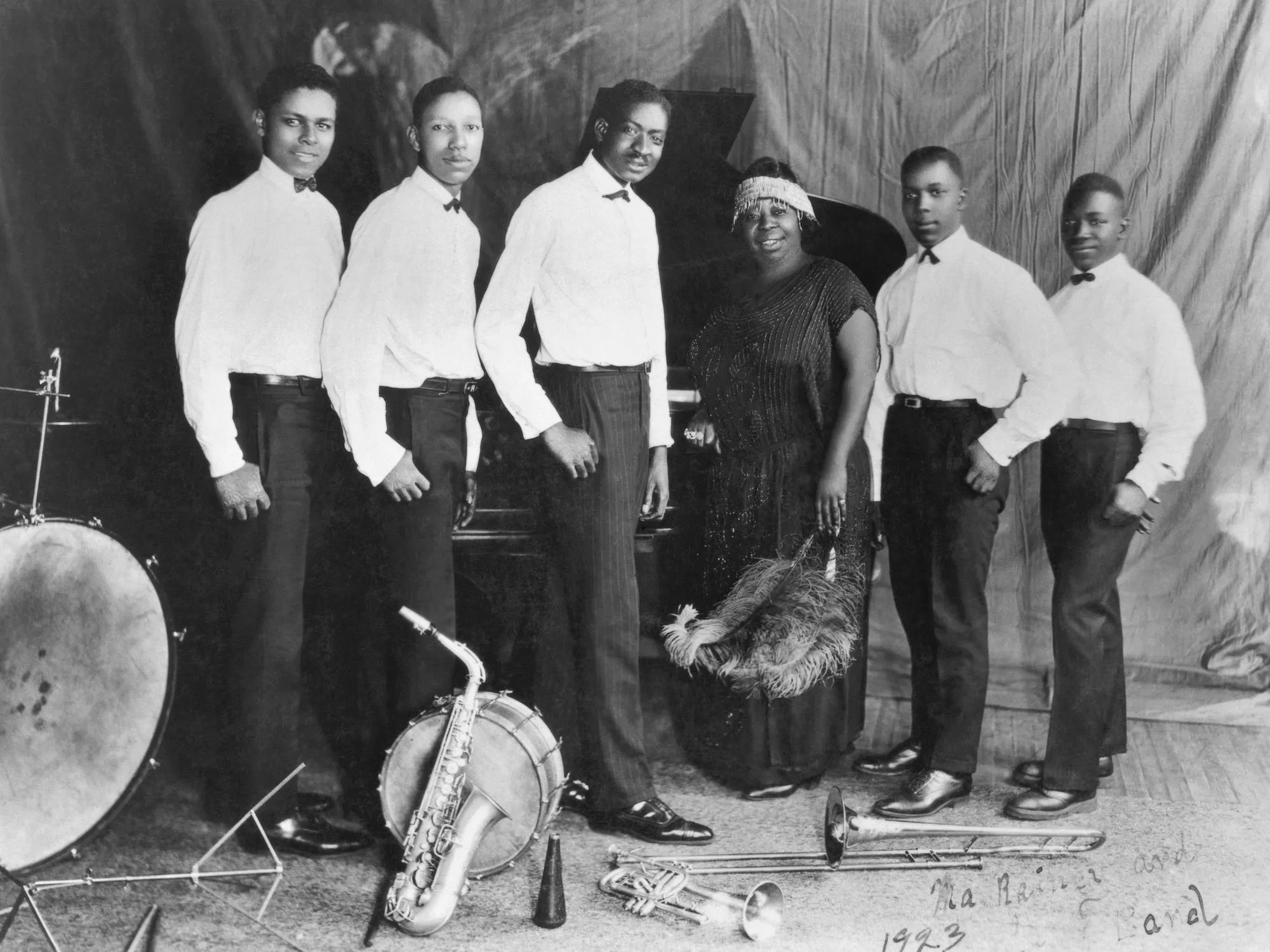
Ma Rainey’s records begin late in her working life. By the time Paramount brought her to Chicago in 1923, she had spent roughly two decades learning what held an audience inside a tent or theater. The label did not discover an unformed singer. It acquired a touring professional with a name, a repertory, stage habits, and a clear sense of how a song should reach the back of a room. The shellac discs captured her voice, but they also compressed a larger business into three-minute sides. 1
That distinction changes how the records sound. The rough edge in Rainey’s contralto belongs to an address built for public space: words projected without losing their grain, phrases timed so a band can answer, and endings that land firmly enough to guide applause. Her authority came from doing the job night after night before a microphone was present.
The road before the catalog
Gertrude Pridgett was born in Columbus, Georgia, on April 26, 1886, according to the biographical record used by the Library of Congress. She appeared at Columbus’s Springer Opera House around 1900 and soon moved into tent-show work. In 1904 she married singer, dancer, and comedian Will “Pa” Rainey. Their billing turned the couple into Ma and Pa, a concise theatrical identity that could be printed large and read quickly. 2
Black touring companies worked a demanding circuit of towns, temporary venues, theaters, and rail journeys. A performer needed more than a signature number. Comedy, dance, costume, pacing, and the ability to adjust to the room all mattered. The blues was one element within that mixed program before the record industry stabilized it as a market category. Rainey learned the form while moving through an entertainment system in which Black performers created the attraction but rarely controlled the venues or transportation.
Newspaper advertisements trace that labor imperfectly. They can confirm a date, a company name, or a claim made by a promoter, but they usually reduce a complicated show to a few superlatives. The Library of Congress newspaper survey finds Rainey within that promotional language: a featured personality whose reputation circulated through print as well as word of mouth. The archive supplies an itinerary in pieces, not a continuous backstage narrative. 3
A voice designed for a company
Accounts of early blues singers often center individual feeling. Rainey’s work also shows arrangement. Her lines leave room for instrumental replies. She can stretch a syllable across the pulse, then close the next phrase with blunt economy. Repetition lets a listener register a change in emphasis. A repeated line can sound skeptical the second time, or funnier, or more severe.
Those choices belonged to ensemble performance. Paramount recorded her with different small groups under names such as the Georgia Jazz Band, and the personnel could alter the balance around her. Cornet, clarinet, piano, and drums did not provide a neutral backdrop. They punctuated the account and helped define how much space the voice occupied. Rainey stayed recognizable because she controlled the center of the arrangement even when the instrumentation changed.
Stage presentation reinforced that center. Promotional photographs show beaded clothes, jewelry, and carefully arranged headwear. These were not decorations applied to make an “authentic” folk singer suitable for commerce. They were professional tools used by a performer who understood spectacle. The Smithsonian’s portrait preserves one studio construction of that public image: a posed, distributed object made for circulation. 4
Paramount makes a product
Paramount Records was attached to the Wisconsin Chair Company in Port Washington, Wisconsin. Its blues catalog turned music made in Black communities into discs sold through dealers and mail-order advertising. Rainey’s value to the company lay partly in the audience she already knew. Her records could be promoted to listeners who had seen her perform, heard her reputation, or recognized a song from the touring circuit.
The arrangement was not equal. Labels controlled masters, release schedules, and much of the accounting. Recording contracts did not convert a successful Black touring artist into an owner of the system. Rainey’s large Paramount output also documents repeated studio decisions: which material to cut, which accompanists to hire, how to fit an established stage practice onto a side, and how to keep a commercial identity coherent across sessions.
She recorded extensively between 1923 and 1928. Those years document the recorded phase of a business already proven on the road, not the whole career. When Paramount advertised her as the “Mother of the Blues,” the title sold seniority and authority together. It also simplified a field made by many singers, writers, musicians, managers, and audiences.
What “See See Rider” records
The 1924 recording of “See See Rider Blues” gives a particularly clear view of Rainey’s control. Louis Armstrong plays cornet, and Fletcher Henderson is present on piano. Their later stature can pull attention toward the accompanists, but the record is organized around Rainey’s timing. Armstrong’s responses sharpen the spaces she opens. They do not turn the side into a trumpet feature. 5
The performance was selected for the National Recording Registry in 2004. That status recognizes cultural, historical, or aesthetic significance; it does not turn the disc into a first draft of every version that followed. “See See Rider” entered a long life of rerecording and adaptation. Rainey’s side matters because it fixes one early, highly deliberate treatment by an artist who had performed blues for years before the session.
No lyric quotation is needed to hear the structure. The repeated vocal units establish a problem, test it from another angle, and move on. The cornet answers without softening the voice’s force. The limited duration makes the arrangement economical, but it never feels hurried. Rainey treats the three-minute side as enough room for a complete public statement.
Authorship without a clean ledger
Early blues credits are difficult documents. Songs moved through oral performance, touring companies, published sheets, and recording sessions. A label might assign authorship in ways that reflected contracts more than a single point of creation. Rainey wrote and adapted material, but a modern listener should resist treating every printed credit as a transparent map of who supplied each line or melodic turn.
What the records do establish is a recurring point of view. Rainey’s narrators assess money, travel, desire, betrayal, violence, and independence without asking to be made respectable. Humor can sit beside danger. Sexuality is stated with a directness that later histories sometimes tame by converting the singer into a dignified ancestor. The performances are more difficult and more alive than that.
Her work also complicates the familiar split between “classic” women’s blues and country blues. Industry categories help describe personnel, marketing, and format, but they can obscure movement between rural audiences, urban studios, theater practice, and songs circulating across regions. Rainey’s career joins those spaces rather than remaining inside one of them.
The tent does not fit on the disc
A 78 rpm record preserved a voice while removing most of the event around it. The listener cannot see a costume entrance, a comic setup, a change of scenery, or the physical distance between performer and audience. The record begins when the needle enters the groove and ends before another stage number would have begun. That material limit helped make songs collectible, repeatable, and available far beyond a tour stop. It also encouraged later histories to treat the studio side as the primary work.
Rainey continued touring while recording. The two businesses supported one another: records advertised the name between appearances, and appearances gave the records a recognizable performer. The road remained physically taxing and financially uncertain. Cars, rail schedules, segregated accommodations, and local promoters shaped the work even when the song itself carried no record of those conditions.
Seeing the touring system matters because “powerful voice” is otherwise too easy a description. Power was practical. It meant sustaining a company, meeting a schedule, protecting a billing, judging an audience, and repeating the performance without making it seem routine.
Leaving Paramount
Rainey’s final Paramount sessions took place in 1928. The record market changed rapidly near the end of the decade, and the Depression soon damaged labels, theaters, and touring circuits. Her departure from recording did not mark a sudden disappearance from her own community. She returned to Columbus, invested in local theaters, and lived in the house now associated with her retirement.
The National Register nomination for the Gertrude “Ma” Rainey House treats the building as rare physical evidence of her life. Recording history often survives as sound detached from property: a digital file can travel while a home, theater, or pressing plant is demolished. The Columbus house anchors Rainey’s career to a place where she lived after the touring years and to a city connected to her beginnings. 6
It should not be turned into a sentimental endpoint. A house cannot reconstruct the tent circuits or settle contested details in a biography. It can preserve scale, materials, neighborhood, and the fact that Rainey’s work produced a life beyond the role of recording artist.
What the archive gets wrong
Rainey died in Columbus on December 22, 1939. Her death certificate identified her occupation as housekeeping, a bureaucratic description sharply at odds with decades of professional performance. The mismatch is often repeated because it exposes the archive’s limits in one line. Official records can preserve a date while failing to name the work that made a person historically significant. 7
Later recognition corrected some of that absence: halls of fame, a postage stamp, stage and film treatments, museum displays, and the Recording Registry entry. These honors make Rainey more visible, but they create another risk. “Mother of the Blues” can become a ceremonial label that removes the contracts, rehearsals, travel, and competitive entertainment business from view.
Read the evidence at its proper scale. A Paramount label records a commercial transaction. A publicity portrait records stage identity. A newspaper advertisement records a promoter’s pitch. A house records property and residence. None is the whole career, but together they show a musician managing work across systems that did not grant her equal control.
Hearing the professional
Rainey’s voice is frequently described with words that suggest natural force: earthy, raw, elemental. Those terms can hide craft. Listen instead for placement. A consonant arrives early enough to make the beat. A held note roughens without losing pitch. An instrumental answer is anticipated by the shape of the preceding phrase. The end of a verse creates the conditions for the next entrance.
That attention keeps the music in its own present. Rainey was not waiting for later blues singers, rock performers, queer readings, or academic histories to explain her. She was making a show function and a record sell. The afterlives are real, and her direct treatment of gender and desire gives later listeners substantial material. But the foundation is a professional method developed before the recording industry decided it had a category called the blues.
The record gives us three minutes. The career tells us what those minutes cost to learn. Ma Rainey’s authority did not begin when Paramount lowered a needle onto a master. The company arrived late enough to document it.