

A clean recording can teach the wrong lesson about mbira. Move a microphone close to the metal keys and the notes may sound delicate, almost private. Step back and hear a player with the instrument seated inside a large gourd, loose metal pieces vibrating at its edge, hosho rattles holding a pulse, and voices entering the cycle. The sound is no longer one line of tuned notes. It is a field of attacks, echoes, buzz, and repeated figures whose relationships keep changing.
The instrument here is mbira dza vadzimu, associated especially with Zezuru Shona musical practice in Zimbabwe. “Mbira” also names a much broader family. Museums and older scholarship have sometimes grouped distinct African lamellophones under labels such as mbira or sanza, obscuring differences in construction and use. Even within Zimbabwe, key layouts, names, repertoires, and tunings are not interchangeable. Starting with the specific instrument prevents a rich practice from becoming a generic “thumb piano.” 2 6
One board carries several registers
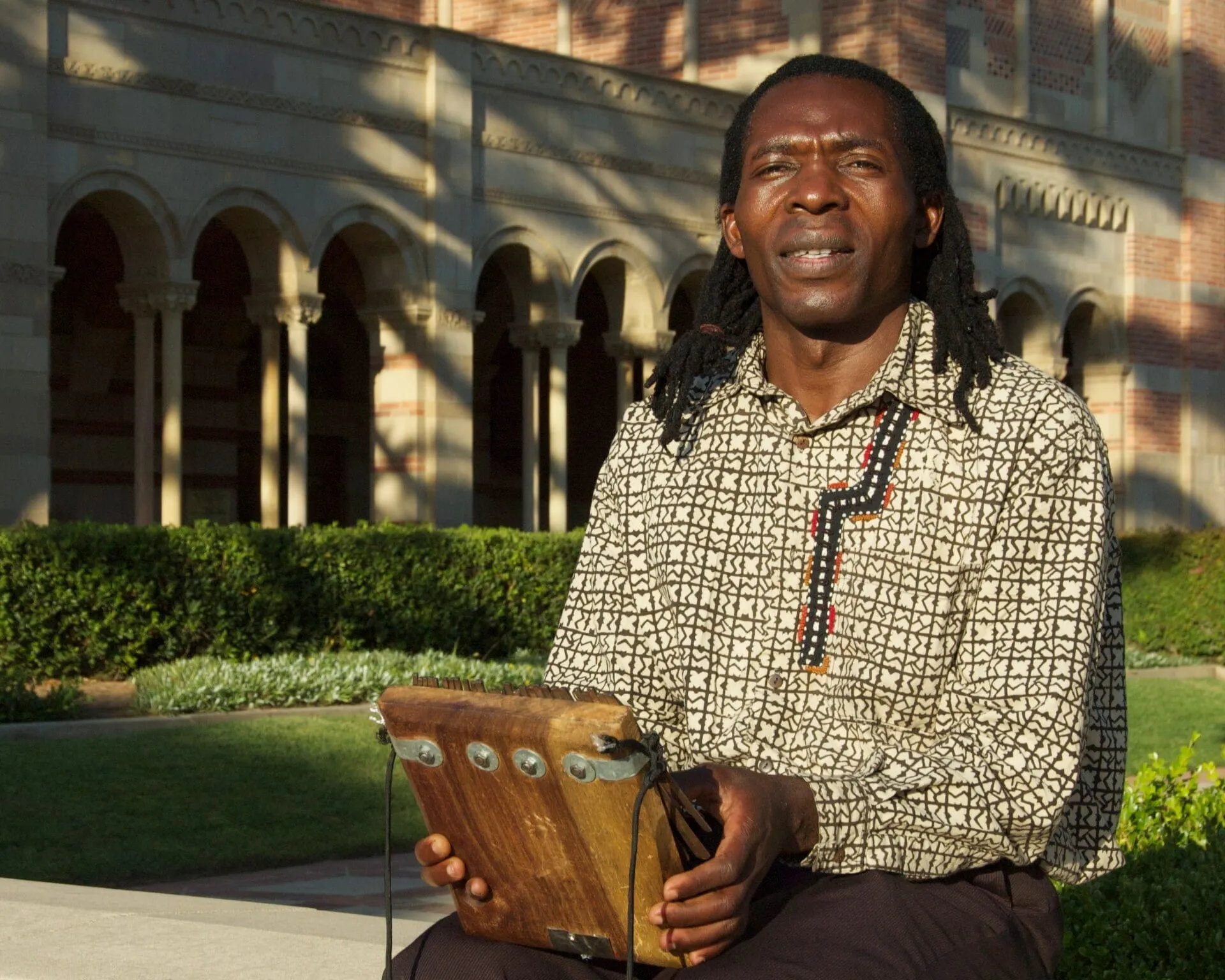
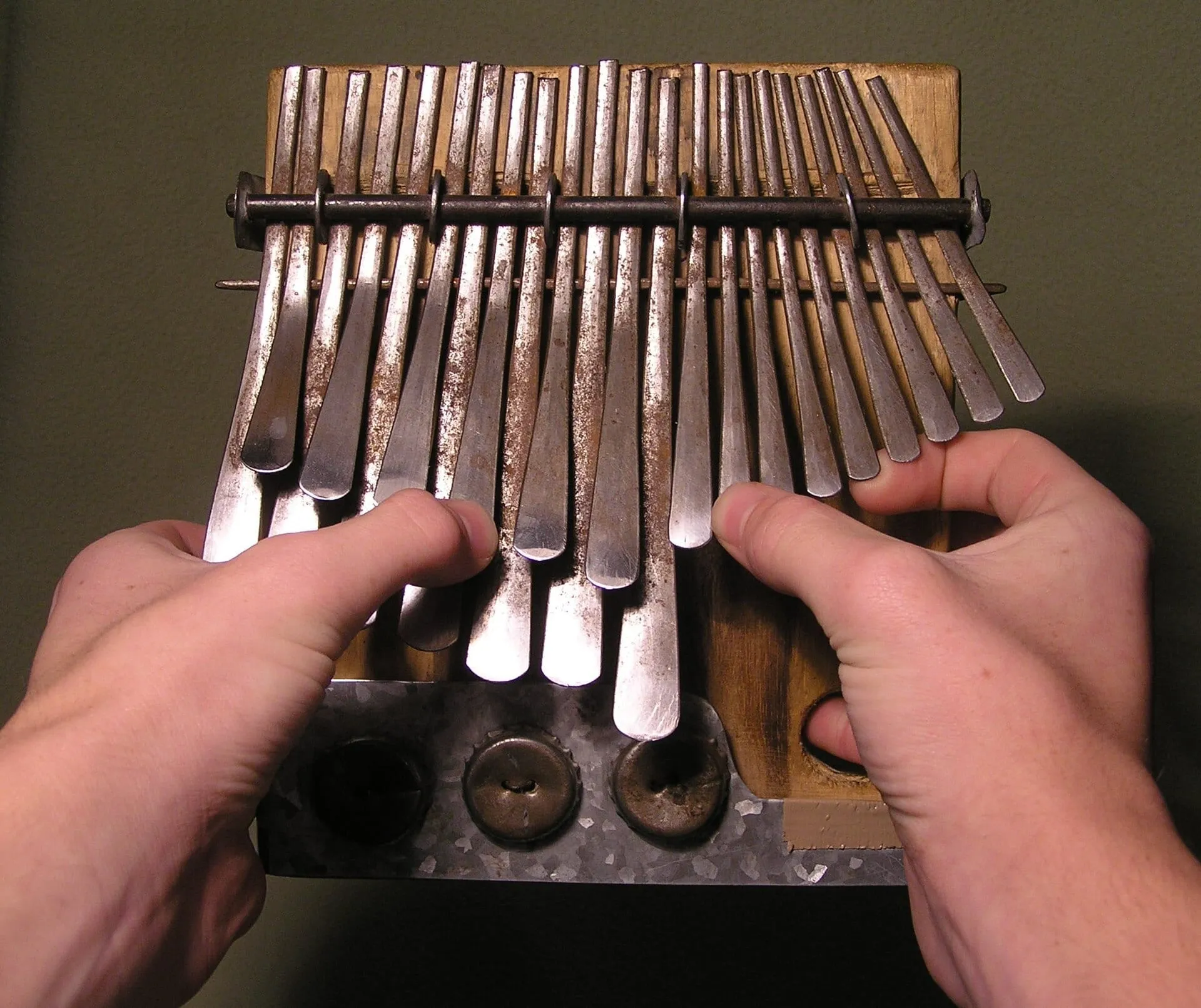
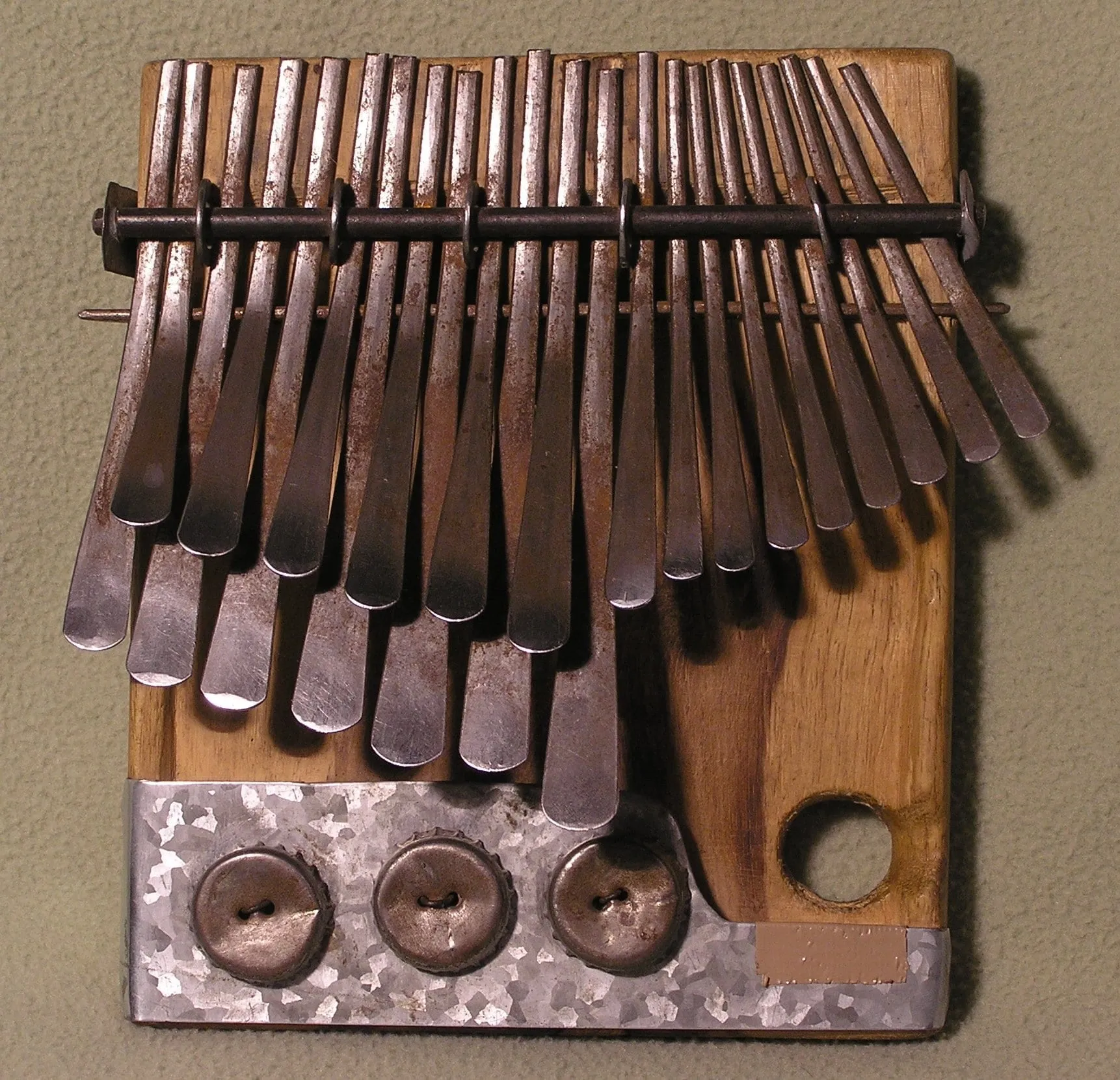
A mbira dza vadzimu begins with a solid wooden soundboard. Between about 22 and 28 metal keys are fixed across it in three ranks. Longer keys sound lower; shorter keys sound higher. The player holds the board with both hands, plucking mainly with the thumbs and using the right index finger for an upper rank. A hole in the lower corner gives one finger a secure grip while the others remain free to play. The layout places bass, middle, and upper responses within a small span of movement. 2
The key is a spring as well as a pitch source. Plucking bends it away from rest; its return sets the metal into vibration and transfers energy into the board. A maker can alter the vibrating length by sliding a tongue beneath its bridge and can refine its response by working the metal. Reused wire, bicycle spokes, and other available metals can become keys. UNESCO’s description of mbira and sansi making emphasizes this practical knowledge, including the reuse of materials and the transmission of craft through families and workshops. 1
There is no single concert pitch to which every mbira dza vadzimu must conform. Grinnell’s instrument record describes a nonstandardized seven-note system spanning more than three octaves, with individual tunings that vary. What matters is the relationship within a particular instrument and, when two mbiras play together, whether their pitch systems can work as a pair. The object is therefore not an imperfect keyboard. Its physical layout stores a particular path through a cycle.
The resonator enlarges more than volume
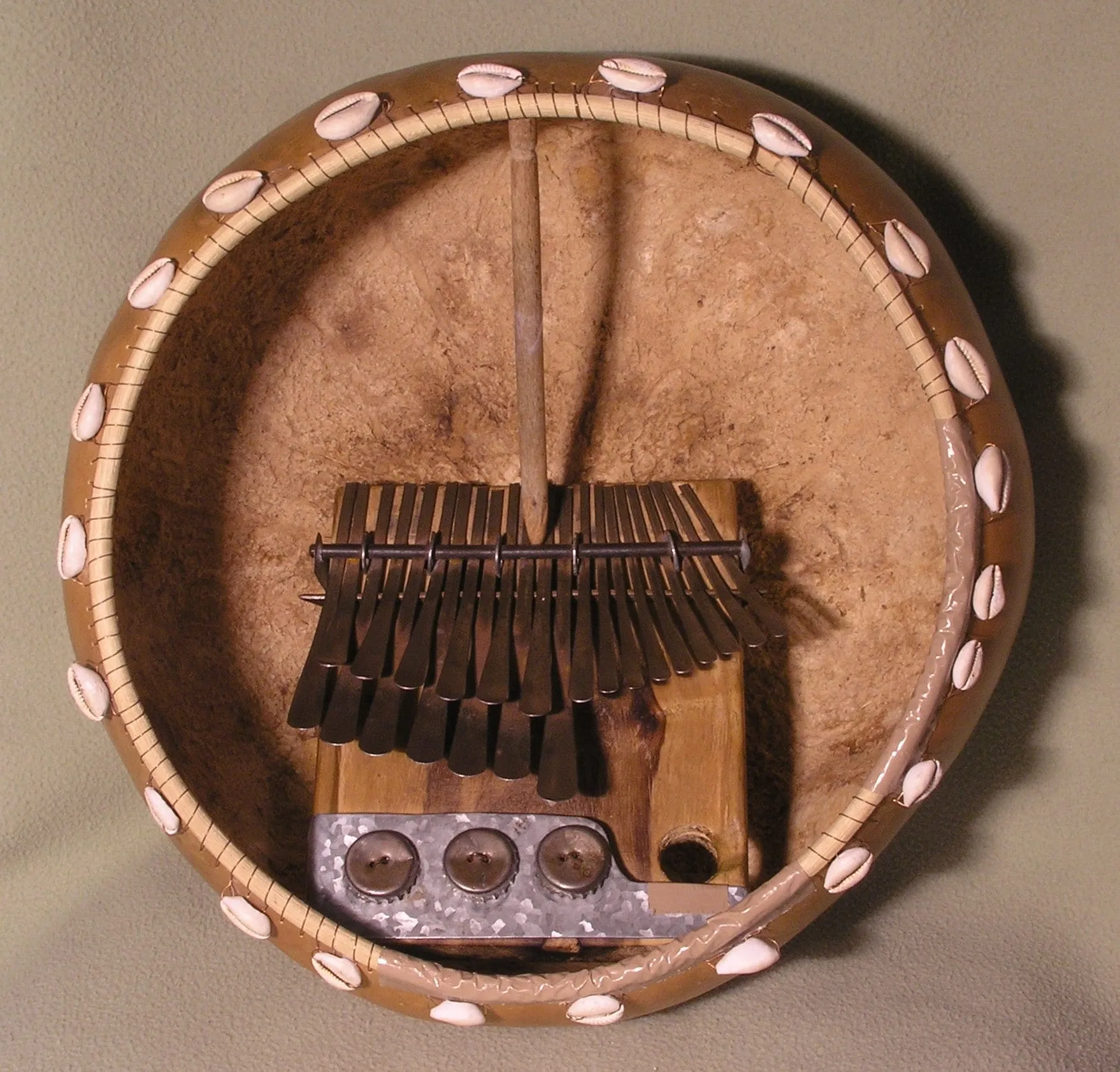
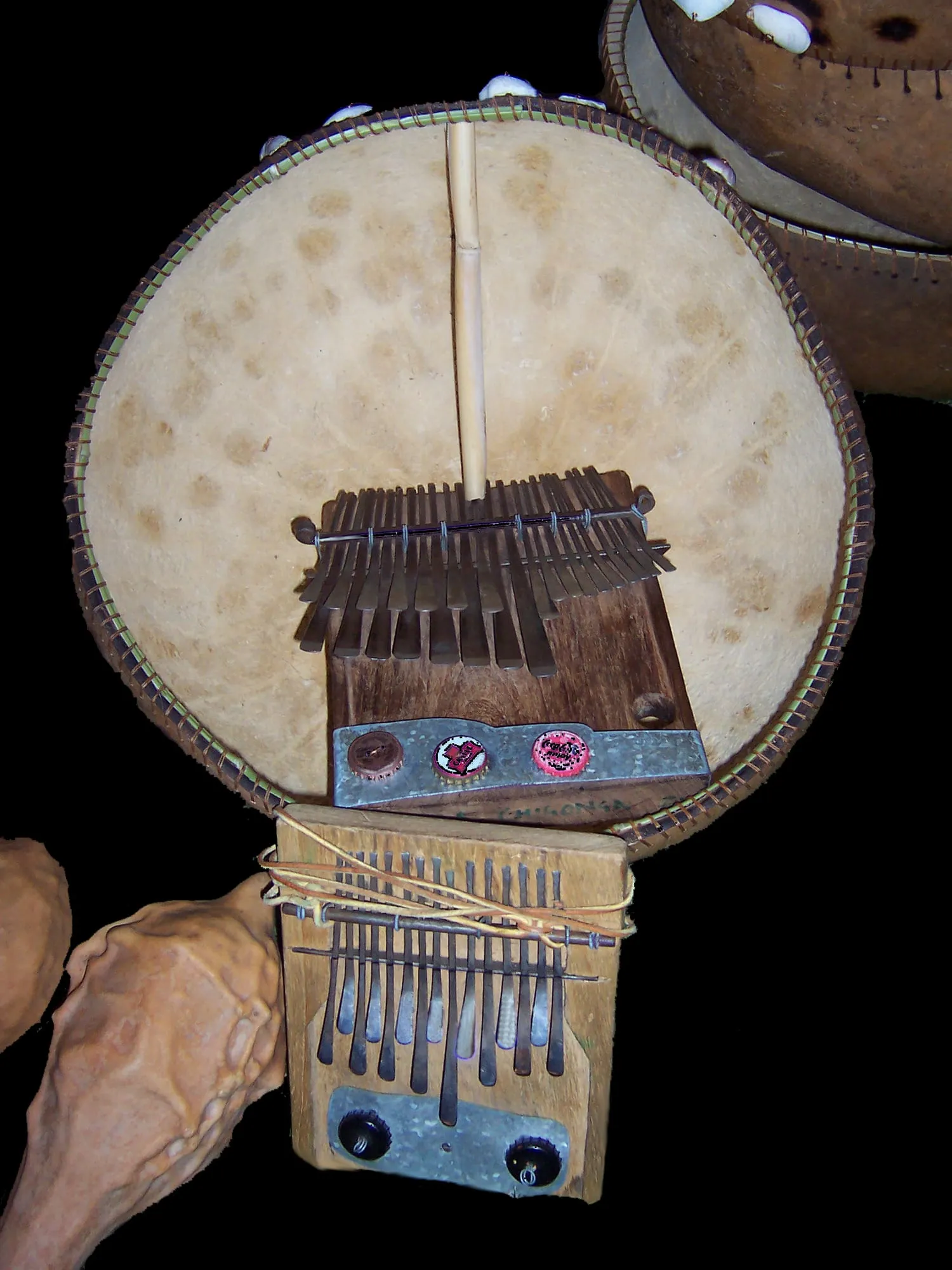
The board can be played alone, but it is often fitted inside a deze, a calabash resonator large enough to surround the instrument. Sound from the vibrating board excites the enclosed air and gourd surface, making the mbira more present in a group. The player can adjust the instrument’s position inside the opening, changing how firmly the parts couple and how the sound projects. 2
Loose shells, metal discs, or bottle caps may be attached to the instrument and resonator. They answer each pluck with a controlled rattle. That buzz is not damage to be repaired or noise to be filtered out. It extends a short metal attack into a rougher envelope and binds separate keys with a shared texture. The Metropolitan Museum’s broader lamellophone record notes both hollow-gourd resonance and the addition of jingling objects; the Grinnell mbira documents bottle-cap buzzers on a specific mbira dza vadzimu setup. 2 6
Balinese paired tuning creates motion by another route. In gong kebyar, the shimmer comes from deliberate pitch differences. Here, loose materials place motion around the note after it is plucked. Neither sound is a failure to reach laboratory purity. Each is an acoustic decision that lets vibration be heard as activity.
Two hands make more than one line
A mbira part is often cyclical, but “repeated” does not mean unchanged. Notes distributed between the hands can produce a bass path, a higher answering figure, and accents that seem to form another melody between them. A listener may follow one register for several turns, then notice a different path without any player switching parts. The pattern stays stable enough to orient the group while remaining dense enough to support several hearings.
UNESCO describes mbira and sansi performances as cyclical, with themes that interweave and vary. The variation is not an ornament placed on top of a fixed block. A player can shift an accent, fill a gap, emphasize a register, or change the contour while preserving the cycle’s identity. Singing adds another route through the same time. Short phrases, sustained lines, ululation, and nonlexical syllables need not duplicate what the keys are doing. 1 5
Staff notation can capture only part of this layered sound. It can record selected pitches and durations, but a transcription must decide which perceived line to privilege. The hands, key layout, buzz, and cycle are not supporting details. They are part of how the music becomes intelligible.
The second player changes the first
Two like-tuned mbiras can perform complementary parts commonly described as kushaura and kutsinhira. Kushaura establishes a leading pattern. Kutsinhira enters in relation to it, interlocking rather than simply doubling every attack. Grinnell describes the combined texture as an evolving cyclical phrase; Forward Kwenda’s program notes stress that the interlock can create different rhythmic perceptions, including duple and triple groupings. 2 5
The listener’s experience changes at the entrance. A note that first sounded like the end of one gesture can become the middle of a new composite figure. Empty spaces acquire answers. Accents migrate even when the first musician continues playing the same material. The second part does not merely make the music thicker; it reveals other structures already available inside the cycle.
A classroom listening sequence from MIT makes the assembly unusually clear. Its examples of “Nhemamusasa” introduce kushaura, then kutsinhira, then hosho before moving to a version in which both mbira players improvise. The order is pedagogical, not a rule for every performance, but it exposes the work of each layer. Hosho does more than decorate the texture. Its repeated rattle clarifies a shared subdivision against which the mbira lines can pull and realign. 3
Ceremony is not a sound effect
Mbira dza vadzimu has an important place in bira, Shona ceremonies concerned with ancestral spirits, and it also appears in secular performance. Grinnell’s catalog records both settings. Williams College’s notes for Forward Kwenda caution against forcing a hard division between sacred and secular experience: repertoire, social memory, spiritual meaning, entertainment, and participation may occupy the same musical practice. 2 5
That context cannot be reduced to an atmospheric drone on a soundtrack. A ceremony involves people who know when to join, sing, dance, listen, and respond. Repertoire can carry histories and social messages as well as musical patterns. UNESCO’s multinational listing describes the broader art of crafting and playing mbira and sansi as a community practice taught through observation, imitation, formal instruction, and instrument making. The designation is useful evidence of continuity, though it covers multiple communities and instruments rather than defining every Shona practice in one paragraph. 1
The instrument travels more easily than its relationships. A wooden board and metal tongues can be displayed in a case. The knowledge shared among maker, player, co-player, dancer, family, and ceremony cannot. Tuning and repertoire connect the portable object to the people who make it speak.
Learning begins before explanation
An instrument with variable tuning and interlocking parts cannot be learned only from a diagram. A new player needs to hear how one local instrument relates to another, how a cycle sits against the hosho, and how experienced musicians vary it without dissolving its identity. Watching hands at close range can transmit information that a row of note names misses: which thumb carries weight, when a key is allowed to ring, and how the body holds the deze while remaining relaxed.
UNESCO describes learning through observation, imitation, and practice, often within families, while also noting more formal teaching. Smithsonian Folkways materials adapt listening, movement, and instrument study for classrooms. These are not rival methods. They answer different needs. Direct participation sustains relationships around a living repertoire; structured teaching can help listeners recognize construction, pulse, and social context without pretending that a short lesson grants cultural authority. 1 4
The maker is part of that education. Choosing metal, shaping keys, fixing them to the board, and bringing an instrument into a usable tuning connect craft with musical memory. A player learns what a pitch system feels like under the hands, not only what frequencies it contains. Because the design and repertoire meet at the key layout, maintenance can also be an act of interpretation. Restoring a loose tongue or replacing a buzzer means deciding which response the instrument should retain.
The pattern moved into amplified music
Mbira practice did not remain sealed away from guitars, studios, or political change. Smithsonian Folkways teaching materials connect Zimbabwean popular music and chimurenga with mbira-derived musical thinking. MIT’s listening guide places Thomas Mapfumo’s electric-guitar treatment beside mbira examples, asking students to hear how an amplified band transforms the instrument’s technique. 3 4
The transfer is structural rather than cosmetic. A guitar can articulate a repeating high-register figure; another instrument can supply the complementary path; bass and drums can reinforce selected points while voices cross the pattern. The timbre changes, but the idea of independent lines making a larger cycle remains audible. That is close to the principle explored in Fela Kuti’s ensemble, where arrangement lived in the relation among repeating parts. The histories and rhythmic languages are different. They share an arranging mechanism; neither tradition explains the other.
Amplification also changes balance. A quiet interlocking key can become a foreground guitar line, while drum kit and electric bass define weight unavailable to an acoustic duo. Adaptation is therefore not a transparent copy of “traditional sound.” It is another set of choices about register, duration, attack, and group role.
Listen inside the buzz
Begin with one complete cycle instead of trying to name every note. Find the lowest recurring gesture and wait for it to return. On the next cycle, follow a higher response. Then listen for a melody that seems to appear between registers even though no single hand plays it alone.
When a second mbira enters, keep one ear on the first part. Notice how its accents seem to move because another line now fills the gaps. Add the hosho to your attention last. Its continuous grain can make the shared pulse clearer while the keys remain rhythmically ambiguous. If voices enter, resist treating them as the lead with accompaniment beneath. Ask which part of the cycle each phrase chooses and what it leaves open for others.
Finally, listen to the edge of each note. The metal key gives pitch; the board and deze give body; loose pieces give a halo of vibration. Removing that halo may produce a neater sample, but it also removes part of the instrument’s design. The buzz was never outside the note. It was one of the ways the note entered a community of sounds.