

Before Rock Against Racism filled Victoria Park, it occupied an address. In August 1976, photographer and designer Red Saunders wrote to the music press after Eric Clapton delivered a racist speech from a Birmingham stage. Saunders’s letter proposed a movement that would oppose the racist poison circulating through popular music and public life. Responses came to a small London network of cultural workers and political activists. The first infrastructure was correspondence: names, envelopes, arguments, and the decision to answer. 3 4
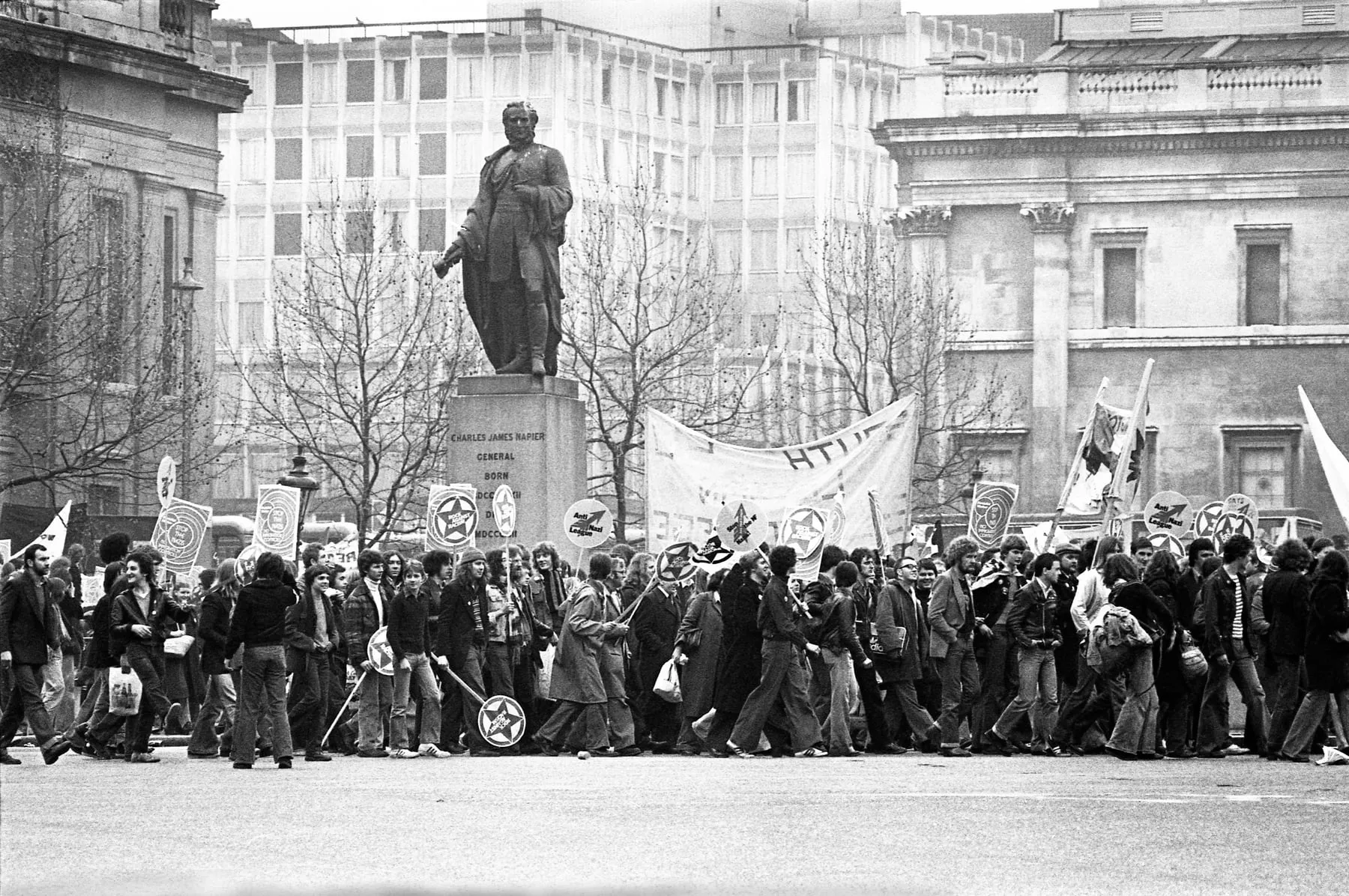
The famous crowd photograph came later. On 30 April 1978, tens of thousands marched from Trafalgar Square to Victoria Park for a Carnival Against the Nazis, where punk and reggae acts shared the bill. That scale had been assembled through less photogenic work: a newspaper designed to be passed hand to hand, benefits in local halls and clubs, contact lists, badges, posters, and groups able to translate a national slogan into a night in their own town.
Rock Against Racism was neither a conventional concert promoter nor a political party with music attached. It was a campaign that treated musical culture as a place where racism could be confronted and an anti-racist constituency could recognize itself. Its wager was practical. If reactionary politics used popular identity, spectacle, and belonging, anti-racism needed forms that did more than correct false claims. It needed rooms, images, sounds, and repeated occasions for people to act together.
A letter becomes a network
RAR emerged during a period in which Britain’s National Front sought electoral and street power, racist attacks were rising, and public debate was shaped by anti-immigration politics well beyond the organized far right. The University of Warwick’s archival guide places Rock Against Racism within a broader field of trade-union, socialist, community, and anti-fascist responses preserved in contemporary leaflets and papers. 1 One musician’s speech prompted Saunders’s letter; it did not create British racism or the resistance to it.
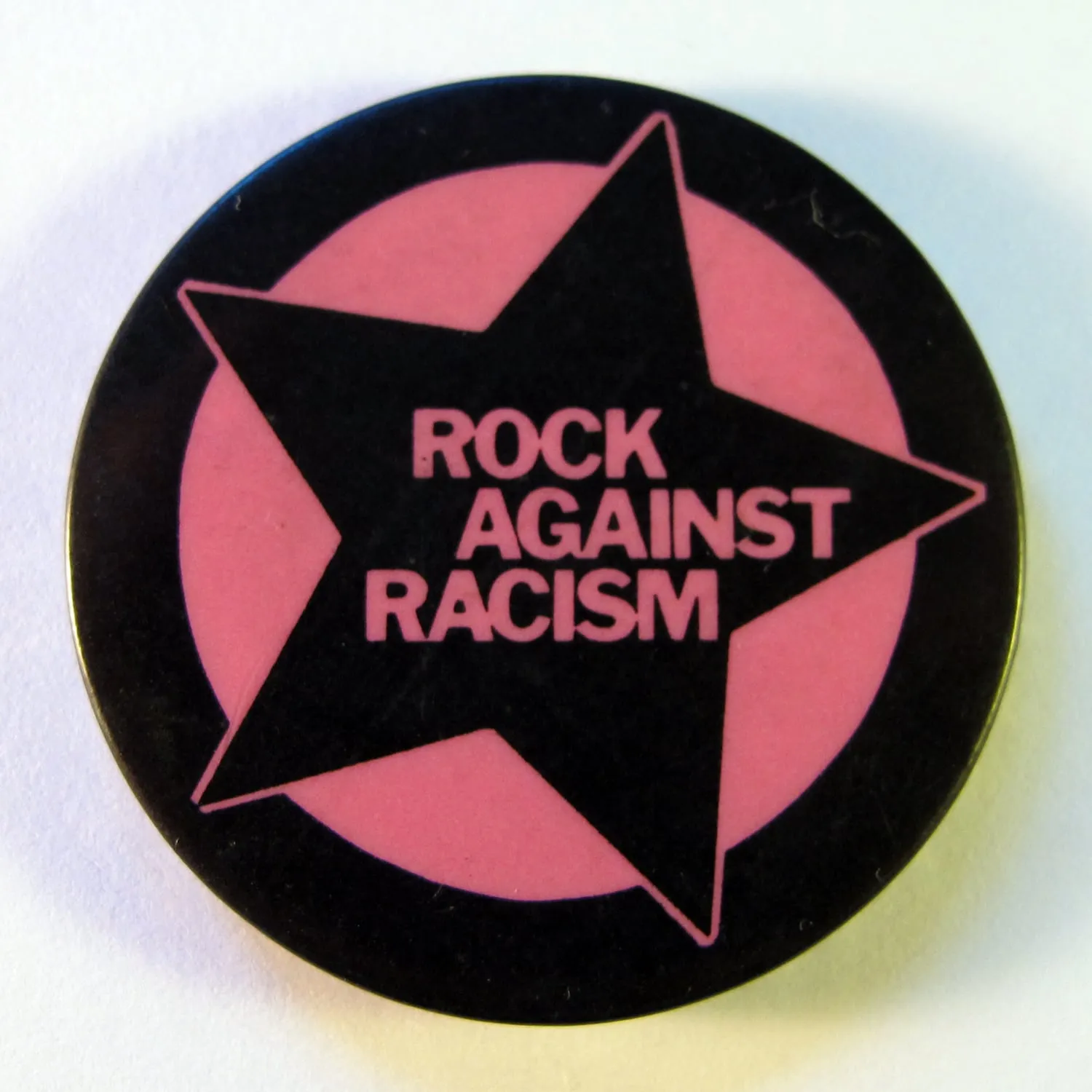
The campaign’s founding circle included Saunders, Roger Huddle, Jo Wreford, Ruth Gregory, and others who brought experience in graphics, theatre, photography, print, and left politics. They did not wait for a complete doctrine before making public material. A repeated formulation—music as something to love, racism as something to oppose—could be printed on a badge or expanded into editorial argument. The simplicity was operational. It let somebody signal affiliation while the longer publication supplied history, reporting, and disagreement.
RAR’s model allowed local groups to organize under a shared name. Central coordination offered imagery, contacts, and a recognizable political frame, but the campaign depended on people booking venues and constructing bills where they lived. This looseness increased reach and produced unevenness. A local event could realize the punk-reggae alliance in sound, or it could reproduce the exclusions the national campaign claimed to challenge. The network form distributed initiative without abolishing power.
Temporary Hoarding was built to move
The campaign’s newspaper, Temporary Hoarding, was not a souvenir of the concerts. It was one of the machines that made them possible. Its title suggested an improvised public surface: something pasted up, read quickly, and replaced, but capable of changing what a street looked like. Designer Ruth Gregory and the editorial collective used abrupt scale, high-contrast photographs, hand lettering, collage, and blocks of type that carried the energy of punk print without reducing the page to style.
The publication joined material that mainstream music coverage often kept apart. Reports on bands sat beside accounts of racist violence, organizing information, letters, photography, and arguments about culture. Readers could see musicians as political actors and political struggle as something occurring in venues, record shops, schools, and streets. The page did not claim that listening to the right record constituted anti-racist work. It supplied routes from attention to participation.
Photographer Syd Shelton joined RAR in 1977 and helped shape its public record. Autograph’s archive shows performers, audiences, demonstrations, and everyday organizing rather than isolating stars under stage light. 3 His images are protected works and are not reproduced here, but they remain vital evidence. They show a campaign concerned with who appeared together in the frame: Black and white musicians, punks, reggae audiences, marchers, children, and organizers. Photography helped propose a coalition while also recording the actual people asked to inhabit it.
Design did similar political work. Black-and-white printing kept costs manageable and gave photographs graphic force. Red accents could turn a page or badge into a signal. Repetition made the campaign recognizable across objects produced for different dates. None of these techniques belonged exclusively to RAR, and visual coherence did not guarantee political agreement. It did make the network easier to find.
Punk and reggae on the same bill
RAR’s most consequential musical decision was to insist on punk and reggae together. This was not a claim that the forms shared one history. Reggae in Britain was connected to Caribbean migration, sound-system culture, Rastafari, and Black British experience; punk’s emerging audience and press ecology were differently positioned. Placing them on one bill could expose listeners to unequal social realities as well as unfamiliar sound.
The alliance also challenged racist attempts to define rock as white property. Reggae bands such as Misty in Roots, Steel Pulse, and Aswad were not included merely to improve punk’s politics. They brought their own audiences, organizations, repertoires, and analysis. A mixed bill worked when it changed the center of the event, not when Black musicians served as ethical certification for a predominantly white scene.
Musically, the combination made contrast productive. Punk could offer short, abrasive acceleration; roots reggae could build weight through bass, space, repetition, and collective groove. A listener moving between them encountered different uses of amplification and rhythm. RAR’s slogan “Reggae, Soul, Rock ’n’ Roll, Jazz, Funk and Punk” named breadth, but the repeated punk-reggae pairing carried the campaign’s clearest public image.
Later accounts can make that image too harmonious. Racism did not disappear inside the venue. Women and Black activists could be visible in the campaign while remaining underrepresented in histories centered on male punk stars. Some anti-fascist language reduced complex Black politics to a general youth unity. Cultural mixture did not solve racism; the coalition created structures for confrontation, contact, and organizing.
From benefits to the Anti-Nazi League
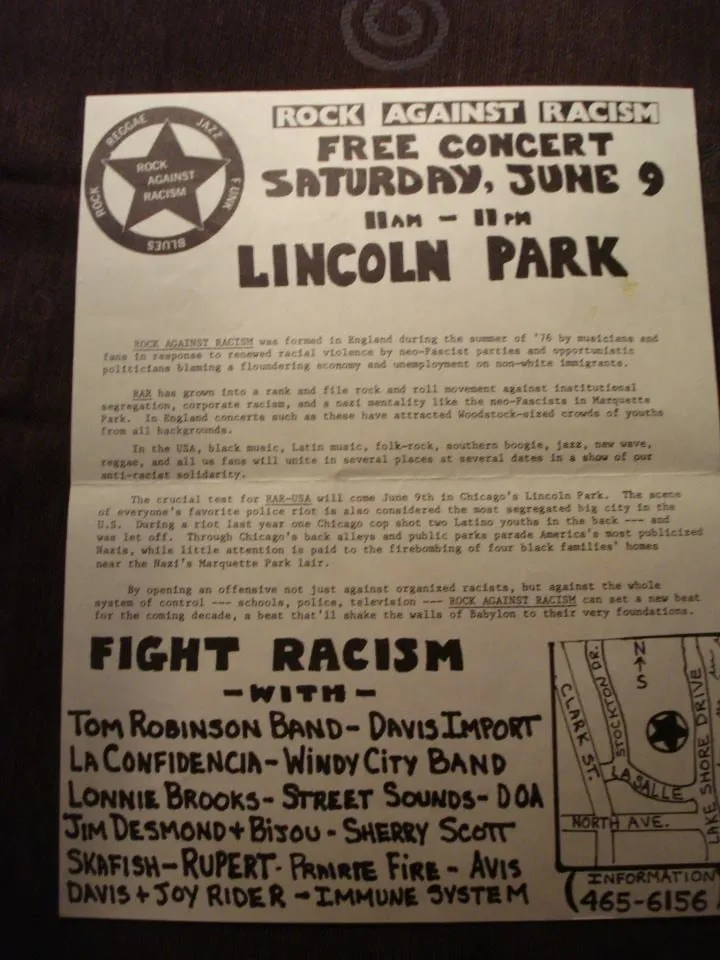
During 1977, RAR events multiplied. Benefits raised money, recruited participants, and let local organizers test how the name worked in practice. A gig required a bill, a room, equipment, publicity, door workers, and a plan for trouble. Each successful event produced knowledge that could be reused. Each also created printed residue: a flyer, listing, photograph, review, or contact address through which another event might begin.
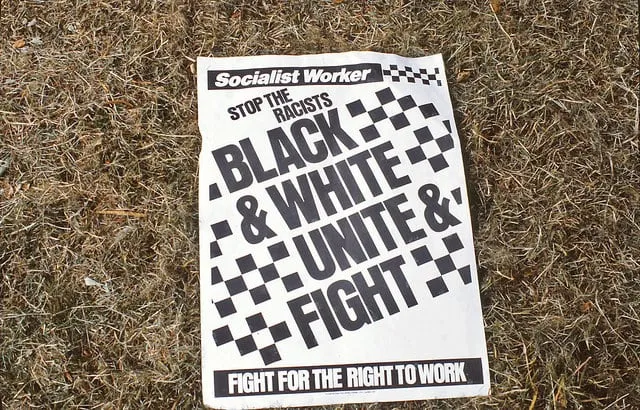
The Anti-Nazi League was launched in 1977 with support from figures in the Socialist Workers Party, trade unions, and public life. Its focus on mass opposition to the National Front overlapped with RAR’s purpose. The alliance increased organizational reach: the ANL could mobilize branches and political networks, while RAR offered cultural forms capable of addressing young audiences who might not attend a conventional meeting. 1
RAR and the ANL were not the same organization. RAR retained its own cultural language and mixed constituency; the ANL had a more explicit electoral and anti-fascist campaign structure. Their cooperation around carnivals joined those capacities. It also brought tensions over control, party influence, and whose priorities defined the coalition. Mass organization supplied resources, but it could make the decentralized energy of local cultural work harder to see.
Six miles to Victoria Park
The first Carnival Against the Nazis on 30 April 1978 began with assembly in Trafalgar Square. Marchers then crossed London toward the East End, passing through an area where the National Front had attempted to build support. The route gave geography to the argument. This was not an audience transported directly to a fenced festival field; it was a demonstration moving through the city before becoming a concert.
At Victoria Park, the Clash, Tom Robinson Band, Steel Pulse, X-Ray Spex, and Misty in Roots were among the performers. Sources disagree on the exact crowd, with estimates commonly running from roughly 80,000 to 100,000. The London Museum’s Temporary Carnival programme, sold for ten pence at the event, fixes the date, place, campaign partnership, and printed interface through which a participant could navigate the day. 2 Hackney Museum preserves a poster and a participant account that emphasizes the variety of people and homemade banners in the march. 5
The programme closes the distance between paper and spectacle. It carried schedules and messages inside the event that earlier print work had helped create. A march of that size could appear spontaneous in a single wide photograph. The cheap programme points back to planning: artwork approved, text set, copies printed, bundles transported, sellers briefed, coins exchanged.
Victoria Park did not invent the coalition, but it changed what participants could believe about its scale. Punk groups who were treated as a disruptive subculture appeared within an organized anti-fascist public. Reggae bands played to listeners gathered through both musical and political networks. The carnival offered joy without making joy politically innocent. Dancing, marching, and public opposition occupied the same day.
What the carnival could not settle
Large crowds invite triumphant causation. The National Front’s electoral decline at the end of the 1970s had multiple causes: organized opposition, internal problems, changing political conditions, and the wider contest over immigration and nationalism. RAR helped make anti-racism public and culturally compelling, but a concert attendance figure cannot by itself demonstrate a converted vote or prevent a street attack.
Nor did the campaign resolve the relation between anti-racism and the music business. Labels, venues, newspapers, and promoters could support an event while continuing unequal practices. Famous white bands often received more durable coverage than the reggae artists who made the alliance musically credible. Later histories can repeat that imbalance by treating Black participation as context for punk’s political awakening.
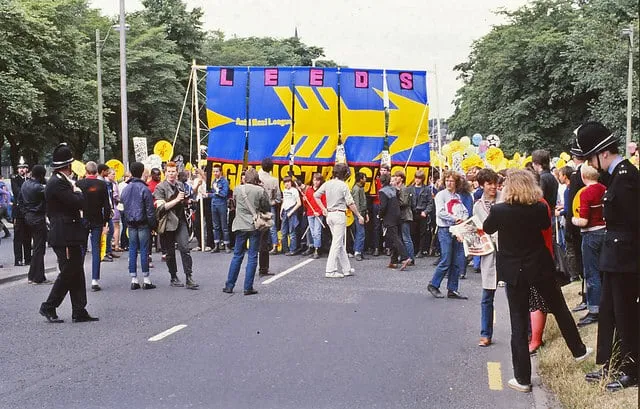
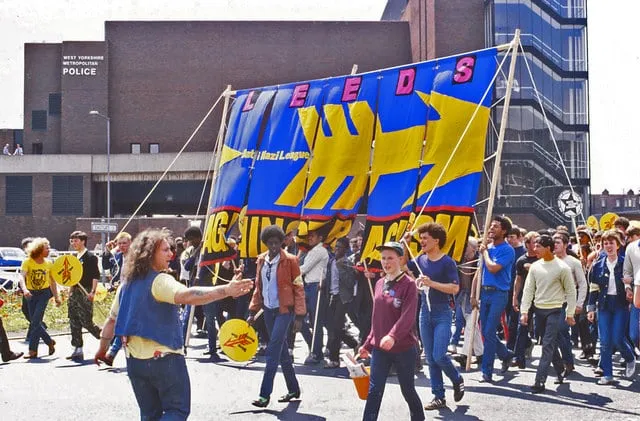
RAR’s archive offers tools against that narrowing. Temporary Hoarding preserves names and arguments that a greatest-hits account loses. Shelton’s contact sheets and photographs keep audiences and organizers in view. Local material held in collections across Britain shows that the campaign continued beyond the London landmarks. Images from a Leeds demonstration in July 1981, for example, document people still carrying the name through a city three years after Victoria Park.
The original RAR period entered its final phase in 1981 and wound down in 1982, after a second London carnival and regional mobilizations including major events in Manchester and elsewhere. 4 Its methods did not vanish. Benefit bills, portable graphics, anti-racist music campaigns, and alliances between cultural workers and political organizers have been reused under new names. Reuse does not make the model automatically effective; it makes its components available for examination.
A slogan needs somewhere to go. Rock Against Racism gave it paper, an address, a local contact, a room, a bill, a march route, and finally a park. Victoria Park remains the emblem because the crowd could be photographed. The campaign started earlier, wherever someone made the next object or arrangement that allowed another person to join.


.jpg)
.jpg)
