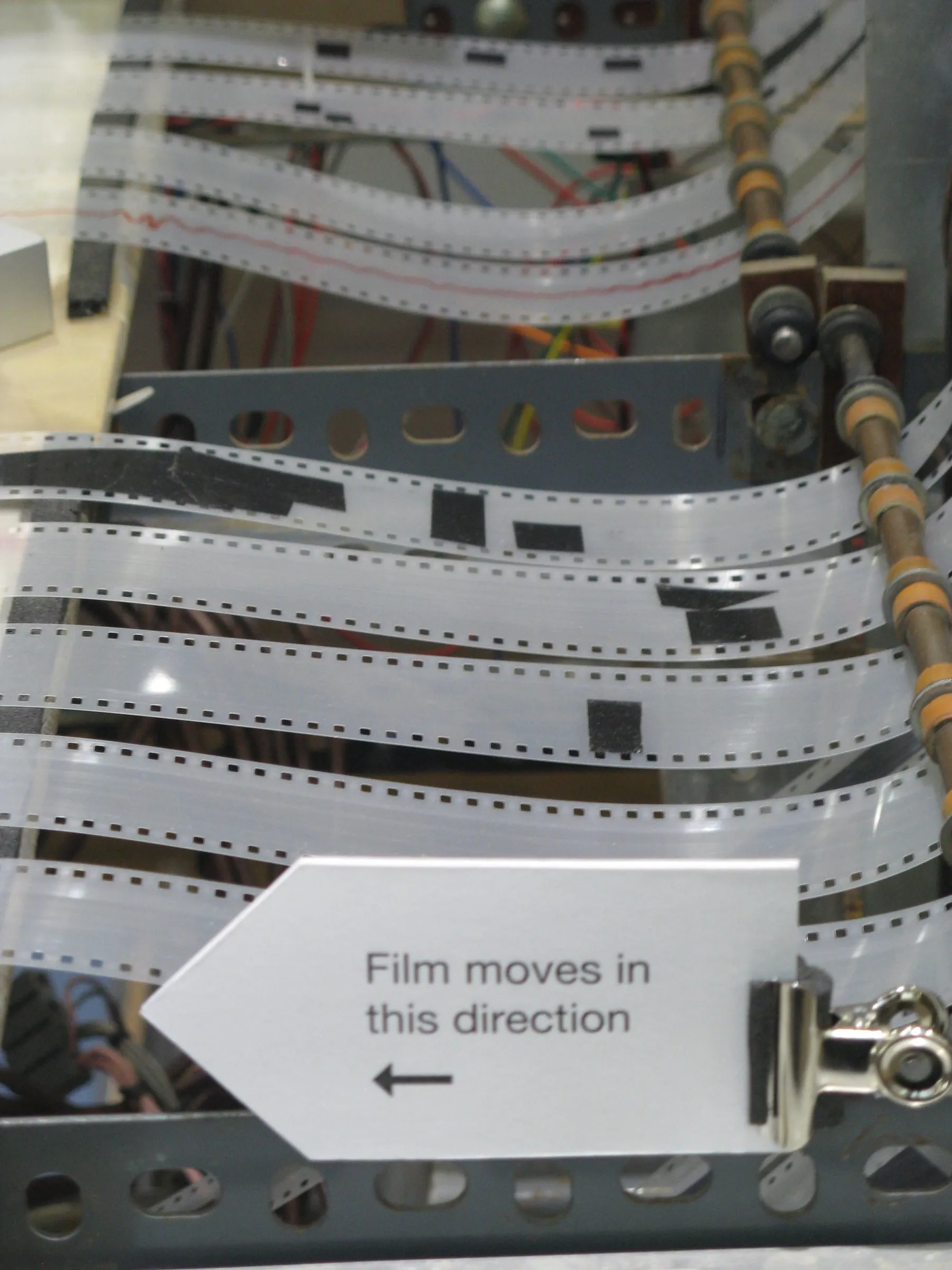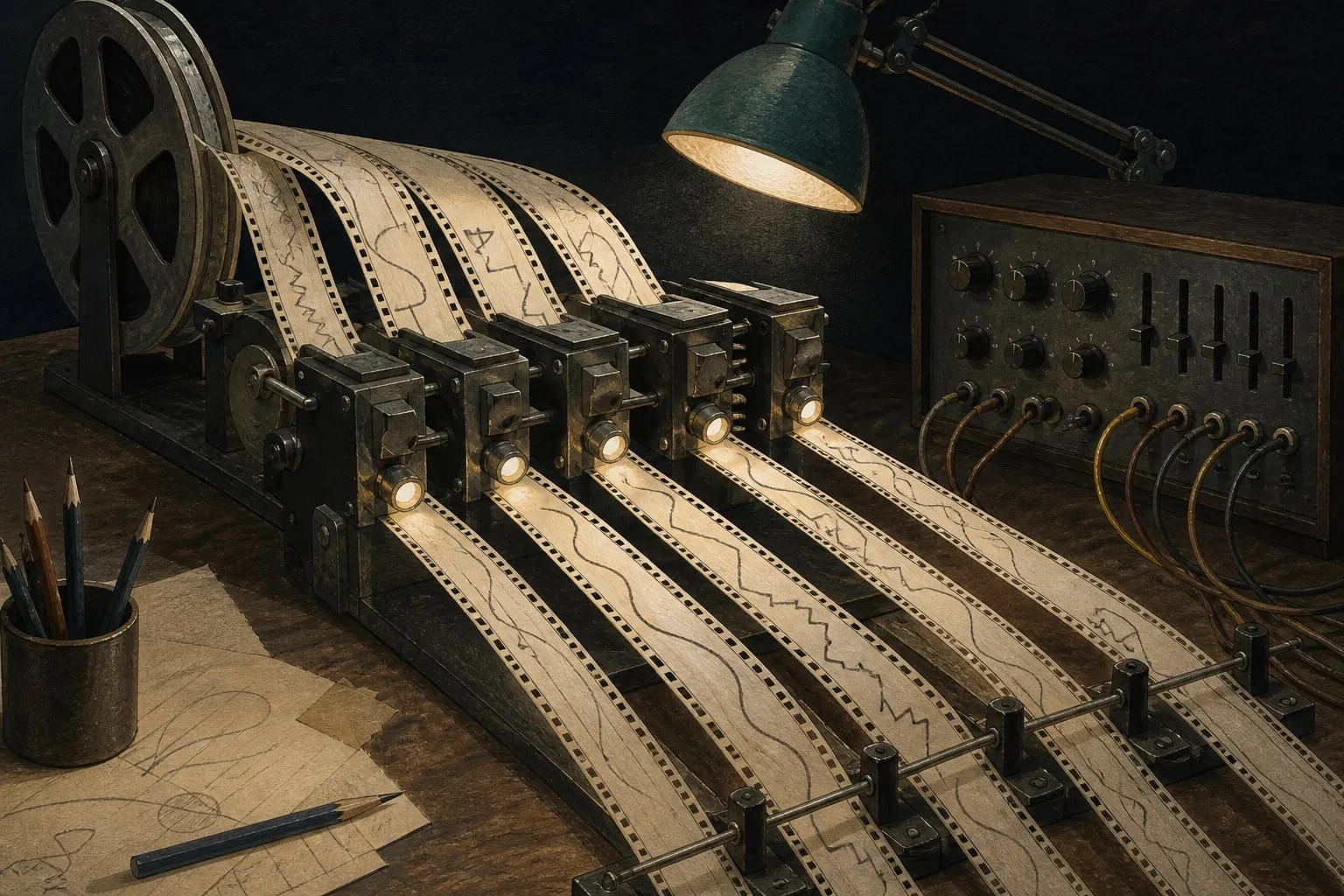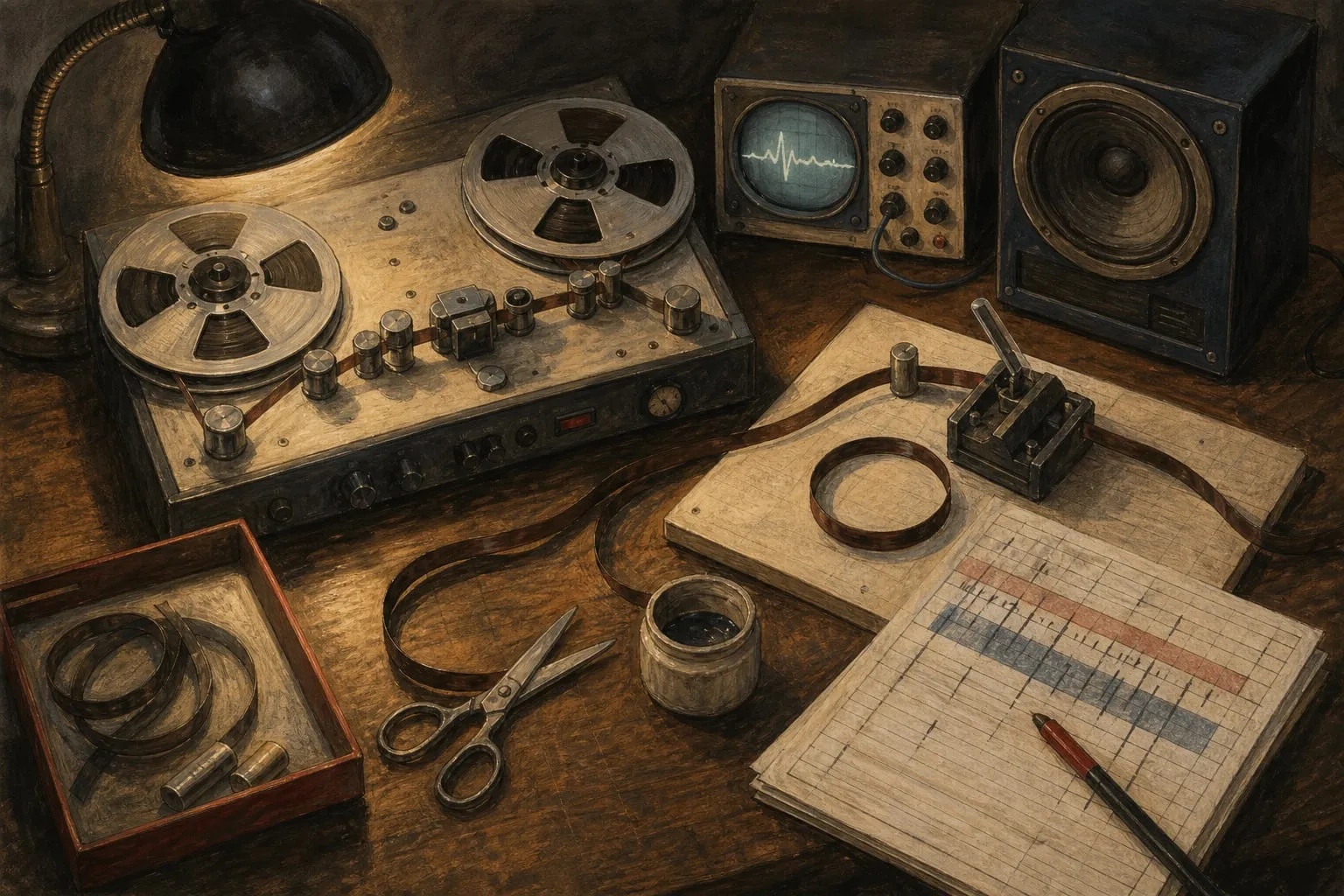

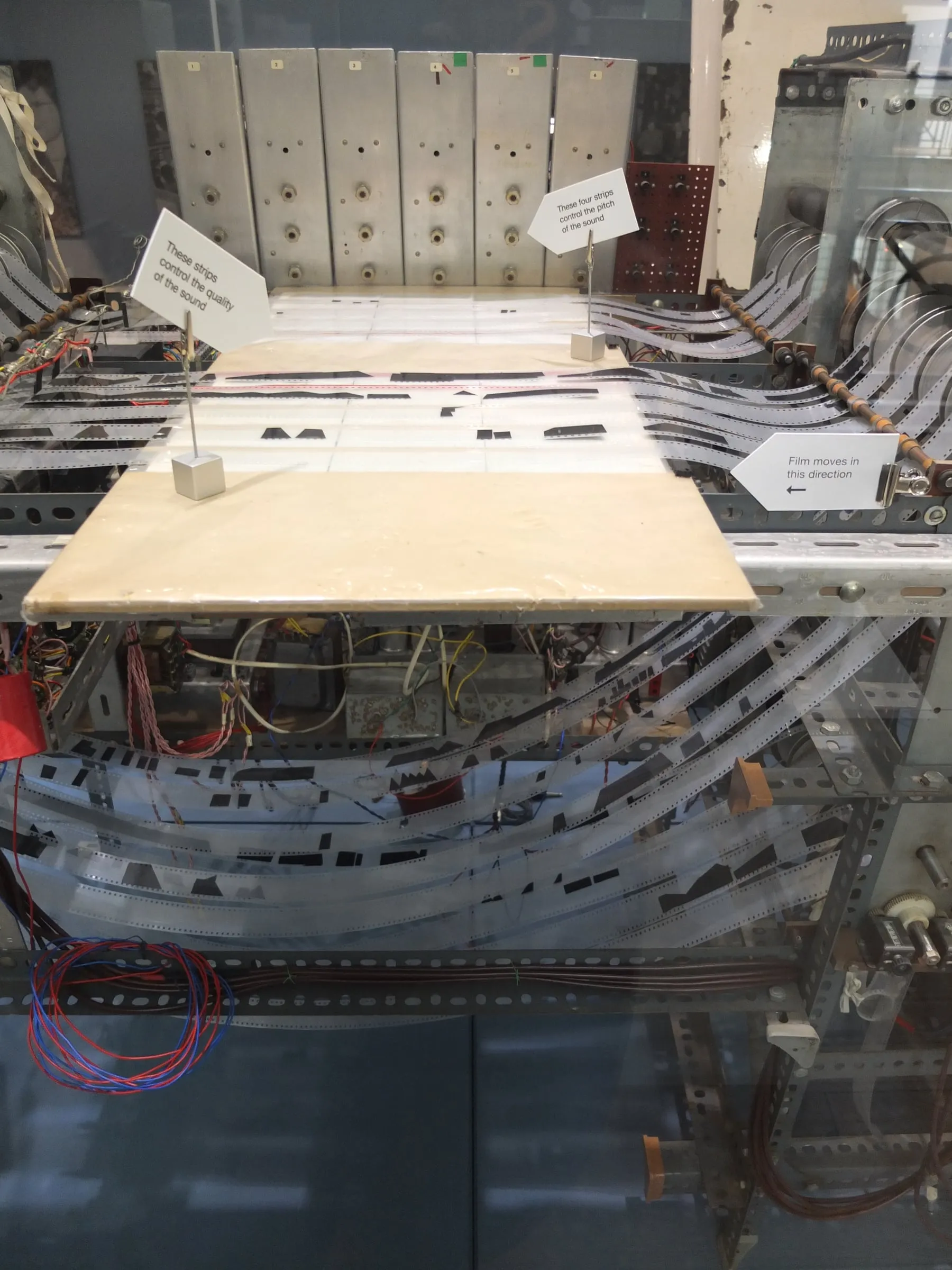
The most revealing part of the Oramics Machine is not its size or its exposed circuitry. It is the empty film. Ten narrow paths cross the machine in parallel, each ready to carry a mark. A composer could draw pitch information, changing volume, vibrato, and the amount of reverberation, then send those decisions past light-sensitive readers. Separate glass slides held painted waveforms. The apparatus did not ask for a keyboard performance that would later be edited. It asked the composer to prepare the behavior of sound as an image moving through time. 2 4
Daphne Oram spent years making that proposition work. It grew from practical knowledge of broadcasting, tape, oscillators, filters, rooms, and institutional limits. It also grew from dissatisfaction. Magnetic tape let a producer reverse, repeat, slow, and splice recorded sound, but its surface did not reveal what the ear would meet at a particular point. Speed and pitch remained tied together. Oram wanted a form of electronic composition in which a gesture could be inspected before it became sound and revised without repeating a keyboard performance. 2
That aim is sometimes compressed into a heroic story about a machine ahead of its time. The surviving equipment gives a more useful account. Oramics was a changing, temperamental system made by a composer working with engineers, grants, commercial deadlines, and components that did not always stay in tune. Its importance lies in the specificity of the attempt: Oram designed an instrument around compositional control rather than assuming what an electronic instrument should look like.
A score for records, microphones, and orchestra
Oram entered the BBC in 1942 as a junior studio engineer and “music balancer.” During wartime broadcasts, one assignment was to shadow a live concert with a recording on turntables, ready to substitute it if the transmission were interrupted. The task joined musical listening to machinery and timing. A record was not merely a finished object. In the control room it could become a live operational layer. 1
Her Still Point, conceived in the late 1940s, expanded that relationship. The surviving materials specify two orchestras, microphones, electronically treated recordings on 78-rpm discs, and controls for echo and tone. The records were not accompaniment placed behind the ensemble. Their sound was to be manipulated during performance, creating an exchange between orchestral writing, room signal, and recorded material. Researchers reconstructing the work describe it cautiously as having a strong claim among the earliest fully scored combinations of orchestra and real-time electronic treatment. The caution is necessary: electronic music has several overlapping histories, and “first” depends on what is being counted. 3 6
The work was not heard in its intended form during Oram’s career. Sketches remained in her archive; a complete score surfaced much later. Performances in 2016 and at the BBC Proms in 2018 therefore belonged as much to archival reconstruction as to revival. They disclosed that Oram’s interest in electronic control preceded the machine usually used to represent her. Oramics was not a sudden invention detached from composition. It continued a question already present in Still Point: how could a composer determine the movement between an acoustic event, its recorded double, and its electronic alteration? 3 6
Tape made the studio an instrument
During the 1950s Oram pursued that question after normal BBC hours. She recorded sounds, cut and joined tape, changed playback speed, reversed fragments, and built loops. Each action altered musical time physically. A shorter loop repeated sooner. A reversed attack acquired a swell. Faster playback raised pitch as it compressed duration. The work depended on listening, measuring, marking, cutting, and trying again; “electronic” did not mean immaterial. 1
For the 1957 radio production Amphitryon 38, Oram used a sine-wave oscillator, tape recorder, and filters of her own design. The Daphne Oram Trust identifies it as the first entirely electronic score produced at the BBC. In the same period, she and Desmond Briscoe supplied radiophonic material for radio drama, including Samuel Beckett’s All That Fall. These were commissioned sounds made to function inside speech, narrative, and broadcast schedules, not autonomous demonstrations of equipment. 1 7
This work carried a problem of credit. Electronic treatment could be absorbed into a production while the person who made it remained unnamed or was classified as technical staff. The Oram Trust attributes uncredited electronic material in Dr. No to her and documents later screen work for Geoffrey Jones’s railway films Snow and Rail. On Rail her contribution was identified as electronic treatment of music, a phrase that avoids the false choice between composing a new score and merely operating equipment. Altering recorded material could reorganize its rhythm, color, and spatial force. 1
Commissioned work gave Oram repeated contact with different constraints. A radio drama had speech to protect; a short film imposed cuts and picture rhythm; an exhibition could surround a visitor with sound rather than address a seated audience. These were not distractions from the “real” invention. They supplied practical cases in which electronic sound had to enter an existing form without losing its own logic. Oramics would turn that accumulated attention to timing and treatment into an interface.
The distinction shaped Oram’s campaign for a dedicated facility. In a 1956 report to BBC managers she outlined a workshop where electronic resources could be developed for programs and for more open experiment. The corporation eventually established the Radiophonic Workshop in 1958 with Oram and Briscoe at its head. Its existence acknowledged that improvised after-hours practice had become a recurring production need. Yet the workshop’s service role also limited the compositional research Oram wanted to pursue. 1
Leaving the workshop to build another one
Oram resigned in 1959, less than a year after the Radiophonic Workshop opened. She moved the work to Tower Folly, a converted oast house in Kent, and established Oramics Studios for Electronic Composition. Leaving the BBC did not release her from practical work. Film, radio, theatre, advertising, exhibition, and lecture commissions financed the studio while consuming time that might otherwise have gone into the machine. Independence changed who set the questions; it did not remove economic constraint. 1 2
A Gulbenkian Foundation grant in 1962 supported development of a drawn-sound interface. The transport mechanism was built by Oram’s brother John. Fred Wood assisted with electronics, and Graham Wrench later redesigned important circuits. By 1966 the group had produced a working prototype. This was not a lone inventor asking technicians to execute a finished blueprint. The controls changed as the hardware developed, and technical labor determined which parts of Oram’s notation could become stable electrical behavior. 2
The collaboration also had fractures. Oram’s technical logs document difficulty keeping the machine reliable and in tune. She separated from Wrench and from her brother during the project, while later versions replaced an elegant but unstable optical tracking method with opaque, filled-in graphs that simpler light-dependent-resistor circuits could read. A drawn interface still required maintenance, calibration, and sometimes a thicker line. 2
What the ten films controlled
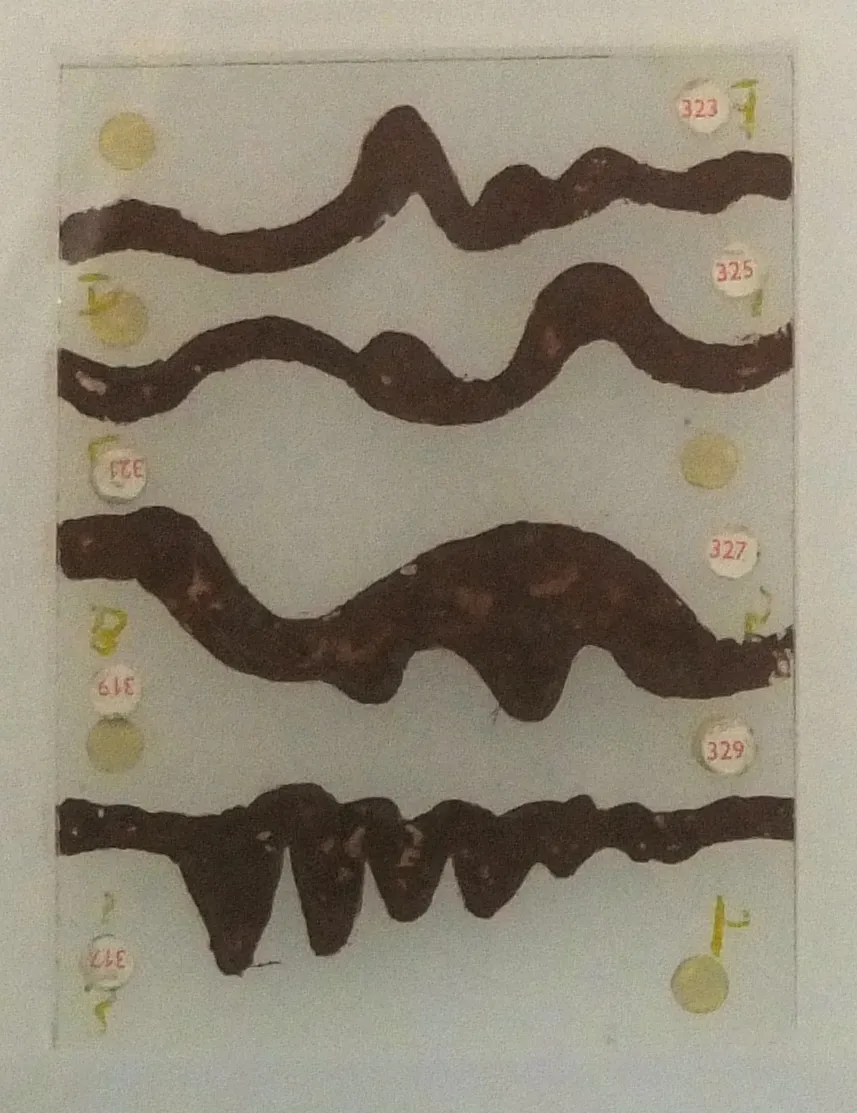
The mature system separated sound generation from control. Oram first painted four wave shapes on glass slides. Inside the generator, cathode-ray tubes produced moving points of light; photomultipliers followed the contours on those slides. The resulting electrical waveforms supplied four timbres. A drawing here did not describe whether a note should rise or fall. It defined repeating shapes from which electronic tone could be made. 2
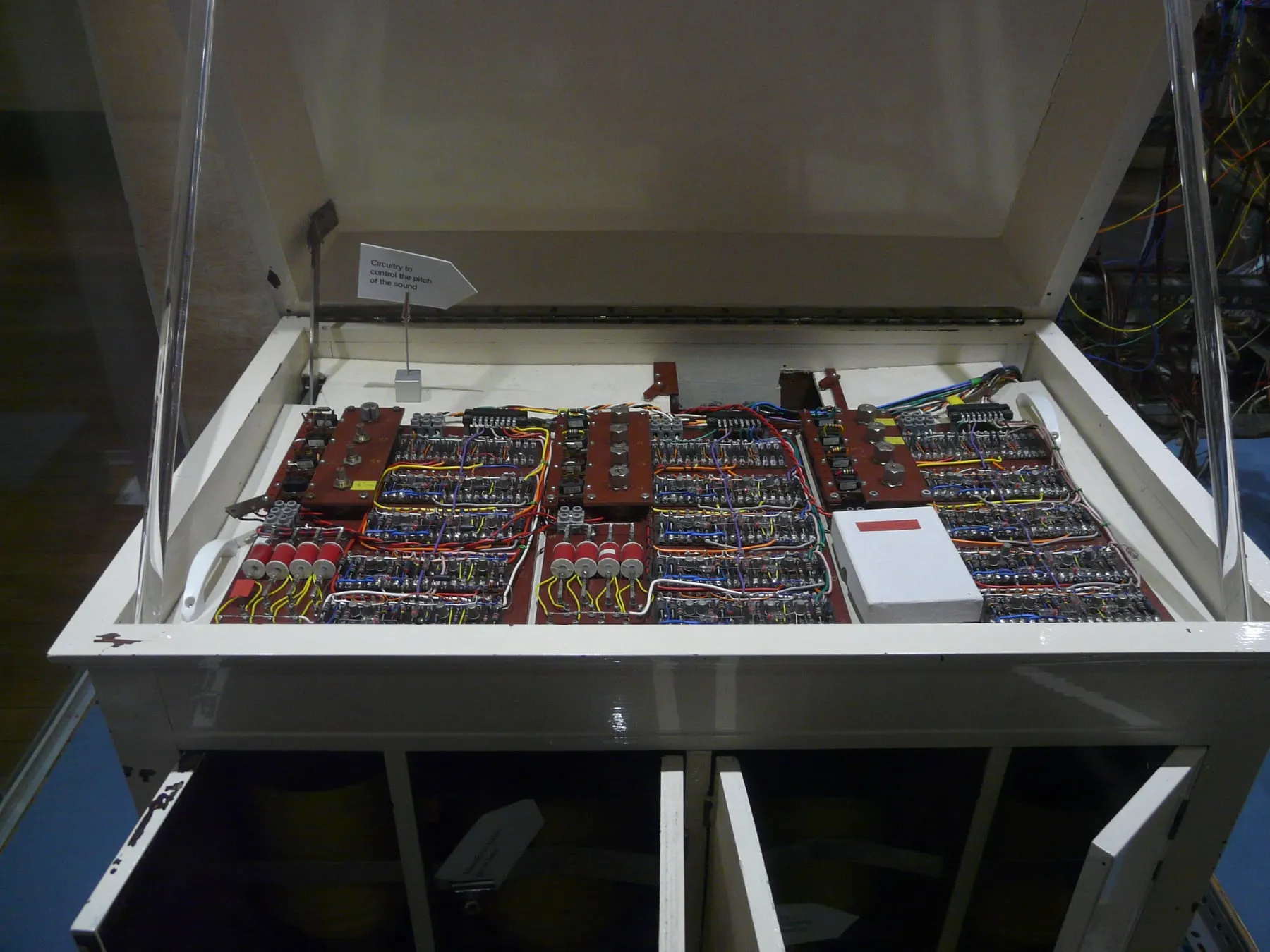
Pitch occupied three of the parallel 35mm films. Oram called the coded marks “neumes,” borrowing a term from early musical notation. Twelve light sensors read their combinations, triggering relays and a network of components that controlled a master oscillator. That oscillator drove the waveform scanners at the chosen frequency. The arrangement joined discrete switching for pitch to continuously drawn control elsewhere; calling the whole machine simply analogue or digital misses that mixed design. 2
Four more film strips governed the volume of the four timbres independently. A composer could therefore bring one waveform forward while another receded within the same event. Another strip shaped pitch vibrato. A further strip controlled how much of the mixed sound entered a reverberation path. Oram used a separate room, loudspeaker, and microphone to create that reverberation acoustically. These are the nine active assignments described for one working configuration; the bed held ten film paths, while control roles and circuits changed as Oram revised the system. Treating every track as permanently fixed would turn a research instrument into a misleading product specification. 2 4
Mechanical speed established the shared duration, but the control films did not behave like independent tape recordings. They were aligned instructions. A mark on one strip could change pitch while a mark beside it opened a volume contour or increased reverberation. Moving one decision relative to the others changed the phrase without redrawing the entire sound. The interface therefore made synchronization tangible: musical relationships occupied neighboring lengths of film and passed their readers at corresponding moments.
Oramics did more than trigger notes. Its interface placed phrasing at the center. A narrowing volume shape, gradual vibrato, and changing blend could be composed as related gestures. The marks could be held side by side and judged visually before the machine read them. They were neither a conventional score interpreted by performers nor recorded audio displayed after the fact. They were control material: the instructions the instrument converted into voltages and switching states.
An interface with resistance
Drawing suggests immediacy, but the machine was not frictionless. Film had to be prepared, aligned, and transported. Pitch codes needed to correspond to working circuitry. Waveform slides and optical scanners required an electronic chain behind them. The composer could revise a curve with a directness unavailable in an opaque reel of tape, yet hearing the result still depended on a large bespoke apparatus. Oramics made some decisions visible by moving difficulty elsewhere. 2
Present-day software offers an easy but misleading comparison. A digital audio workstation can display recorded waveforms, automation lanes, synthesis parameters, and sequences on one screen. Oramics anticipated parts of that visual vocabulary, but it did not contain audio clips or offer instant nondestructive editing. Its films were physical control surfaces; its glass slides generated repeating electronic shapes; its timing followed mechanical motion. The machines share a question, not an identity.
Oram continued to revise the system rather than turning it into a standard product. The collection that survives includes plans, correspondence, scores, tapes, technical documentation, photographs, and machine material. Together they show an extended research practice, not one triumphant object. Commercial compositions and educational writing belonged to that practice too: they tested ideas, paid for work, and carried electronic sound into contexts where an experimental concert machine could not travel. 1 8
The machine returned as an archive
After Oram’s death in 2003, her archive entered institutional care at Goldsmiths. Researchers traced the machine to France in 2008 and worked with the Science Museum to document and exhibit it. The 2011 Oramics to Electronica exhibition, originally planned for six months, remained for several years. Its public life shifted again: an instrument built to convert drawings into sound became an object through which electronic music history could be revised. 3 5
Exhibition can make an unfinished machine look settled. The archive counters that effect. Logbooks preserve failure; drawings preserve alternative routes; tapes preserve results without pretending the device was easy to operate. The recovered Still Point materials widen the account further, placing Oram’s orchestral and turntable thinking beside her better-known work in synthesis. What returns is not a missing gadget added to a shelf of canonical instruments. It is evidence that the categories of composer, engineer, studio manager, and instrument designer were already crossing inside one career. 3 8
The museum object and the archive perform different jobs. The object lets a visitor trace film across readers and see that the interface was physical. The archive restores decisions that cannot be inferred from a chassis: abandoned designs, funding applications, scores, correspondence, commercial obligations, and the long intervals between a proposal and a reliable result. Together, they keep “pioneer” from becoming a substitute for explanation. Oram’s work matters not because every later electronic tool descends from it, but because she defined a compositional problem precisely enough to build, revise, document, and argue with a machine.
Listen for the drawn decision
To hear Oramics, follow one parameter. Notice a tone whose edge changes while its pitch holds, or a phrase that grows through a drawn volume envelope rather than a player’s key pressure. Listen for vibrato as a separately shaped line and reverberation as something admitted in changing amounts. The machine was designed so those behaviors could be composed together but not collapsed into one gesture.
That design places Oramics on a path toward the later Fairlight CMI, where a screen, light pen, stored samples, and sequencer made another set of musical decisions visible. The machines are not versions of the same system. Oram began with drawn control and electronic waveforms; Fairlight began with digitized sound and computer memory. Their common ground is narrower and more consequential: both assumed that looking could become part of listening, and that an interface could change what a composer considered available to write.
In each, the visible surface did not merely report music after the fact; it proposed where musical thought could be placed.