

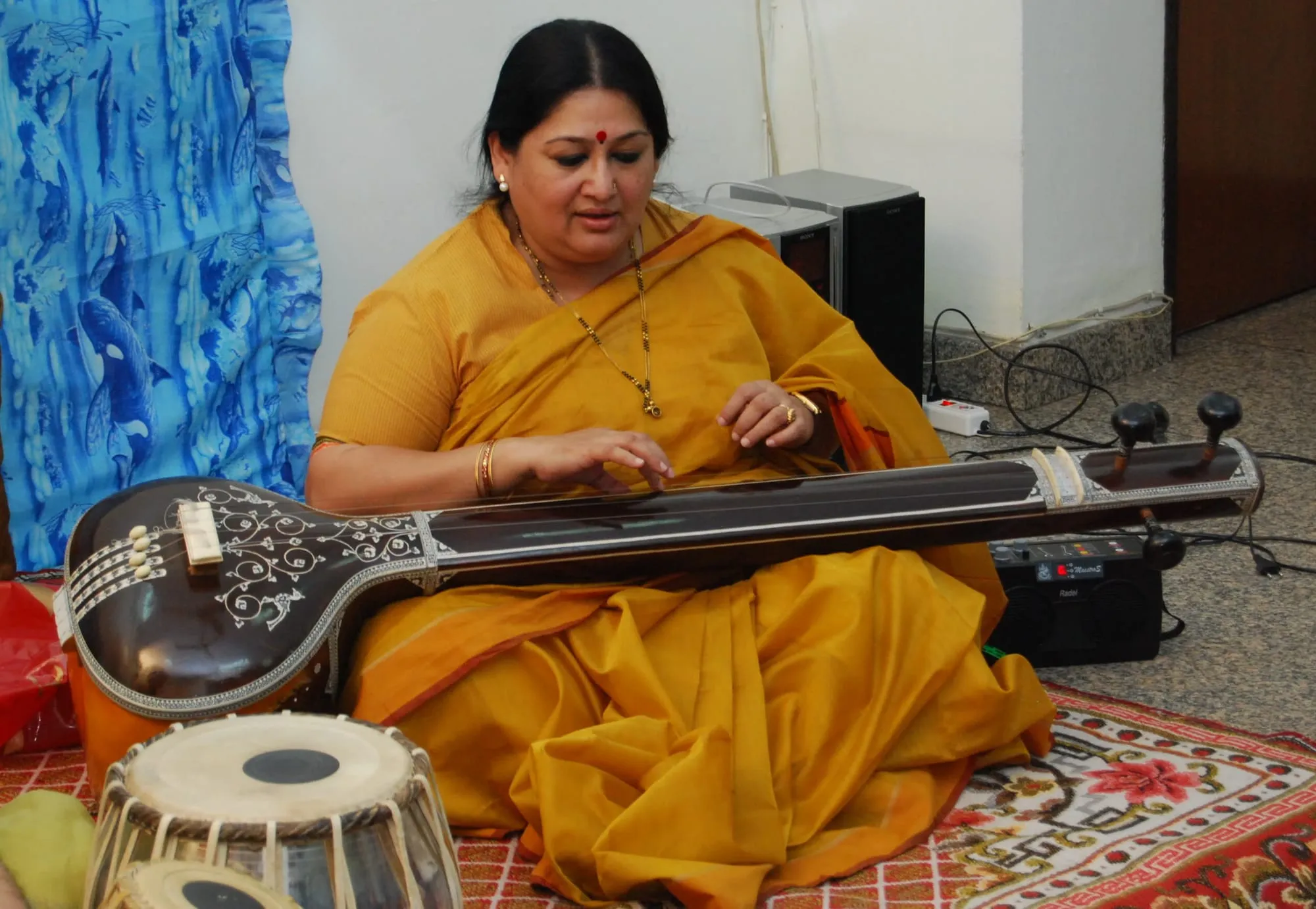
The tanpura can disappear in plain hearing. A singer shapes a phrase, a sitar bends a note, or a violin climbs through a raga while four open strings keep returning beneath it. Call that sound a background and the instrument seems passive. Listen to one complete plucking cycle, however, and the supposed background keeps changing. One string blooms low, two meet on the tonic, a higher string clears space, and their decays overlap in combinations that never settle into a flat line.
The tanpura, also spelled tambura, is a long-necked, fretless lute used as a drone instrument in both Hindustani and Karnatak classical traditions. Those traditions use different instrument proportions and performance practices, so one generic diagram cannot stand for every tanpura. The shared principle is narrower and more useful: its strings are played open, one after another, to maintain a tonal reference through a performance. 1 3
It therefore does not perform a melody badly. It performs another task with unusual precision. The tanpura gives a soloist somewhere to place a note, and it gives a listener relationships to hear before anyone explains their names.
Four strings define a field
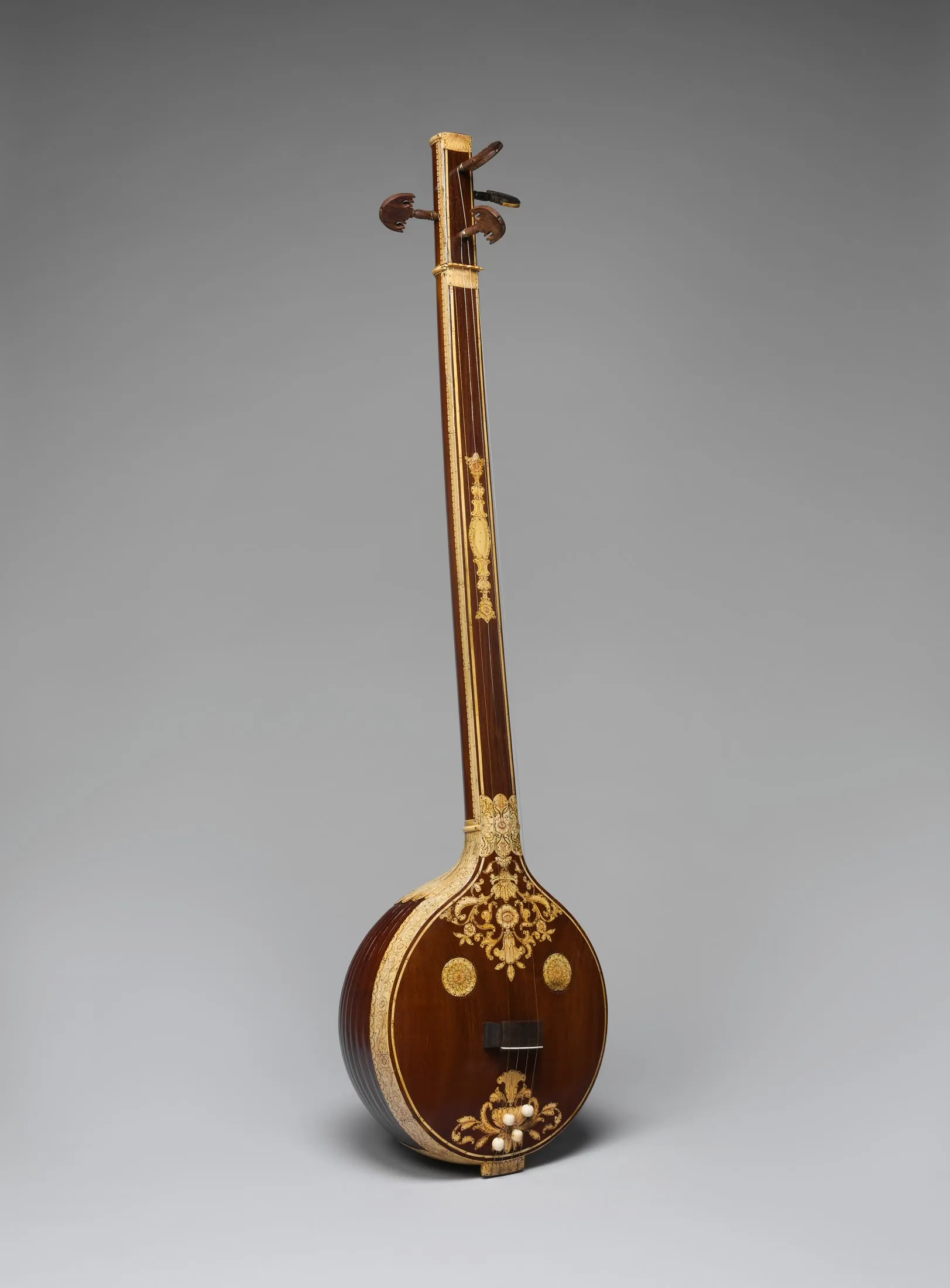
A typical Hindustani tanpura has a hollow neck joined to a large resonator, four wire strings, four friction pegs, a broad curved bridge, and small beads for fine tuning. It has no frets because the player does not shorten the strings against a fingerboard. The whole vibrating length remains available on every pluck. Grinnell’s instrument record describes three steel strings and one brass string; other models vary in size, material, register, and string count. 1 4
The tuning follows the tonal center chosen for the soloist rather than a fixed concert pitch printed on the instrument. One common four-string arrangement sets the strings to the fifth, two middle tonics, and a lower tonic. If the raga calls for another stable pitch, the first string may change. The point is not to spell a Western chord. It is to keep the tonic present across octaves while another selected pitch helps define the raga’s interval field. 1 5
Because the strings are not struck together, the tuning arrives as a sequence. A lower tone can decay under the next tonic; the second tonic can reinforce energy still hanging from the first; the final string can reopen the top of the spectrum. The ear joins those events into continuity. What sounds sustained is actually renewed by a hand.
The pluck must leave room
The player usually uses the fleshy tips of the index and middle fingers, moving through the strings in a regular order. Grinnell notes that the attack is kept nearly inaudible and that the soloist may determine the speed and rhythm of the pattern. This restraint is physical, not merely polite. A tanpura string needs enough energy to travel against the bridge, but a hard pull can disturb the contact that produces its characteristic response. 1
High-speed measurements at IIT Kanpur found that the desired overtone behavior depended on pluck amplitude. In the experiment, high-amplitude plucks reduced the effect produced by the thread and bridge. A quiet hand is therefore part of the acoustic system. The player does not simply trigger a finished machine; touch determines whether the machine reaches its intended sound. 2
Regular does not mean metronomically indifferent. A cycle can breathe with an alap, the unmetered opening exploration of a raga, or sit differently once percussion enters. The pattern must be stable enough to orient other musicians without demanding the foreground. That balance is a performance skill: keep time without turning the drone into a beat, and keep tone alive without drawing every ear to the attack.
The bridge refuses a clean release
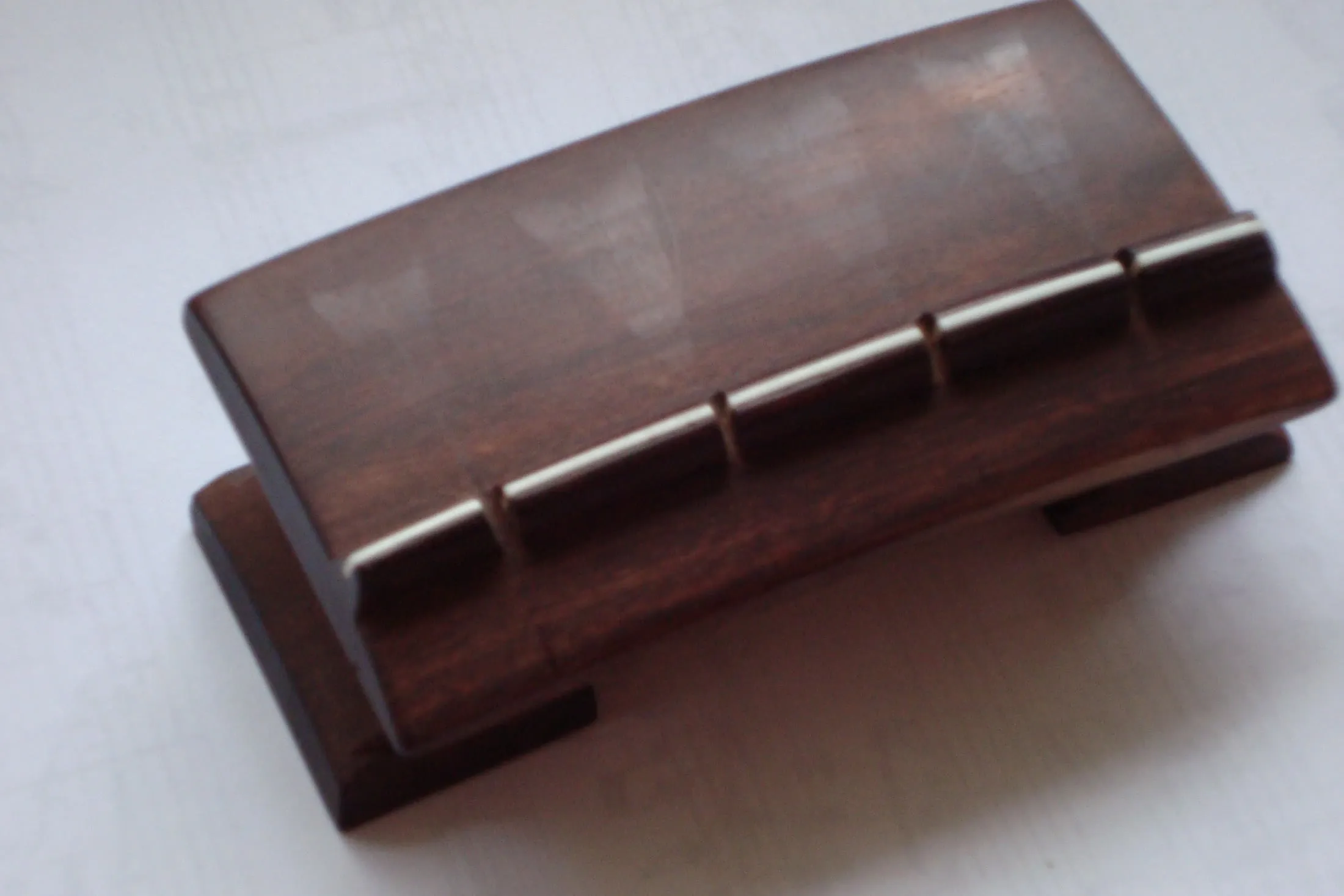
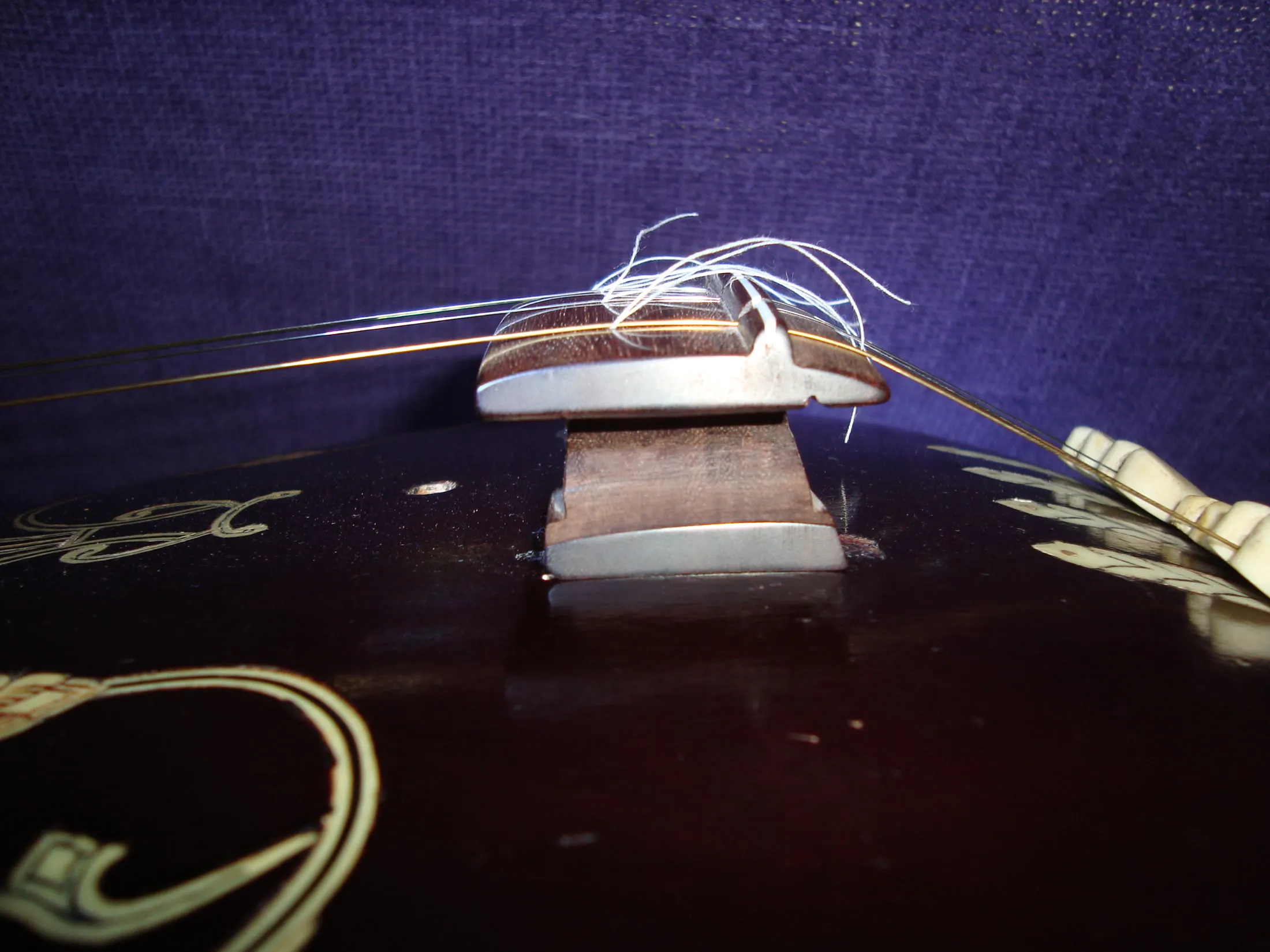
On many string instruments, a narrow bridge edge marks the point beyond which the string vibrates freely. The tanpura uses a wide, gently curved bridge. A vibrating string grazes that surface, repeatedly making and losing contact as its motion decays. The changing contact interrupts an otherwise simple vibration and redistributes energy among partials. The result is the bright, slowly evolving quality called jivari or jawari. 2 6
That rough edge is designed, not tolerated. The tanpura shares this principle with the mbira dza vadzimu in The Buzz Was Part of the Note, where loose pieces extend each pluck with a controlled rattle. The mechanisms and musical worlds are different. In both, however, removing every apparent impurity would remove information the instrument was built to produce.
Computer models describe the tanpura contact as nonlinear because the boundary itself changes while the string moves. A model can reproduce parts of the descending high-frequency pattern, yet researchers still test how friction, two directions of string motion, bridge shape, and thread position alter the result. Jivari is not a decorative effect applied after a stable tone. It emerges from a string repeatedly negotiating its boundary. 6
A thread moves the whole spectrum
Between each string and the bridge sits a fine thread, often called jiva. Sliding it by a small amount changes the string’s height and the place where grazing contact begins. The player or instrument maintainer adjusts each thread until the attack, buzz, sustain, and overtone spread work together. Grinnell describes silk thread; the IIT experiment documents cotton. Material and terminology can vary, but both records make the central point clear: correct placement is essential. 1 2
The IIT measurements compared a string with and without jiva. With the thread correctly placed, energy cascaded from lower to higher overtones and several partials remained strong as the note decayed. Without it, the higher overtones faded faster and the fundamental dominated. The familiar tanpura halo is therefore not a cloud of random resonance. It has a time course that can be observed in a spectrogram and altered at the bridge. 2
Simulations presented at the Vienna Talk on Music Acoustics reached a complementary result. Changing the modeled distance corresponding to thread position changed the length and frequency of the sustained high-frequency plateau. The model did not claim to finish the problem; its authors explicitly called for further experiments. That limitation matters. The tanpura is a sensitive physical object, not a poetic mystery that science cannot touch or a solved diagram that practice no longer needs. 6
Tuning continues after the peg
Turning a peg brings a string near its pitch. Sliding a small tuning bead near the tailpiece changes tension more delicately. Moving the jiva thread then changes the tone, which can slightly change how pitch is perceived. The work proceeds back and forth: rough pitch, fine pitch, contact, overtone response, then another check against the soloist’s tonic. 1
This is why a tanpura is tuned as a set of interacting strings rather than four isolated numbers on a meter. Shared partials can strengthen the sense of the tonic. Beats between nearby frequencies can reveal an adjustment. The resonator and room return some frequencies more strongly than others. A player listens to what accumulates across the cycle, then makes a small change and listens again.
The process also explains why a recorded sample cannot fully replace a live instrument by copying one ideal pluck. A loop repeats the same spectrum and decay unless software changes them. A player renews strings at slightly different moments and amplitudes while making minute corrections through the performance. Electronic tanpuras and shruti boxes are now widely used in concerts and practice, but computational-music researchers still identify the acoustic instrument’s richness as a modeling challenge. 5
The drone makes intonation relational
In raga performance, a pitch is heard against a tonal center and against characteristic routes through other pitches. The tanpura makes that center continuously available without locking the soloist to keys or equal-tempered steps. A singer can approach, shade, sustain, or leave a note while the drone lets the ear judge distance and return. 3
Calling the drone one note misses its density. Octave-related tonics are present, a fifth or another selected pitch may recur, and the bridge produces many upper partials. Different solo notes meet different parts of that spectrum. Some seem to fuse with it; others create audible tension; a return to the tonic can feel like a change in texture as much as a change in melodic direction.
The tanpura does not dictate the raga by itself. It does not supply the ascending and descending behavior, characteristic phrases, emphasis, or timing that musicians learn within a tradition. It supplies a durable field in which those decisions become exact. The Metropolitan Museum’s overview usefully places raga and tala at the center of both Hindustani and Karnatak systems while also distinguishing their histories and instrumental practices. 3
The person behind the drone remains audible
Tanpura playing is sometimes assigned to a student accompanying a teacher, and vocalists may also play while singing. Grinnell describes the student role as an honor. That social arrangement can be missed when the drone is reduced to a utility track. Someone has learned how to tune the instrument to this soloist, how firmly to pluck, how quickly to cycle, and when the jivari needs attention. 1
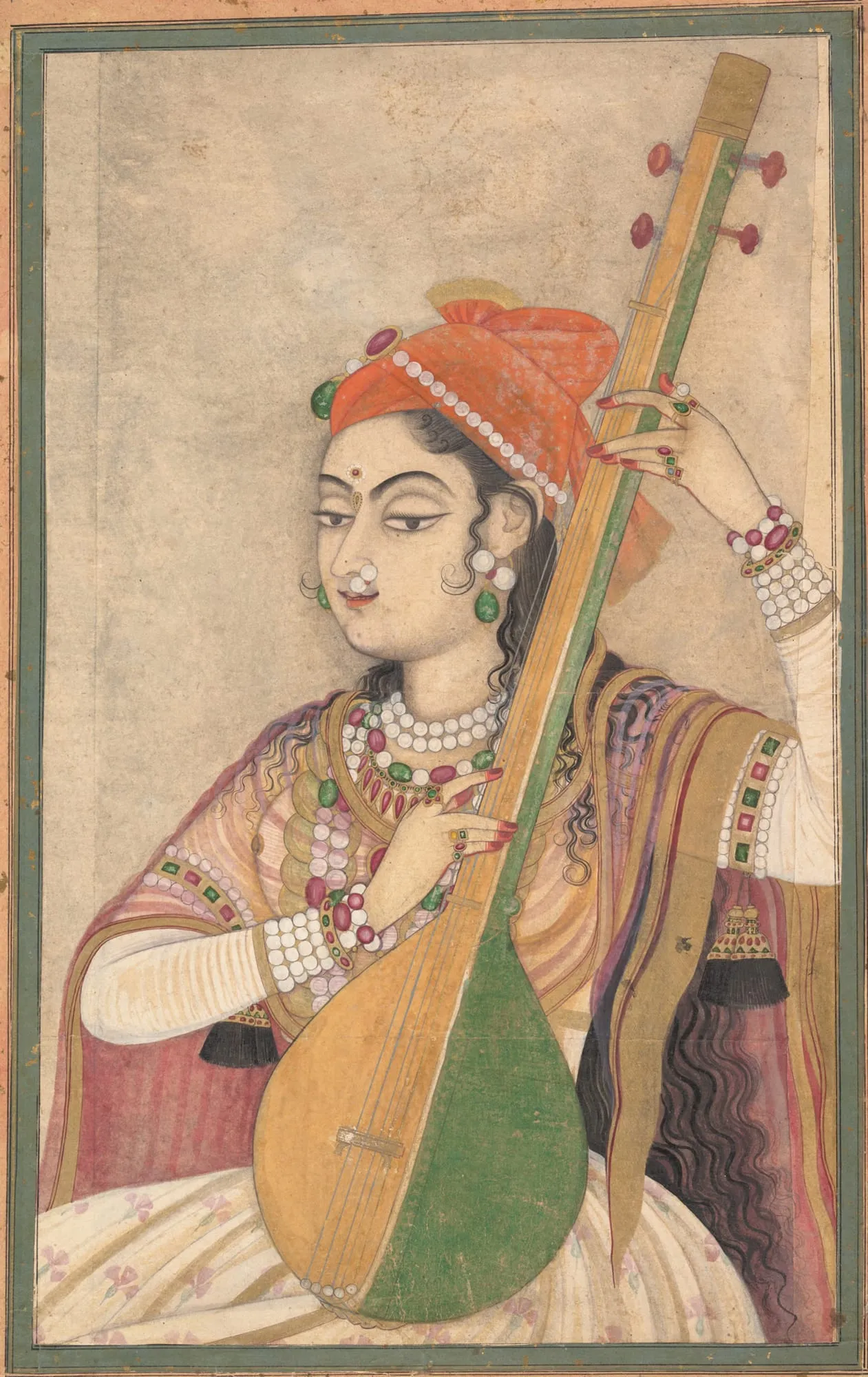
Historical images likewise show more than an instrument type. A Kishangarh painting from about 1735 depicts a woman holding a tanpura; the Met’s early nineteenth-century Tanjore example belonged in the modern era to dancer and singer Y. G. Srimati. These objects moved through courts, workshops, collections, teaching relationships, devotional practice, and concert life. Their long necks make them visually conspicuous, but their musical authority comes from sustained service rather than solo display. 4
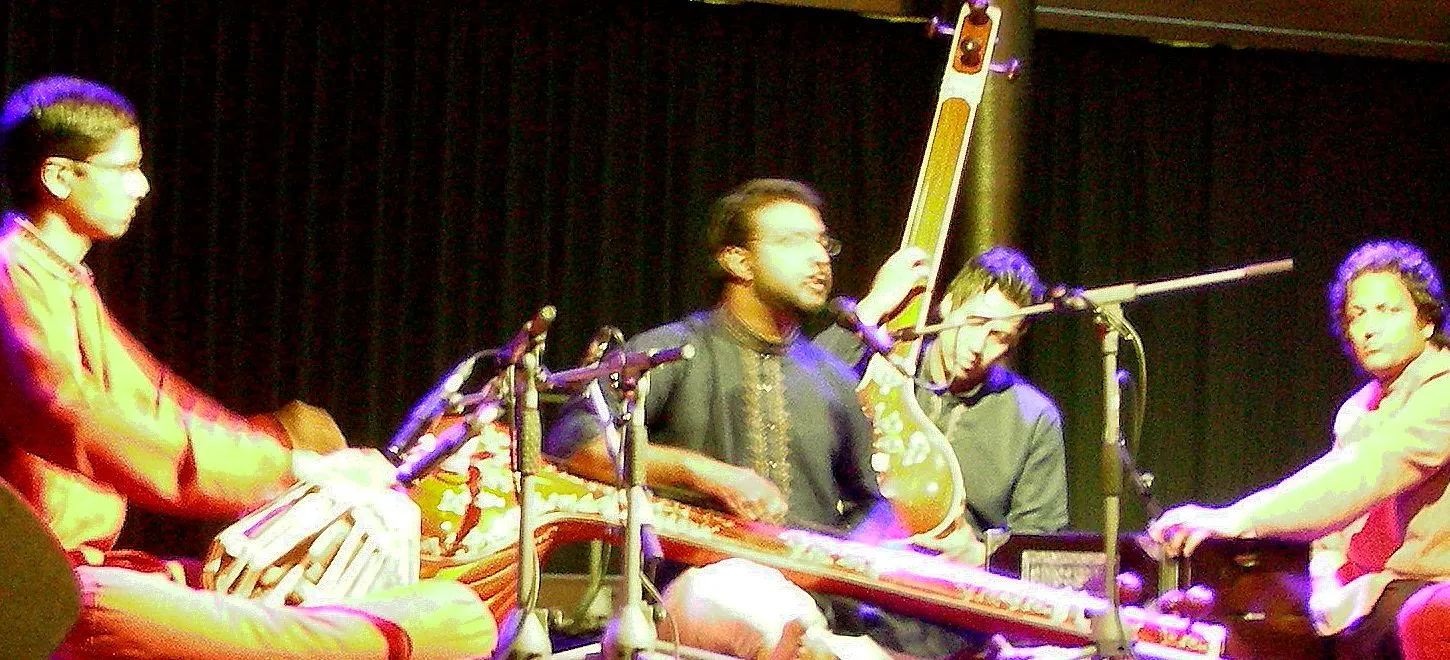
Two tanpuras in one ensemble make that service easier to hear. Their cycles can overlap, so one string is still opening while another decays. Small differences in timing and spectrum thicken the reference without requiring new pitches. The drone becomes a shared task much as Africa 70’s arrangement in The Band Was the Arrangement emerges from divided responsibilities. In one case the division creates a dense dance-band engine; in the other it protects a center spacious enough for a soloist.
Listen between the returns
Begin by ignoring the melody for one tanpura cycle. Identify the lowest string, then hear where the two middle strings reinforce each other. On the next cycle, attend to the top of the sound rather than the named pitches. The bright band does not remain fixed. It falls away in stages as the string’s contact with the bridge changes.
Next, listen for the hand. A good pluck may be almost hidden, but the sequence still has direction. Notice whether the cycle accelerates, relaxes, or stays firm when the soloist changes phrase length. If two tanpuras are present, try to separate their attacks before letting them merge again.
Finally, follow one solo note into the drone. Hear whether it rubs against the field, activates a shared partial, or seems to disappear into the tonic. The tanpura has not moved to a new harmony, yet the relationship changes because the melody changed what the ear selects from it. Four strings have kept returning. The drone was never still.
.jpg)

_properly_adjsted,_photo_by_Martin_Spaink.JPG)

