
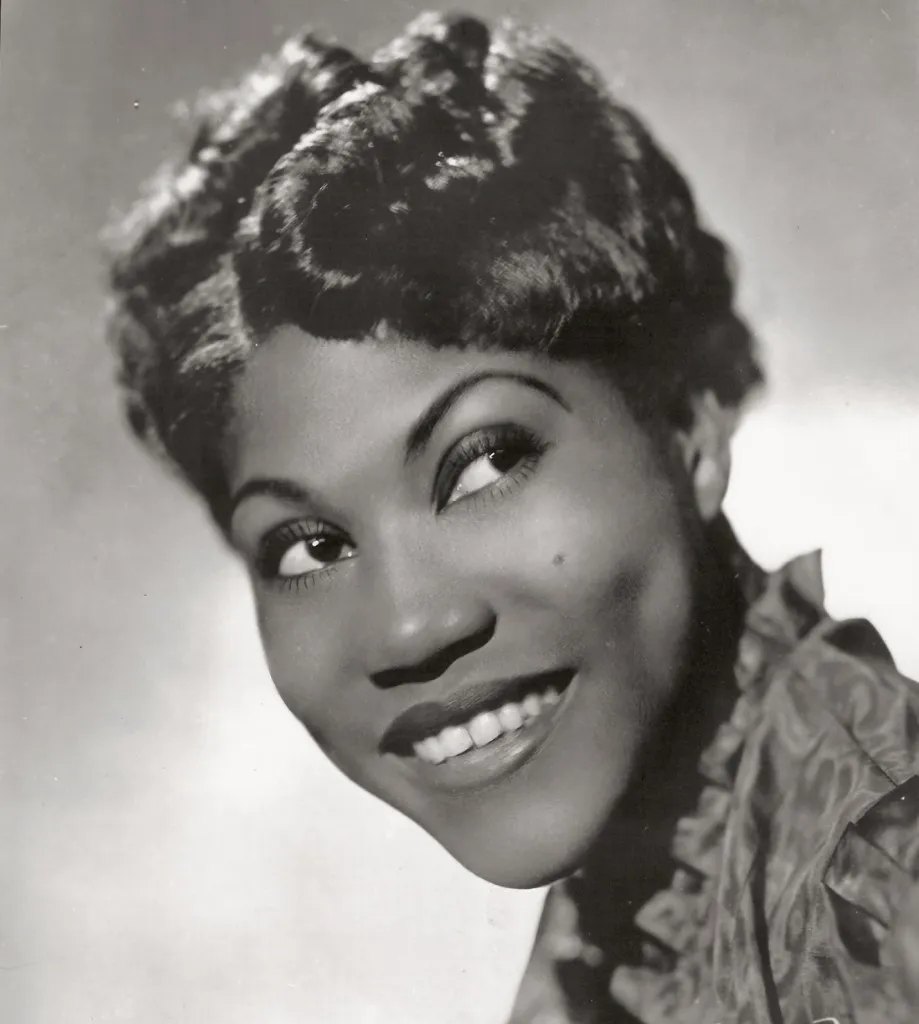
The useful place to begin with Sister Rosetta Tharpe is not the honorary title often attached to her decades later. It is the sound of work being done. Her right hand keeps a hard, regular pulse. Her left hand shortens a chord, answers the voice with a compact run, then returns to timekeeping before the song loses its forward motion. The guitar is rhythm section, reply, and interruption. That method came from gospel performance, not from a future genre waiting to be invented. Rock musicians later heard their own vocabulary in it. Tharpe had built the vocabulary for another purpose. 1
A child on the church circuit
Rosetta Nubin was born in Cotton Plant, Arkansas, on March 20, 1915. Her mother, Katie Bell Nubin, preached and sang in the Church of God in Christ, a Black Pentecostal denomination in which instrumental music, bodily movement, and forceful participation were part of worship. Rosetta performed as a child, singing and playing guitar beside her mother. When they moved to Chicago, church meetings and touring programs became her school. The guitar was not an accessory to a singer. It was one of the means by which a room was organized: setting tempo, lifting a response, and making a voice carry.
That background matters because later accounts often treat sacred and secular music as two fixed territories that Tharpe crossed. Her practice was less tidy. Gospel performers worked theaters and churches, recorded for commercial labels, listened to popular styles, and adjusted arrangements for different audiences. The tension was real, especially when nightclub billing and suggestive material troubled church listeners. But the music itself had already developed through exchange. Tharpe did not need to leave gospel technique behind to enter popular entertainment. She brought its rhythmic engine with her. 2
By her early twenties she had married preacher Thomas Thorpe, adopted a modified version of his surname, and separated from him. The name Sister Rosetta Tharpe joined a religious title to a professional identity. It also traveled well on posters. In 1938 she moved into a different scale of work: a Decca recording contract, an appearance at the Cotton Club, and a place in John Hammond’s From Spirituals to Swing concert at Carnegie Hall. Those engagements put a young Black gospel musician into commercial spaces whose rules were shaped by segregation, gender, and the expectations of white promoters. 3
Four sides in a studio
On October 31, 1938, Tharpe recorded four titles for Decca. The Smithsonian lists “Rock Me,” “That’s All,” “My Man and I,” and “The Lonesome Road” as the session that established her recording career. The sides do not present one settled formula. They move among spiritual material, popular song, swing accompaniment, and prominent guitar. What connects them is control. Tharpe places the beat with enough firmness to support a band, then changes the guitar’s role between vocal lines. 4
Recording changed what that control could mean. A church audience experiences volume, gesture, and collective response in a room. A disc compresses the event into a few minutes and asks the microphone to decide what comes forward. Tharpe learned to make the guitar legible under those conditions. Short attacks survived the recording chain. Repeated figures established form quickly. A bright amplified tone separated her part from brass, piano, and drums. These are practical decisions, not evidence that she secretly intended a genre that the record business had not yet named.
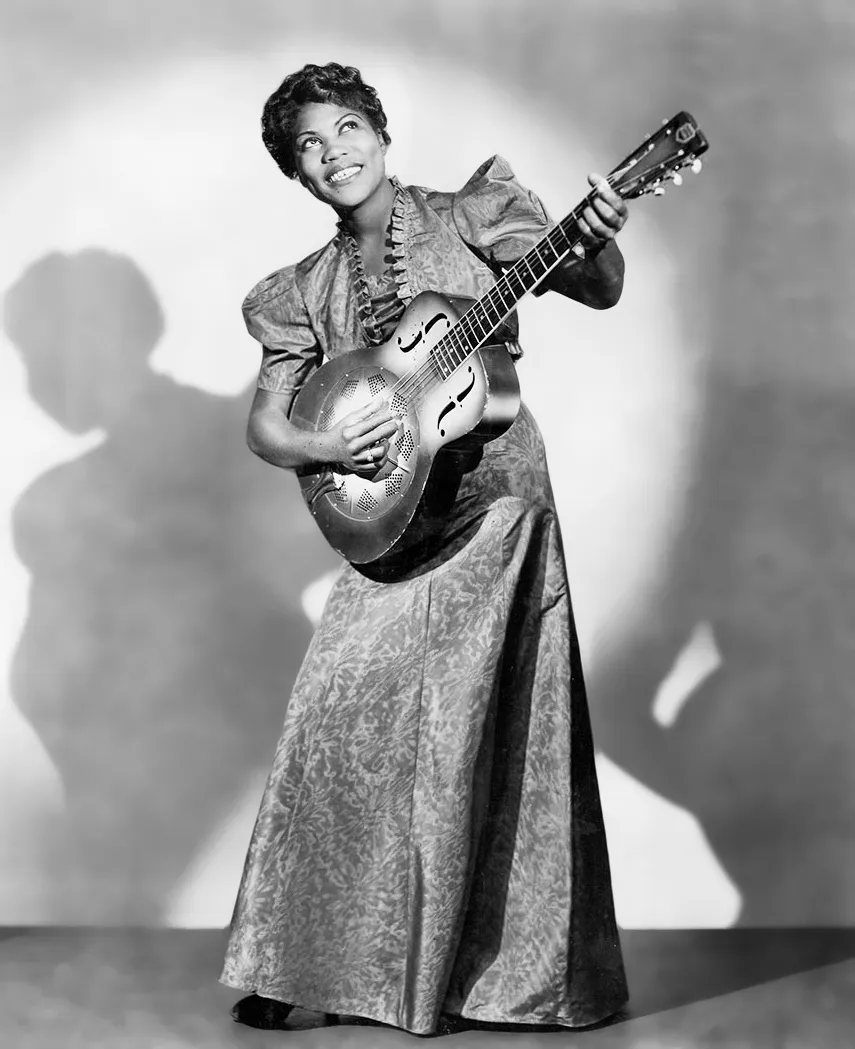
Her instrument choices changed across the career. Publicity images show acoustic and resonator guitars. Later photographs and film show hollow-body electrics, a Gibson Les Paul, and the white Gibson SG now strongly associated with her. The Smithsonian’s summary emphasizes her combination of gospel singing and virtuoso electric playing. The continuity lies less in one model than in the way she made amplification serve phrasing. Volume allowed a single note to hold its place against an ensemble, but her attack still came from a player trained to maintain the whole song. 5
The beat inside the testimony
Tharpe’s guitar parts often begin with a physical fact: downbeats need weight. She uses full chords like punctuation, sometimes damping them so the next vocal phrase arrives in cleared space. Between those points she inserts moving bass notes, treble replies, or a run that compresses the harmony into a quick gesture. Voice and guitar sound conversational because they do not duplicate each other. One states the line; the other comments on its rhythm.
That division of labor helps explain why later guitarists could take so much from her records. The playing offers portable units: the bent arrival note, the repeated boogie-like figure, the chord struck as a backbeat, the pause that makes a return feel larger. Those units work in gospel, rhythm and blues, country, and the developing language of rock and roll. Influence here does not require a simple family tree. It can move through records, touring bills, radio, remembered gestures, and young performers watching how an established musician holds an audience.
The Rock & Roll Hall of Fame’s induction material calls attention to that guitar authority, but the archive also shows why retrospective praise needs care. Calling Tharpe a precursor can reduce her to an opening act for men who became more famous. She was already a headliner with a long professional network, commercial records, and audiences of her own. The historical question goes beyond who copied a lick. It asks why the category of rock later made her work seem peripheral when so much of its technique was audible in her hands. 6
Sacred work in commercial rooms
Nightclubs created opportunity and suspicion. Tharpe could reach listeners beyond the church circuit, work with leading swing musicians, and gain access to national promotion. At the same time, some gospel audiences objected to venues and repertoire they associated with secular entertainment. The conflict was not a colorful footnote. It affected bookings, reputation, and the way her music was described. Accounts that celebrate a fearless crossover can miss the unequal choices underneath it. A Black woman musician could be marketed as a novelty even while displaying command equal to anyone on the bill.
She handled that pressure by changing context without surrendering the center of her style. A spiritual could receive a driving arrangement. A popular stage could hear the cadence of testimony. Clothes, spoken introductions, and humor helped her address different rooms, but the guitar kept its practical authority. Her performances could be warm, comic, admonishing, and technically exact within the same number. That range made her difficult to file and easy to remember.
In the mid-1940s, “Strange Things Happening Every Day” became one of her defining records. It joined an urgent vocal with an electric guitar part whose rhythmic snap can be heard as an early rock-and-roll grammar. Later institutions have repeatedly used the record to place Tharpe in rock history. The Recording Academy admitted it to the Grammy Hall of Fame in 2014 and added “This Train” in 2016. Those honors document later recognition; they do not settle a contest for the first rock record. 7
What a ten-inch record carried
The National Museum of American History holds Decca 48009, the 1944 shellac release that paired “Strange Things Happening Every Day” with “Two Little Fishes and Five Loaves of Bread.” The catalog describes a ten-inch, 78 rpm disc made in New York. Each face carries one performance. That compact format puts Tharpe’s guitar method into a useful material frame: the arrangement has to establish tempo, vocal character, and instrumental identity without the long sequence available to a later LP. 8
Reading the first side only as proto-rock breaks the record’s own pairing. Both titles belong to Tharpe’s gospel work. The sharper guitar attack on “Strange Things” did not arrive because Decca had temporarily placed her in a different genre. It came from a working approach that could change emphasis from song to song while keeping testimony, pulse, and audience address connected. The record offers no reason to separate the electric part from that practice.
A surviving shellac copy has a label, catalog number, two playable faces, and a surface that wears under a stylus. Later reissues can place the track inside a career survey or a rock-and-roll genealogy. Decca 48009 placed it beside another Tharpe performance and asked a listener to turn the disc over. Sequence was physical before it became an editorial menu.
That physical scale helps explain the economy of the guitar part. Tharpe does not wait for an extended solo to establish authority. The opening attack, the weight of the chords, and the replies around the voice make the player identifiable quickly. The record preserves a complete arrangement rather than a demonstration reel for a future style. Its later reputation rests on choices made for one side of a gospel single in 1944.
Partnership and scale
Tharpe’s late-1940s partnership with singer Marie Knight placed two distinct voices in a tightly managed touring act. Their records and stage work widened the sound without turning the guitar into background. The pairing also belongs to the professional infrastructure of gospel: package shows, promoters, musicians moving from city to city, and audiences that followed names across congregations and theaters. Success depended on stamina as much as inspiration.
The scale could be spectacular. In 1951, Tharpe staged her wedding to Russell Morrison as a public concert at Griffith Stadium in Washington, D.C. The event joined private ceremony, religious performance, publicity, and ticketed entertainment. It is tempting to read it as a modern celebrity stunt dropped into the wrong decade. More usefully, it shows a performer taking control of promotion in a business that often packaged her from outside. The marriage did not provide a neat romantic ending, and the concert should not be used to turn a complicated working life into folklore. 9
Her American prominence declined during the 1950s as the gospel market changed and rock and roll developed its own younger public image. That shift demonstrates how genres distribute credit. A sound may continue while the industry changes the face, age, and setting attached to it. Tharpe kept performing. European tours offered a new audience and eventually produced the film clip through which many present-day listeners first encounter her.
A platform in Manchester
On May 7, 1964, the American Folk Blues and Gospel Caravan arrived at a disused railway station in south Manchester for a television recording. Tharpe enters the platform in a horse-drawn carriage, picks up an electric guitar, and performs for an audience seated across the tracks. The setting is so visually complete that it can overpower the work. Wet pavement, railway architecture, and the white SG make an instantly shareable image. Yet the performance is not valuable because it looks improbable. It is valuable because her time, articulation, and command remain intact in difficult conditions.
The clip also changed the route by which her reputation traveled. Television footage could be rebroadcast, excerpted, uploaded, and circulated without the surrounding tour history. A musician once known through records and live programs became, for later viewers, the woman playing electric guitar at a station. The image helped correct an absence, but it could create another simplification. Tharpe was not a surprise discovered in 1964. She had already spent more than twenty-five years as a recording artist.
Her health deteriorated around 1970. After a stroke and complications connected with diabetes, she continued to sing when she could no longer maintain the same schedule. She died in Philadelphia on October 9, 1973. The Smithsonian records the dates plainly. The gap between that death and her most visible institutional recognition is much longer than the gap between her early records and the rise of rock. 10
Recognition after the categories hardened
The Rock & Roll Hall of Fame inducted Tharpe in 2018 in its Musical Influence category. The Recording Academy gave her a Lifetime Achievement Award in 2020. Such honors have material effects: museums catalog objects, journalists commission biographies, playlists place old recordings before new audiences, and musicians name an influence in public. They also arrive within institutions built after the music had been divided into market categories. Recognition can repair neglect without undoing the system that produced it.
Listening closely offers a less ceremonial form of correction. It keeps gospel at the center rather than treating it as raw material extracted for rock. It hears a touring professional adjusting her tools across churches, studios, theaters, stadiums, and television. It notices that distortion is only one part of the sound. Timing, chord placement, vocal breath, and audience address do just as much work.
Tharpe’s importance does not depend on proving that every later guitarist knew a specific record. Her documented career is substantial enough: national recording from 1938, prominent electric guitar, crossover bookings, sustained touring, and a performance method that joined testimony to amplified rhythm. Rock eventually gave that method one of its names. The guitar had been speaking clearly before the label caught up.
.jpg)
.jpg)