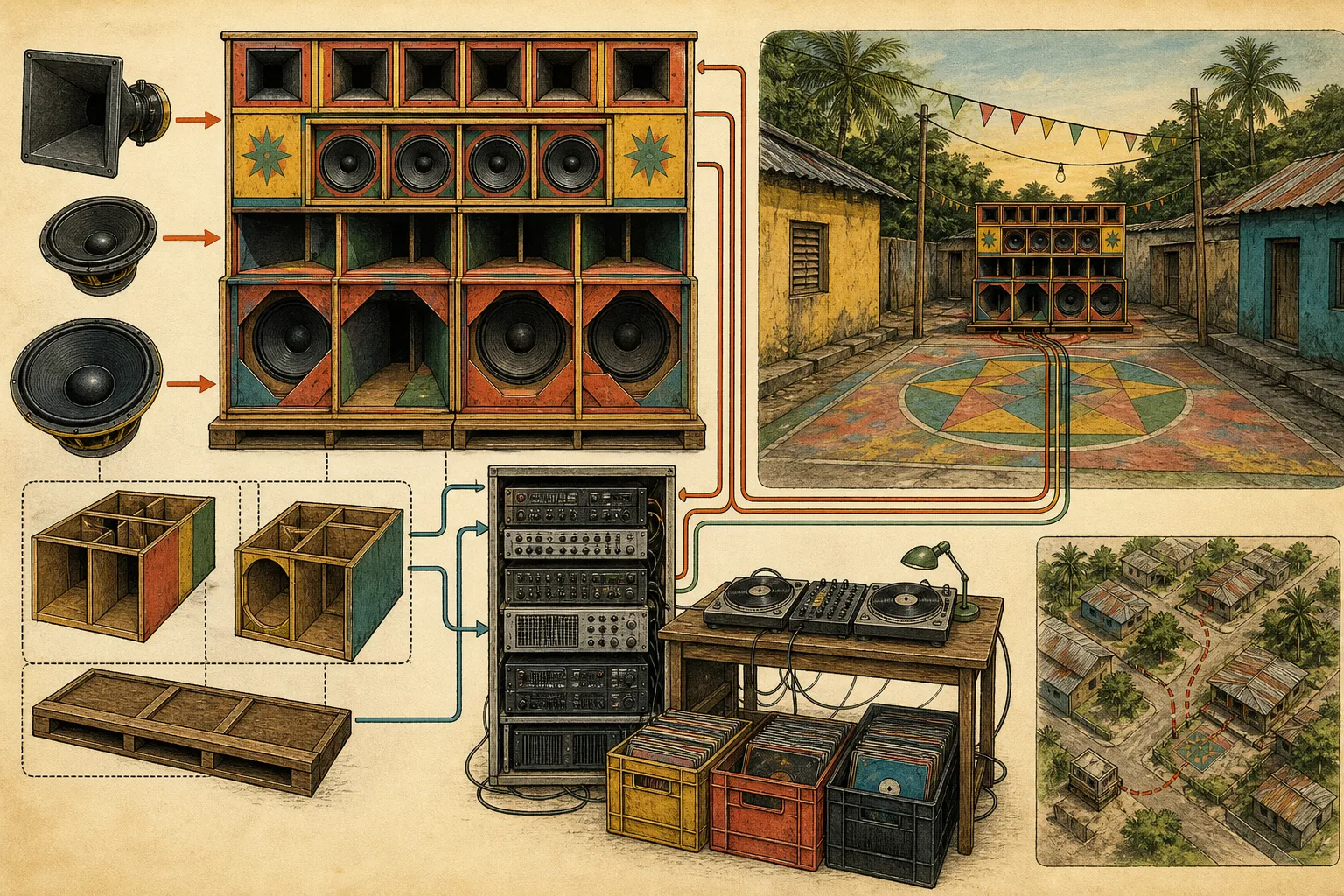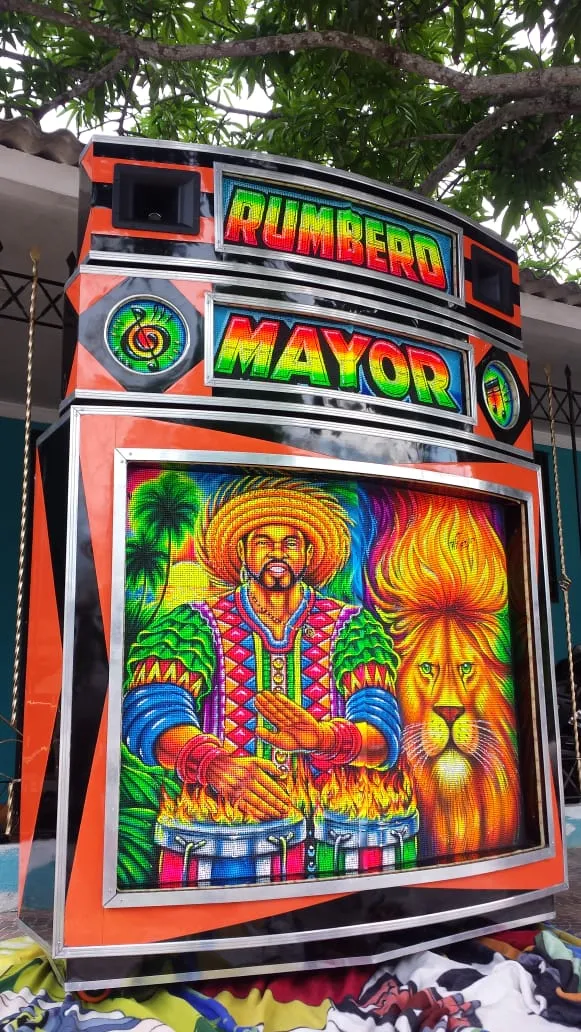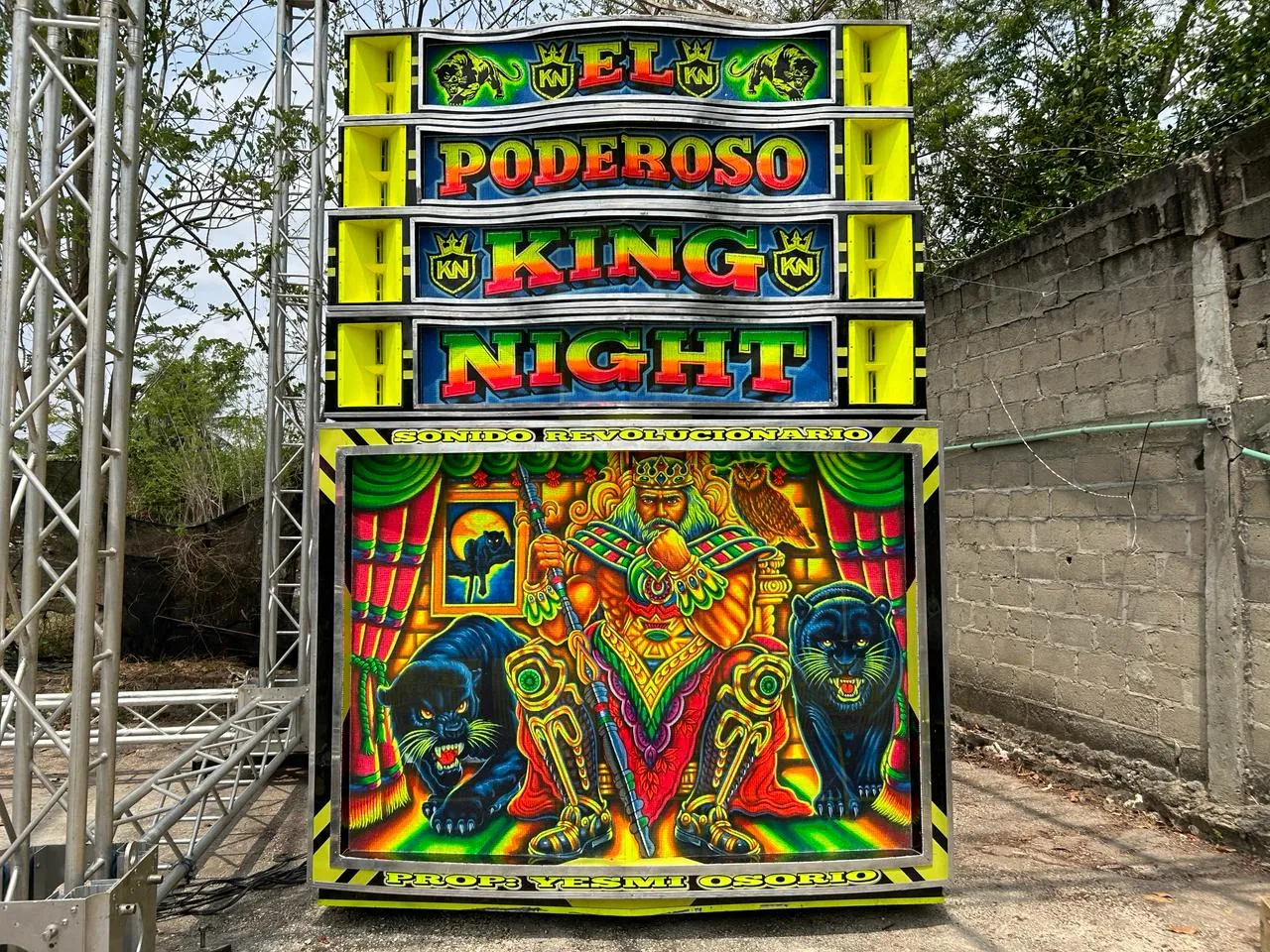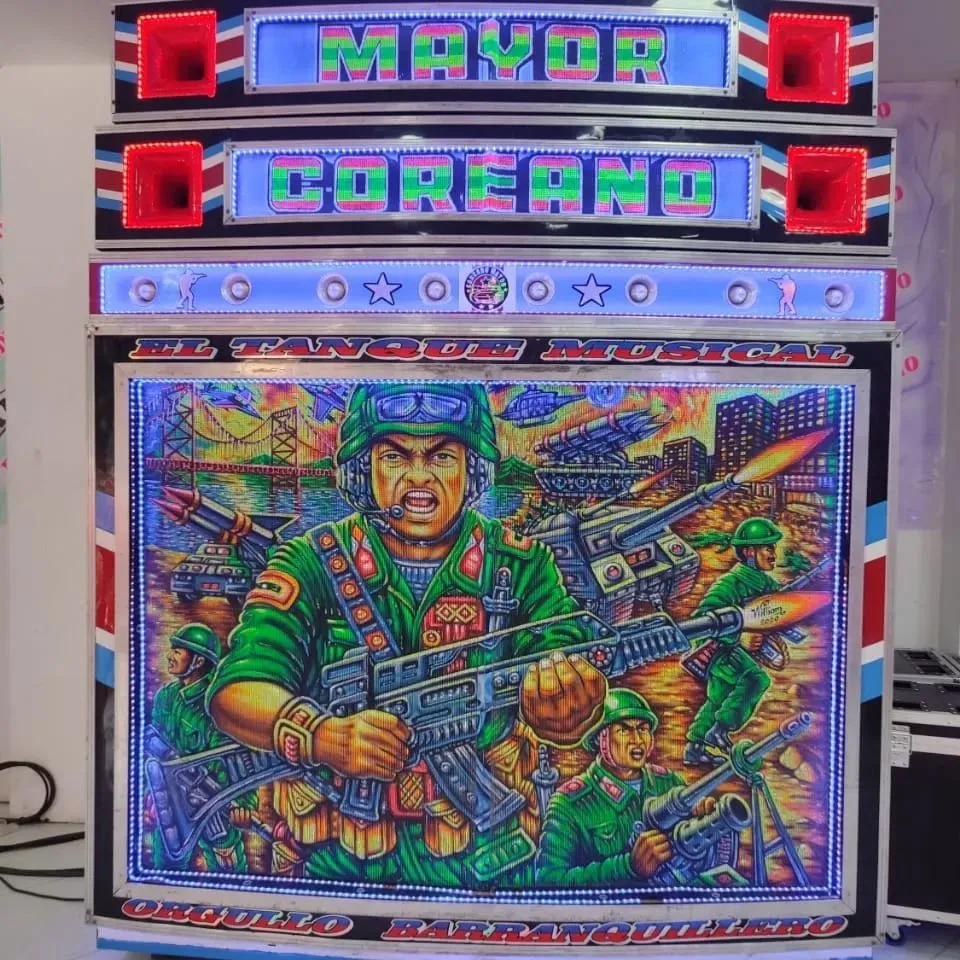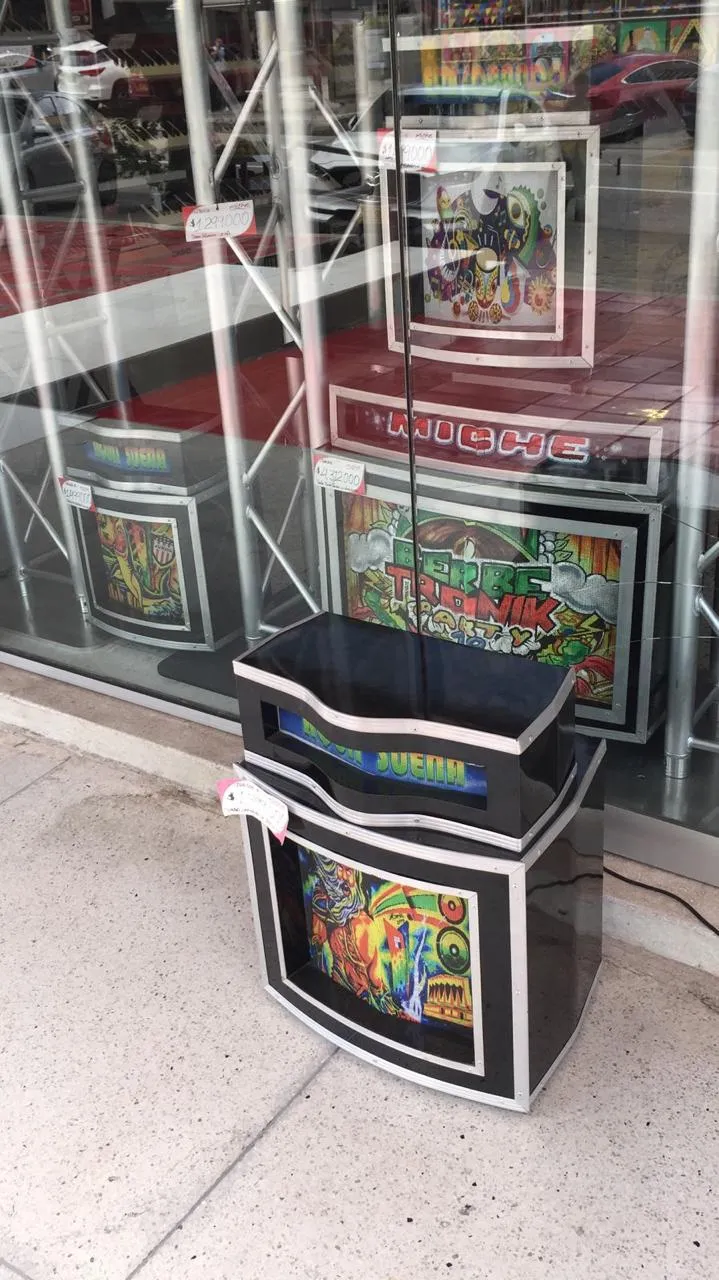


The cabinet arrives before the party does. Its painted face may carry an animal, a warrior, a cosmic landscape, or a name built to travel by word of mouth. Behind that face sit horns, woofers, timber, wire, and the accumulated repairs of repeated use. When the sections are assembled and powered, they do more than make a record louder. They establish a temporary address: this is where the music is, this is who brought it, and this is the sound by which tonight will be remembered.
On Colombia’s Caribbean coast, that machine is a picó. The word can tempt a quick translation into “sound system,” but translation loses the density of the object. A picó is equipment, a named public character, a mobile venue, a record collection, and often a small firm. It ties an owner to technicians, painters, selectors, announcers, promoters, vendors, dancers, and musicians. Research on picó culture treats those relations as part of the technology rather than scenery around it. 1
Champeta did not simply become popular and then find large speakers waiting for it. Picós helped determine which records people encountered, which passages became local favorites, how tracks were renamed and remembered, and where local recordings could prove themselves. The machine was not placed at the party. In practical terms, the machine organized it.
A cabinet with a proper name
Domestic hi-fi equipment is commonly designed to disappear into a room. The picó does the opposite. Its scale advertises capacity, while its painted surface advertises an identity. Names such as Huracán, Rumbero Mayor, and King Night turn separate hardware into a continuing protagonist. A promoter can announce the machine as an attraction; an audience can compare its power, selections, and operator with a rival.
Painting belongs to the system’s public life. The front panel must be legible across a crowd and in the imperfect light of a verbena. Repeated colors and motifs bind replacement cabinets to the same identity. A memorable image lets a machine persist while drivers, amps, and cables are repaired or exchanged. Universidad de los Andes’ account of picotero painting describes artisans who specialize in giving these boxes their visual force. 3
The face also insists that imported equipment has been remade locally. Drivers and amplifiers may have international manufacturing histories, but cabinet dimensions, paint, wiring, transport, and maintenance answer to coastal working conditions. A workshop culture remakes consumer electronics for local use. Photographs of small units offered for sale in Barranquilla make the economy visible: builders do not merely service established giants; they produce new points of entry.
Records crossed the water
The repertoire arrived through ports and informal routes as much as through official radio. Sailors, merchants, collectors, and traveling buyers brought records from the Caribbean and African countries into Cartagena and Barranquilla. Congolese rumba, soukous, highlife, mbaqanga, calypso, reggae, Haitian compas, salsa, and other music could meet in a picó collection without first belonging to one retail category.
For dancers, a record did not need a familiar language or a nationally promoted performer. It needed to work through the system. Bass weight, a guitar figure, a vocal refrain, or a break could earn recognition before listeners knew the title. Operators and audiences developed local names for hard-to-identify imports. Those names were not careless mistakes. They were practical cataloguing devices for music whose original sleeves, languages, and distribution networks were distant.
Scarcity gave selection economic value. An operator who found an effective record could conceal its label, rename it, or keep the only usable copy close. Exclusivity made the collection more than inventory: it was a competitive asset. A rival might reproduce the physical stack, but not immediately reproduce the sequence of records, the knowledge of when to deploy them, or the audience history attached to them. Colombian cultural documentation repeatedly joins the picó’s technical power to this work of musical circulation. 1
The verbena as listening room
A verbena is not an acoustically neutral container. Streets, patios, casetas, walls, and bodies shape what the system must do. The operator works with that environment in real time. Volume is only one variable. The balance between vocal presence, percussion, and low frequencies can decide whether a record holds a crowded space. Announcements punctuate the sequence, identify the machine, greet neighborhoods, and keep the event’s social map audible.
The audience returns information immediately. A floor can fill, thin, answer a chorus, or demand a rewind. Dancers reveal which sections survive amplification and which rhythmic details invite a collective response. That feedback becomes knowledge held by the operator and the picó’s regular public. The next sequence is programmed with a memory of previous nights.
Portability did not erase place. A machine could move, yet its reputation attached to particular neighborhoods and routes. Transport, setup, power, weather, police restrictions, admission, and local agreements all affect whether the event can happen. The picó is mobile infrastructure, not frictionless media. Every appearance requires labor before the first record and after the crowd leaves.
From selection to production
Imported records established a demanding musical conversation. Local performers did not merely imitate one source; they worked inside a listening field where African and Caribbean recordings had already been placed beside one another. Guitarists absorbed interlocking lines, singers developed locally intelligible addresses, and percussion patterns met the physical expectations of picó playback. What came to be called champeta grew through this environment.
The relationship became more direct when picó owners and associated labels recorded music themselves. A system with a regular audience offered something a conventional label often lacked: a place to test a track repeatedly, an announcer who could make its name stick, and a distribution path grounded in events. A recording could move from studio to acetate or disc to dance floor without waiting for national media approval. The University of Rosario research frames picós as crucial platforms in champeta’s public formation, not as loud afterthoughts to a finished genre. 2
Production for this environment changes the meaning of a mix. The low end has to carry across open space. A refrain has to remain identifiable through crowd noise. A break can be valued because an operator knows how dancers will meet it. Champeta was more than a speaker test; musical form and playback conditions learned from one another.
A small company in public
The picó is both a business and communal infrastructure. Its material conditions are plain: someone purchases records and components. Someone pays for fuel, transport, storage, repairs, painting, promotion, and labor. Events generate fees and sales. Reputation affects bookings. Exclusive music can protect an advantage, while a failed component can cancel the night’s income.
At the same time, value is not contained by the owner. The audience supplies attention, judgment, movement, and local memory. Painters produce recognizable public art. Technicians keep aging and improvised combinations functional. Vendors build an economy around the gathering. Musicians hear their work become social fact. The picó coordinates these contributions without turning them into a single harmonious unit; competition, unequal access, noise disputes, and regulation remain part of the story.
No component list can capture that mixed status. Two systems with similar drivers can occupy different positions because their names, collections, operators, and histories differ. Conversely, the same named picó can survive extensive technical change. Its continuity lies in the relationship between sound, image, ownership, and public recognition.
What the painted wall remembers
A painted picó carries information that a component list cannot. The front may combine a proper name, a slogan, and a central figure—an animal, deity, superhero, or musician—so an audience can identify the system before hearing a selection. The support is part of the engineering: artists work on the speaker mesh, keeping the image visible without sealing the sound behind a solid panel. 3
William Gutiérrez Peñaloza, profiled by Universidad de los Andes after decades of this work, joins international musicians and popular figures to local emblems rather than treating “local” and “imported” as opposites. When a cabinet is repaired or remodeled, recognizable colors and symbols can carry the name forward. The wall remembers a lineage of owners, painters, components, and public appearances even when none remains physically unchanged.
Competition is a form of engineering
Accounts of picó rivalry can sound like folklore when detached from the machines. In practice, competition produces technical decisions. An owner has to decide whether a new amplifier, another bass cabinet, a revised crossover, or a more reliable transport rig will improve the system enough to justify its cost. A painter has to preserve the recognizable identity while making a rebuilt front look newly formidable. An operator has to protect rare selections without letting secrecy make the program predictable.
The comparison happens in public. Advertised encounters between systems give listeners a chance to judge power and repertoire, but the criteria are not reducible to a meter reading. A system that is painfully loud yet muddy can lose authority. Clean vocal projection, bass that remains defined across a space, and a sequence that understands the crowd can matter as much as maximum output. Technical capacity becomes meaningful only when an operator turns it into an event.
That public test encourages incremental design rather than one final ideal machine. Cabinets are repaired and recombined. Components arrive at different times and price points. A system grows through earnings, breakdowns, opportunities, and the knowledge of local technicians. The visible stack is therefore a history of decisions under constraint. Treating every irregularity as amateur construction would miss the practical intelligence required to keep heterogeneous equipment working together.
Competition also sharpens the value of the announcer. The microphone identifies the picó over records that may circulate elsewhere, marks dedications, challenges rivals, and converts a sequence into a local broadcast. A well-placed voice can reset attention between tracks or make an exclusive inseparable from the machine that introduced it. Here again, the social and technical systems cannot be pulled apart: microphone level, timing, language, reputation, and neighborhood knowledge all determine whether the intervention works.
Nor is rivalry the whole culture. Operators borrow knowledge, technicians service multiple systems, records move despite attempts at exclusivity, and builders establish shared approaches. Competition takes place inside a network capable of sustaining it. Without repair skills, spaces to play, audiences able to compare, and informal routes for music, a named machine would be an isolated possession rather than a continuing public actor.
Streaming can make musical travel appear instantaneous and originless. The picó keeps older routes visible. A record crossed an ocean, passed through hands, acquired a local name, and entered a competitive collection. A technician made it audible at scale. A crowd decided which moments mattered. Local players then answered that archive with new recordings, which returned to the same loudspeakers.
The painted cabinet condenses that history without illustrating it literally. Its face says that reception is also authorship: choosing, naming, sequencing, amplifying, and placing music can transform its public life. This is why a picó deserves to be studied as more than colorful folk equipment and why champeta’s story cannot be told only through singers and records.
At the end of a night, the temporary venue comes apart. Cables are coiled, cabinets are loaded, records are packed, and the street returns to other uses. Yet the machine’s name travels onward. People remember who played which exclusive, which system carried the bass cleanly, which new track stopped conversation, and where the next verbena might be. The party disperses. Its infrastructure keeps a biography.