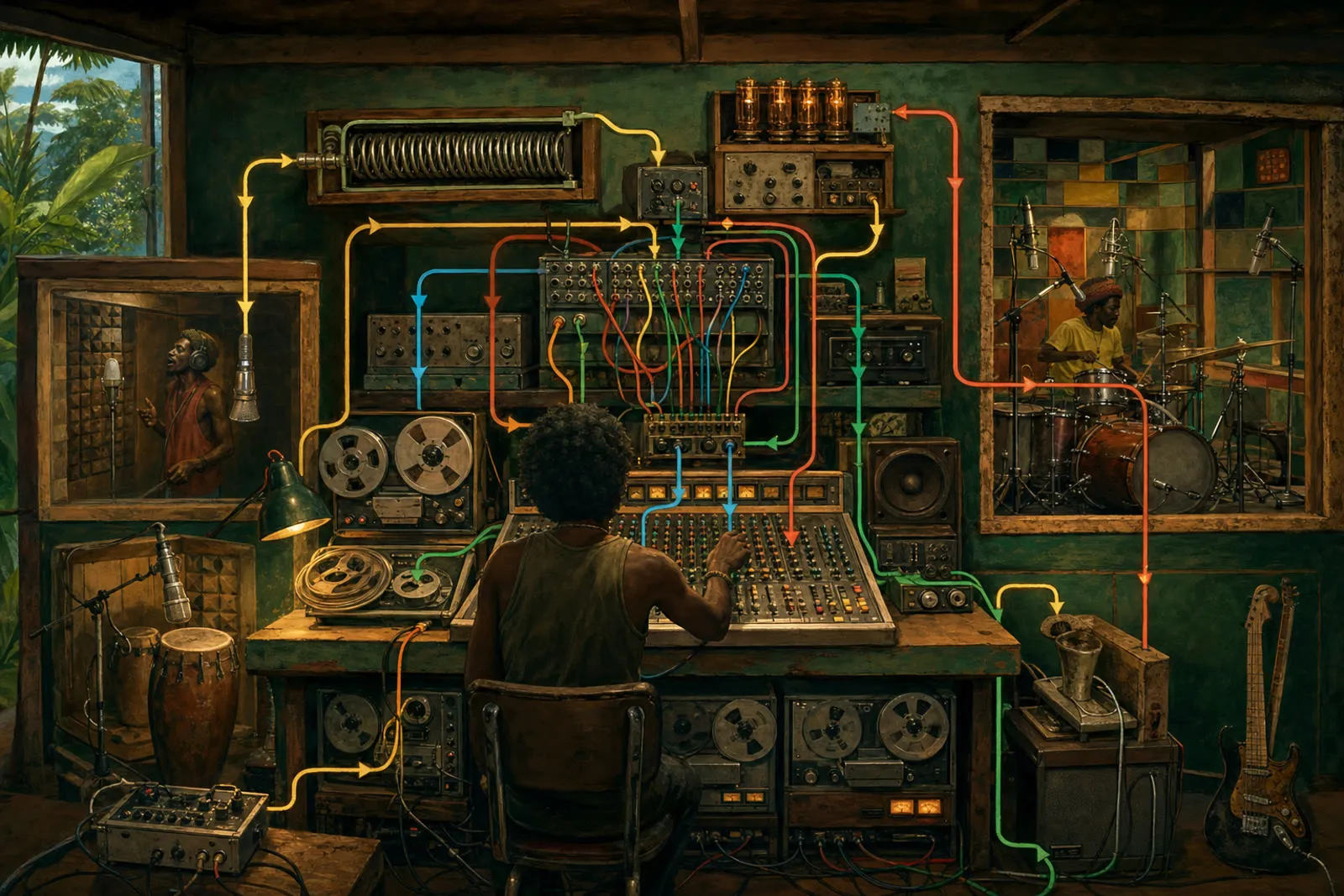


The Black Ark did not look like a facility built to defeat limits. Lee “Scratch” Perry constructed it behind his home in Washington Gardens, Kingston, and centered it on a four-track tape machine. Larger commercial studios could advertise more channels and cleaner separation. Perry’s room offered proximity, control, and time. A rhythm could remain available after the singer left. A recorded part could be copied, thinned out, sent through echo, or covered by another sound. The arrangement did not have to end when the musicians stopped playing. 3
That open-ended arrangement sits at the center of Perry’s work. Descriptions of him often begin with costume, prophecy, fire, or a list of aliases. He encouraged some of that theater. It can also hide the attentive producer who recognized a useful bass line, directed a session, controlled a label, and heard several possible records inside one performance. At the Black Ark, the mix was not a report on a finished song. It was another place to write the song.
Learning the record business from the floor
Rainford Hugh Perry entered Kingston’s recording trade before he owned a studio. He worked around Clement “Coxsone” Dodd’s sound-system and Studio One operation, doing tasks that placed him close to auditions, records, dancers, and the competition between mobile sound systems. The job taught more than microphone technique. A producer had to know which rhythm would hold a crowd, which singer could carry it, how quickly a new release could answer a rival, and where the money moved after a record was pressed. 4
Perry later worked with Joe Gibbs, then established his Upsetter imprint. The name made conflict into a business identity. His 1968 record “People Funny Boy” answered Gibbs directly and opened with the sound of a crying baby. The borrowed sound was not a decoration placed behind a complete band performance. It interrupted the normal scale of the record, announcing that anything captured on tape might become musical material.
The episode is sometimes treated as an isolated prehistory of sampling. It also shows how Perry listened: records were assembled objects. Voice, noise, rhythm, accusation, and label could be rearranged together. Long before the Black Ark, production already meant authorship through selection.
A band that could become several bands
The Upsetters were less a permanently fixed lineup than a production frame. Different musicians entered sessions, while Perry supplied direction and the records supplied a recognizable name. That flexibility suited Jamaica’s recording economy. A rhythm section could build the foundation for a vocal release, an instrumental side, and later versions. The identity lived partly in personnel and partly in the producer’s decisions.
Perry’s work with the Wailers around 1970 shows the value of that arrangement. Bob Marley, Peter Tosh, and Bunny Wailer brought songs and a developed vocal relationship. The musicians around Perry gave those songs a firmer, leaner setting. Records including “Duppy Conqueror,” “Small Axe,” and material collected on Soul Rebels joined close vocal harmony to rhythm tracks that left bass and drums unusually exposed. Perry did not manufacture the Wailers, and the Wailers were not passive voices for his method. The records came from a collaboration whose later ownership disputes should prevent a tidy mentor-and-student legend. 3
The sessions nevertheless established a durable principle: a producer could make space by removing as decisively as by adding. Guitar strokes became punctuation. Organ and piano appeared in separate pockets. Bass carried melodic weight without filling every frequency. That spacing would become crucial when a recorded rhythm was opened again at the mixing desk.
Building independence in the backyard
Perry opened the Black Ark in the first half of the 1970s. Locating it at home changed the working day. Studio time no longer arrived only in rented blocks under another owner’s clock. Musicians could gather, wait, test an idea, and return. Perry could keep the machinery near the ordinary traffic of his household and neighborhood rather than entering a sealed institutional room.
The equipment was modest but not primitive. Accounts identify a TEAC four-track tape machine, a compact Soundcraft desk, an Echoplex delay, a phaser, and spring reverb among the working tools. The exact inventory changed, and gear lists cannot reconstruct a sound by themselves. The important condition was routing: a signal could leave the straight path from microphone to tape, pass through an effect, feed back, and return with a different shape. 3
Four tracks demanded decisions. Several instruments might be recorded together or bounced onto a shared track to free space. Once combined, their internal balance could not be recovered like separate files in a digital session. Commitment created risk, but it also made the producer listen ahead. A new overdub had to justify the space it occupied.
Recording a room, not collecting clean parts
Black Ark records are often praised for atmosphere as if humidity simply entered the tape. The density was worked. Instruments leaked into microphones. Repeated transfers changed the tape. Effects accumulated noise and softened edges. Perry used those conditions rather than treating every trace of the room as an error.
This did not mean that any distortion was acceptable. Bass had to remain forceful; drums needed a readable pulse; a singer still had to hold the center of a vocal record. The roughness surrounding those elements made their placement more important. A small studio with limited tracks could sound deep when foreground and distance were actively managed.
Perry also brought non-instrumental sounds into the chain. Reports and session stories describe breaking glass, animal sounds, and other noises appearing in his productions. These details invite novelty lists, but their musical role depended on timing. A brief sound could mark a transition or disturb the listener’s sense of the room. The point was not that the producer owned unusual props. It was that the recorded environment remained open to events beyond the expected band setup.
The version as working method
Jamaican singles commonly paired a vocal side with an instrumental or altered version of its rhythm. Producers could reuse a successful foundation for another singer or a DJ’s spoken performance. This economy encouraged close listening to the rhythm itself. Once the lead vocal disappeared, a guitar accent that had seemed secondary might become the event around which a new mix turned.
Dub extended that practice. Faders could remove instruments in real time. Echo might catch the final word of a phrase after the dry voice vanished. Reverb could make one snare strike occupy a space larger than the original room. Bass and drums could remain nearly alone, then give way to a short burst of organ or horn. A mixer performed an arrangement from material already on tape. 6
King Tubby is central to this history, both as engineer and as an innovator whose mixes helped establish dub’s grammar. Perry’s contribution should not be inflated by erasing Tubby or the broader Kingston studio network. What distinguished the Black Ark was the continuity between tracking and transformation. Perry could organize the initial session with later versions already imaginable, then pursue them without leaving his own room.
Effects need hands
An echo unit does not decide which syllable deserves repetition. A phaser does not know when a guitar should lose its stable outline. The machinery offered possibilities; Perry’s timing turned them into form. He could send a signal into an effect for only a moment, change the return level, and withdraw it before the texture settled.
Faders, mute switches, equalization, and effect sends made the mixing desk a playable instrument during the pass. The resulting mix recorded those gestures. A different pass from the same tape could become another composition because the sequence of absences and returns changed. Tape Op’s interview with Perry returns to playback, replay, and feedback as a cycle rather than a final technical stage. 2
The method also depended on collaborators whose work is easily swallowed by the producer’s legend. Musicians supplied the resilient performances that could survive subtraction. Engineers and assistants maintained connections, operated machines, and helped sessions continue. Singers including Junior Murvin, Max Romeo, and the Congos brought voices and songs with their own histories. Perry’s authorship was real, but it was exercised through other people’s labor as well as electronics.
Voices that changed the architecture
On Junior Murvin’s “Police and Thieves,” the high, narrow lead vocal floats above a track whose bass and drums carry more physical mass. Perry’s production does not try to make every element equally large. The contrast is the arrangement. Small guitar and keyboard figures answer the voice while the rhythm continues with calm pressure.
The Congos’ Heart of the Congos required a different balance. Cedric Myton’s falsetto and Roydel Johnson’s lower register create a vertical vocal range, and the production builds an environment around that difference. Percussion, harmony, and reverberation do not merely thicken the songs; they change the apparent distance between voices. The Black Ark sound was therefore not one preset applied to every client. It was a set of ways to place a performance.
Perry could also become the voice inside his own productions. Spoken interjections, toasting, laughter, and sung fragments made the producer audible without requiring a conventional front-person role. His later stage persona expanded that presence, but it began with control of when a human voice entered and what authority it claimed.
Myth is not a technical explanation
Perry spoke through religious images, puns, curses, animal identities, and cosmic claims. Interviews could turn into improvised performances that resisted a reporter’s linear questions. Berklee’s 2020 conversation preserves that difficulty: he answers a question about building a new record from an old track by sounding out drums, guitar, and bass rather than offering a textbook definition. 1
Those answers belong to the artist’s method, but they cannot verify every disputed story. The destruction of the Black Ark is the clearest example. Perry gave different accounts of the studio’s decline and fire; other witnesses and retellings do not settle all details. Presenting one dramatic version as fact makes spectacle replace evidence.
The material record is clearer. By the end of the 1970s, the Black Ark had ceased to operate as the intensely productive studio heard on its best-known records. Business conflict, exhausting demand, damaged relationships, and deteriorating conditions all belong to the history. The loss matters without requiring a final scene in which madness explains everything.
Leaving the Ark without leaving the method
Perry continued recording and performing for decades after the Black Ark period. He worked with British and European producers, musicians from electronic and alternative music, and new studio systems. He was not the human extension of one vanished room. His method could travel because it was based on relations: rhythm against space, playback against revision, a voice against its echo.
Later collaborators sometimes rebuilt recognizable dub surfaces around him. The best work did more than imitate old tape noise. It allowed Perry’s live improvisation to redirect the session. Tape Op’s account of a modern recording encounter shows him turning an interview toward a possible song, collapsing conversation and production again. 2
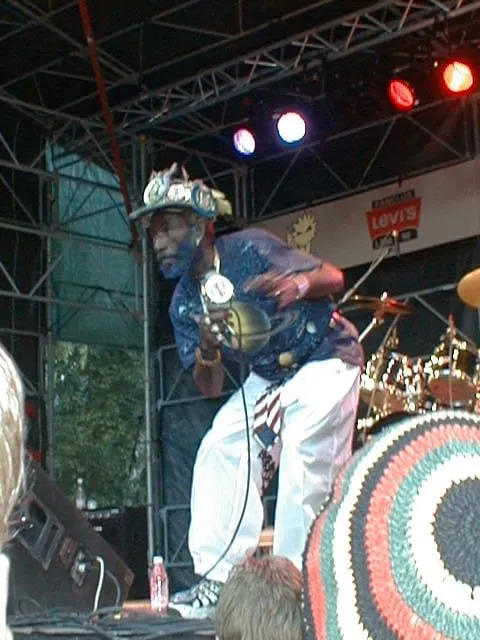
His public appearance also became a mobile artwork of written shoes, mirrors, jewelry, dyed hair, and altered objects. The images can look unrelated to the disciplined choices of the Black Ark. In fact, both practices refuse a clean boundary around the finished object. Clothing can be revised, language can be broken and recombined, and a released rhythm can return as another record.
What four tracks made necessary
It would be easy to turn the Black Ark into a lesson that cheap equipment is secretly superior. That is not what the records prove. Limited tracks can destroy a session as readily as they can focus it. Perry’s advantage was not scarcity alone. He combined ownership of the room, knowledge of the local record trade, strong musicians, and the judgment to commit sounds while possibilities were still open.
Four tracks made arrangement audible as a chain of choices. If instruments shared a track, their balance had to be decided. If a track was copied, the copy changed. If an echo was printed, it occupied space that could not later be made clean. These are not romantic imperfections. They are conditions under which Perry learned to make revision irreversible and still keep moving.
The result changed what a finished record could mean. A vocal release could remain the source for an instrumental, a DJ performance, or a dub in which absence carried the main drama. The original was not discarded, and the version was not merely leftover product. Each one demonstrated that the recording still contained unrealized form.
Listening after the legend
Perry’s influence is often described with a straight line toward remixing, hip-hop, post-punk, or electronic production. Some connections are documented through direct collaboration and listening; others become too broad to explain much. His records show repeatedly that recording could generate material rather than simply preserve it, and that mixing could carry rhythm, surprise, and authorship. 5
A bass line remains when the costume and smoke briefly recede. A vocal disappears before its echo does. One percussion strike exposes the depth of a room that did not exist in that form until the controls moved. Nothing mystical is required to hear the precision, though Perry’s own language refused to separate precision from spirit.
The Black Ark was a home studio, a workplace, a social room, and a damaged machine for making records. Its four tracks did not contain an infinite number of sounds. They forced choices about which sounds could share space and which could return in another version. Perry’s enduring invention was to treat those choices as musical events. The performance continued after the band stopped, because the mix was still being written.