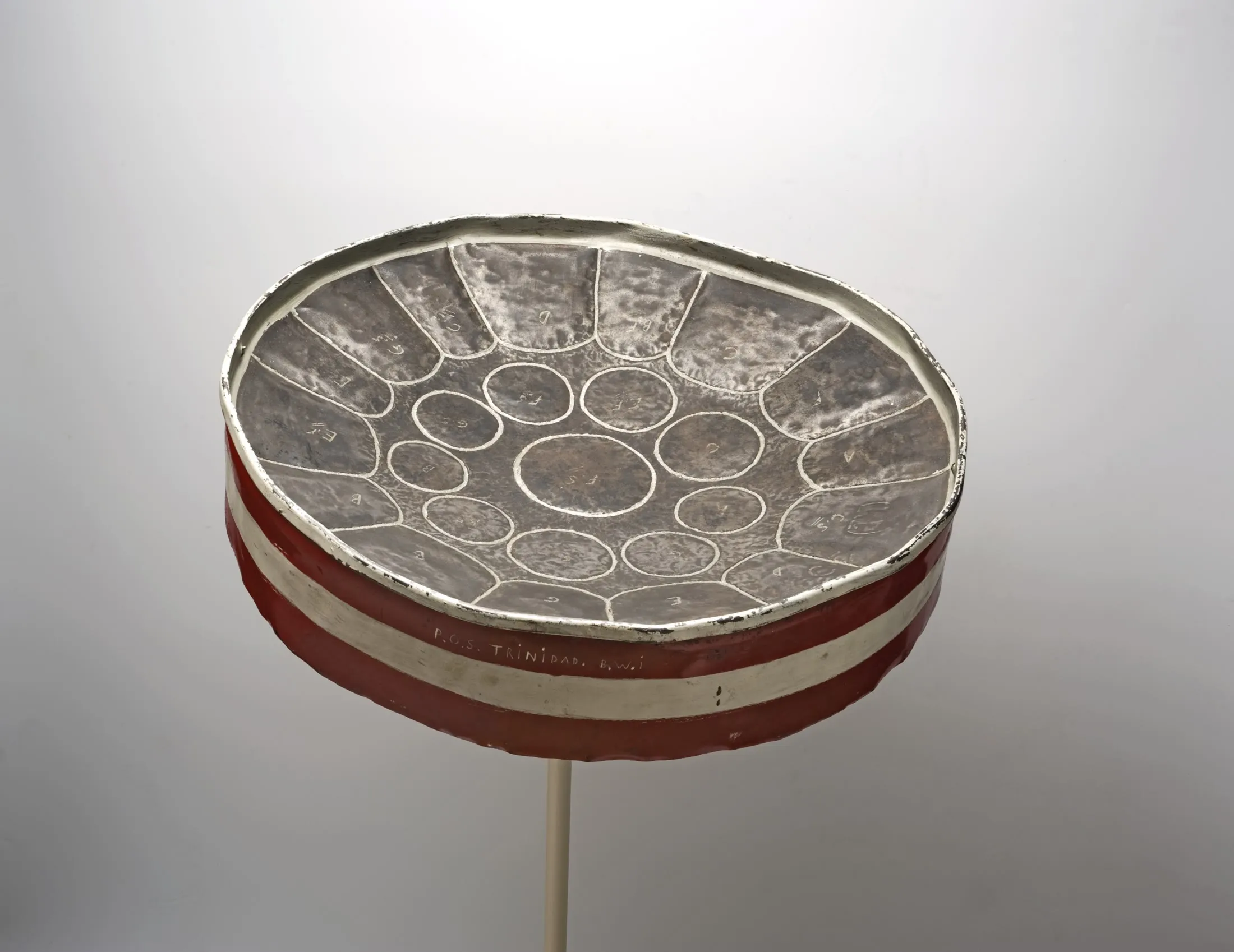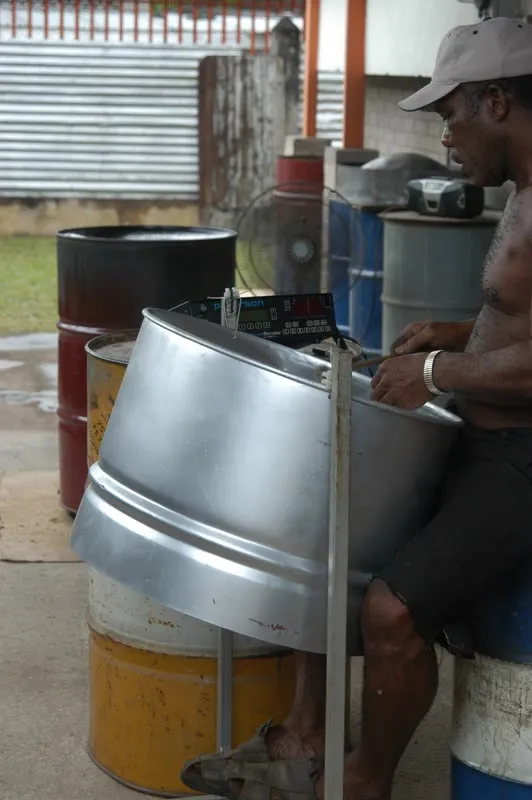

The steelpan does not hide how it was made. Its bowl carries hammer marks. Curved borders divide one sheet of metal into many notes. Short sides belong to high instruments; full-length barrels stand behind the band as basses. A player can see the problem that makers had to solve: how can one surface hold separate pitches, and how can those pitches become an orchestra?
The answer did not arrive as a single patent or a clean sequence of inventions. Steelpan developed through shared experiment in Trinidad and Tobago during the late 1930s and 1940s. Players, tuners, band leaders, arrangers, fabricators, and supporters changed the material and the organization around it. Competing accounts attach particular advances to different people. That uncertainty is part of the history. It describes a movement in which an improvement heard in one yard could become the starting point for work in another. 2 8
Before steel, the band was already organized
Steelpan did not begin with an empty oil drum. Carnival percussion in Trinidad had already been shaped by colonial restriction. In the late nineteenth century, authorities limited public drumming and other instruments. Tamboo bamboo ensembles answered with cut lengths of bamboo stamped on the ground or struck together. The sections were differentiated by register and task: higher sticks carried active patterns, midrange parts filled the center, and long boom tubes supplied low weight. Metal objects gradually joined this arrangement. When bamboo split and wore out, biscuit tins, brake parts, dustbins, and other containers offered louder and more durable surfaces. 1 2
The origin is more than a fable about waste material suddenly turning musical. The material changed, but the collective knowledge of how a procession balances high, middle, bass, and time was already present. Smithsonian ethnomusicology materials draw a direct line from the lead, midrange, and boom functions of tamboo bamboo to the later steelband family. The modern engine room—iron, congas, scrapers, drum kit, and other unpitched percussion—also preserves the principle that tuned pans do not have to carry every rhythmic job. 1 2 7
By around 1939, players were finding distinct pitches in metal containers. The first pans were not yet standardized instruments cut from identical 55-gallon drums. Makers learned that denting or raising an area changed its pitch and that several areas could coexist on one surface. Wartime Carnival restrictions interrupted the public festival, but experimentation continued. NALIS dates the first public Carnival appearance of steelpan to 1940 while also stressing that claims about a sole inventor remain contested. The rapid conversion of noisy metal percussion into a family of tuned instruments matters more than a winner’s name. 2
A note is a shaped part of the bowl
A steelpan note is not a key attached to a resonator. It is a region within the same continuous sheet as every neighboring note. The maker first sinks the drum end into a concave bowl. Note fields are then outlined, raised or flattened, and worked with hammers. Heating relieves some of the stress introduced by shaping. The skirt is cut to a depth suited to the instrument; a bass pan keeps much more of the barrel than a tenor. Paint or chrome protects the surface, but coating can shift the tuning, so the pan is checked again afterward. 5 6
Pitch depends on the field’s size, shape, curvature, and tension. Large areas support lower frequencies; small areas fit more high notes into a tenor bowl. The grooves around a field help define it, but they do not make it an isolated plate. Research using vibration measurements shows that energy is strongly localized in the struck note while some coupling remains across the surface. The skirt acts as an acoustic baffle, limiting cancellation between sound from the front and back of the bowl. These interactions help explain why a pan cannot be tuned by treating each outline as a separate metal button. 6
The tuner listens to more than the named pitch. Hammering at different parts of a field adjusts its fundamental vibration and selected higher modes. On many notes, an octave and another upper partial are brought into a useful relationship with the fundamental. That work gives the strike a definite center without removing its bright, complex attack. It is iterative: changing one mode can disturb another, and a blow intended to correct one field can affect its neighbors. The finished surface is therefore a record of controlled tension rather than a grid stamped to fixed dimensions. 5
The term “steel drum” can be misleading. The instrument begins with a drum-shaped container, but its playing logic is pitched and planar. A soft-tipped stick sets a local field vibrating; the bowl and skirt radiate the result. One surface acts like a compact map of resonators, each made through deformation rather than assembled from a separate bar, string, or pipe.
The stick is part of that acoustic system. Its rubber tip has to set the metal moving without choking the note or flooding the bowl with a hard click. Players alter attack through touch, rebound, and where they strike inside the field; tuners have to hear those ordinary playing conditions when they decide that an instrument is finished. Each note is more than a scale degree with metallic timbre. It begins as a brief impact and opens into several coordinated vibrations, which is why clean technique can sound both percussive and sustained. 5 6
One bowl could not cover the orchestra
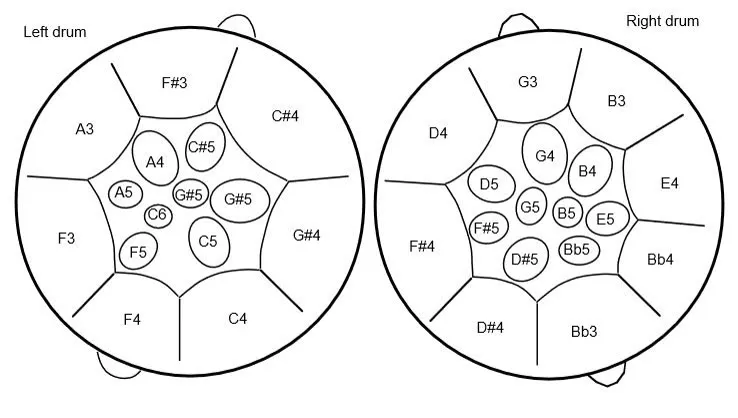
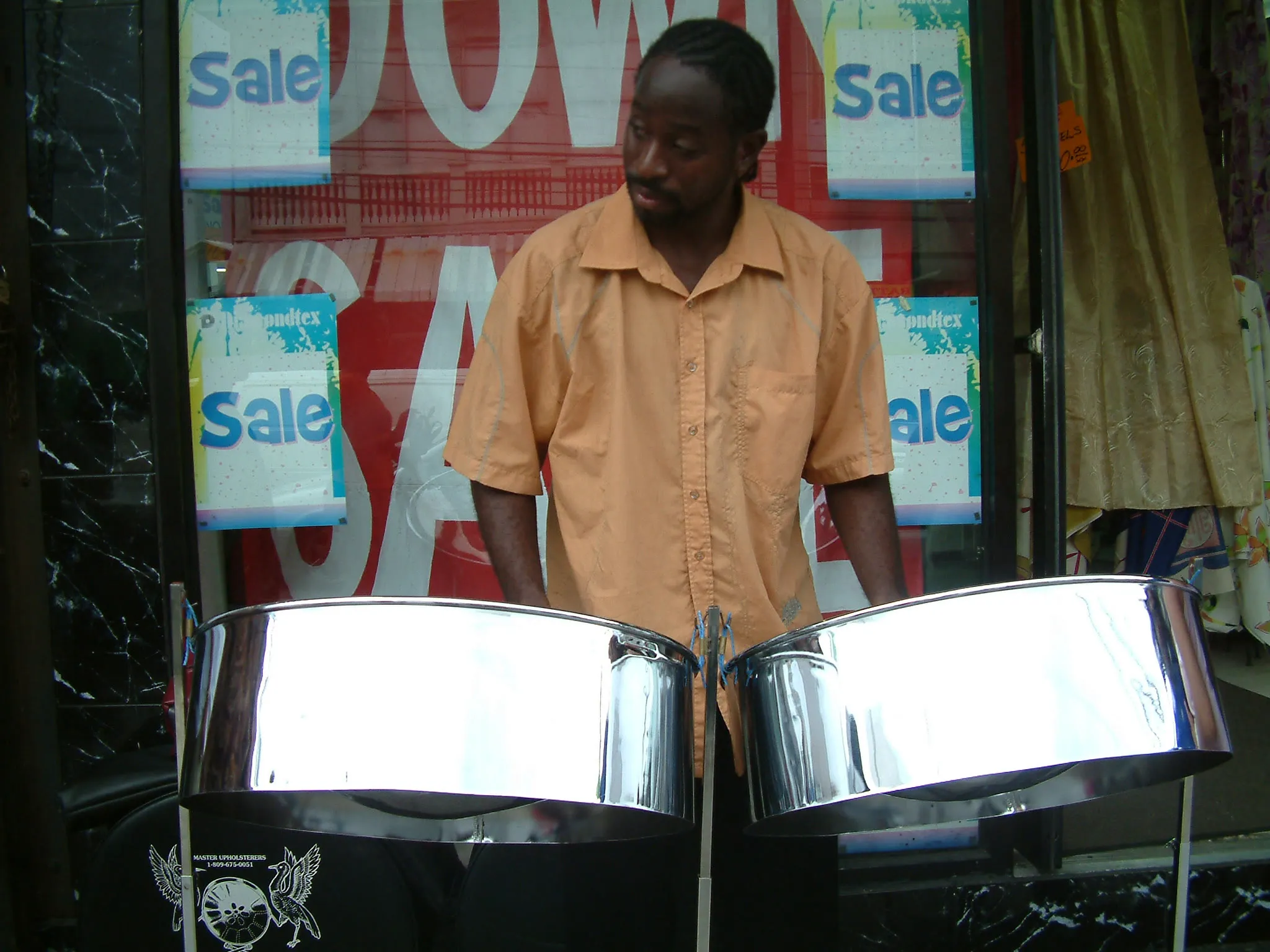
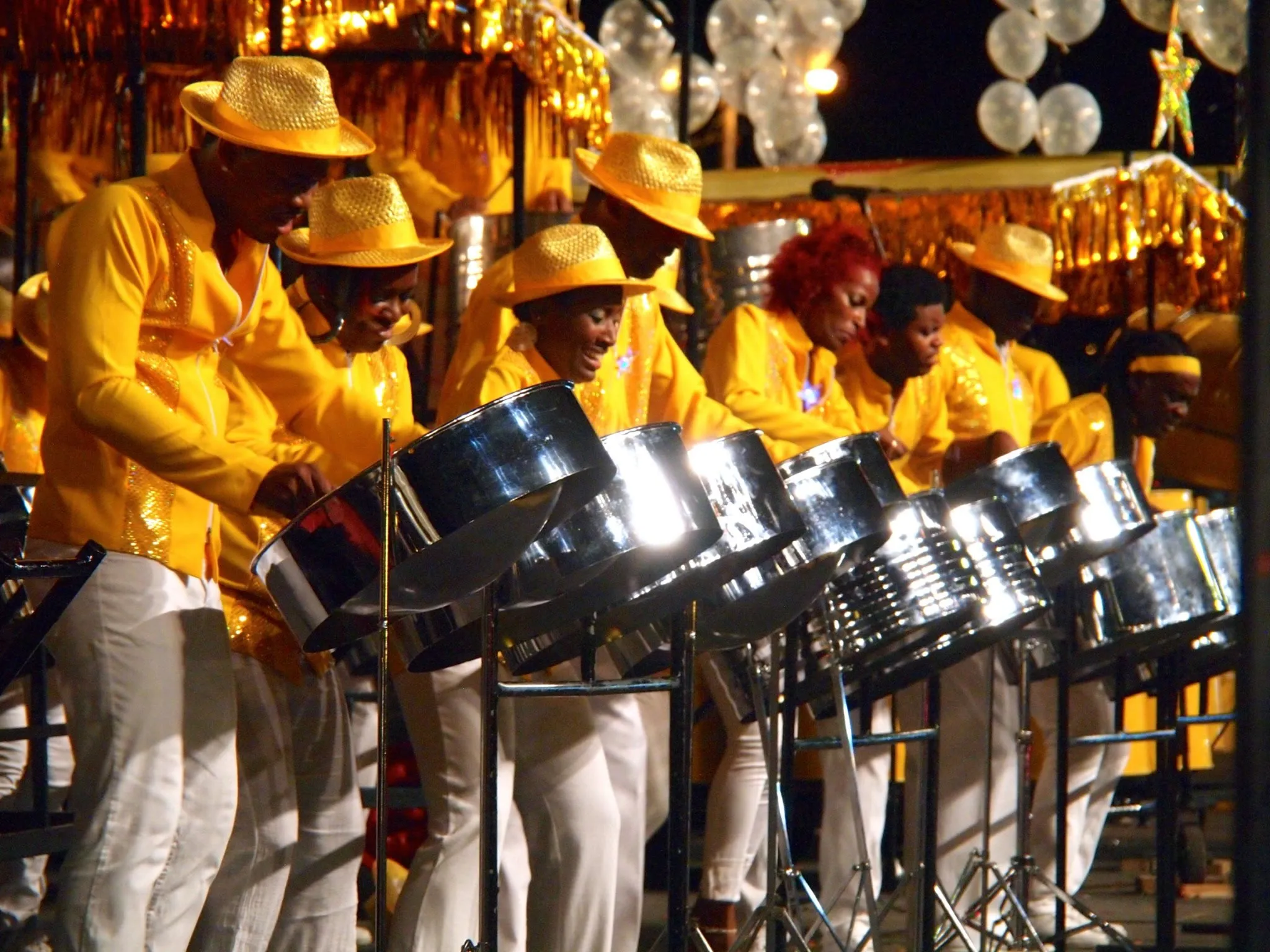
As tuners added reliable pitches, range became an organizational question. A tenor pan can carry a chromatic melody with roughly thirty compact note fields. Lower pitches require larger areas, so midrange instruments spread their notes across two, three, or four pans. Bass players may stand inside a semicircle of six or more full barrels, moving between a few large notes on each. The change in register produces a change in gesture: a tenor player’s hands travel within one bowl, while a bass line asks the whole body to turn through an array. 2 4
Different makers proposed layouts as well as ranges. Anthony Williams developed a tenor arrangement in which adjacent notes follow cycles of fourths and fifths, placing consonant relationships near one another and related octaves along radial paths. He also worked on bass design, stands, and the orchestra as a complete voiced system. Ellie Mannette, Winston “Spree” Simon, Neville Jules, Bertie Marshall, Rudolph Charles, and many others are connected to advances in sinking, stick design, harmonic tuning, new registers, amplification, and mobility. Assigning the finished instrument to any one of them erases the way their solutions accumulated, competed, and traveled between bands. 2 3
The Trinidad All Steel Percussion Orchestra, or TASPO, made the ensemble itself a development platform. Formed to represent the colony at the 1951 Festival of Britain, it brought leading players and tuners into one group. Williams was among them. UWI’s account describes the work around TASPO as a catalyst for an orchestra made entirely from oil drums, with bass chords distributed across multiple pans. The tour demonstrated that steelband could sustain arranged repertoire on a concert stage, but it also brought techniques from different Trinidadian bands into close contact. 3 8
Arrangement begins with allocation
A steelband does not imitate a symphony orchestra one instrument at a time. Its sections are built from related surfaces with different ranges, sustain, and physical demands. Tenors and double tenors often state melody or fast inner lines. Double seconds, guitars, and cellos can strum chords, answer phrases, or thicken a countermelody. Bass pans place a broad fundamental under the harmony. The engine room supplies an attack and rhythmic grain that the tuned bowls are not asked to reproduce. 2 7
For an arranger, the question is where a musical event should live. A calypso melody can pass from tenors to cellos and return in another register. A sustained harmony may be divided so that one section articulates repeated notes while another holds the bass movement. Rolls—rapid alternating strokes—extend a pan’s naturally decaying tone, but a roll is not neutral sustain. Its pulse remains audible and can intensify a chord. The arrangement therefore includes motion: mallets moving between fields, players turning between drums, and sections changing roles in view of the audience.
Panorama, inaugurated in 1963, concentrated this work into a major pre-Carnival competition. Large bands prepare extended arrangements of a selected calypso or soca piece, often rebuilding introductions, transitions, harmonic routes, breaks, and climaxes for their particular sections. Williams arranged the winning North Stars performances in the first two competitions. UWI describes those versions as a template for later Panorama arranging, where the tune remains identifiable while the orchestra demonstrates what it can do with it. 2 3
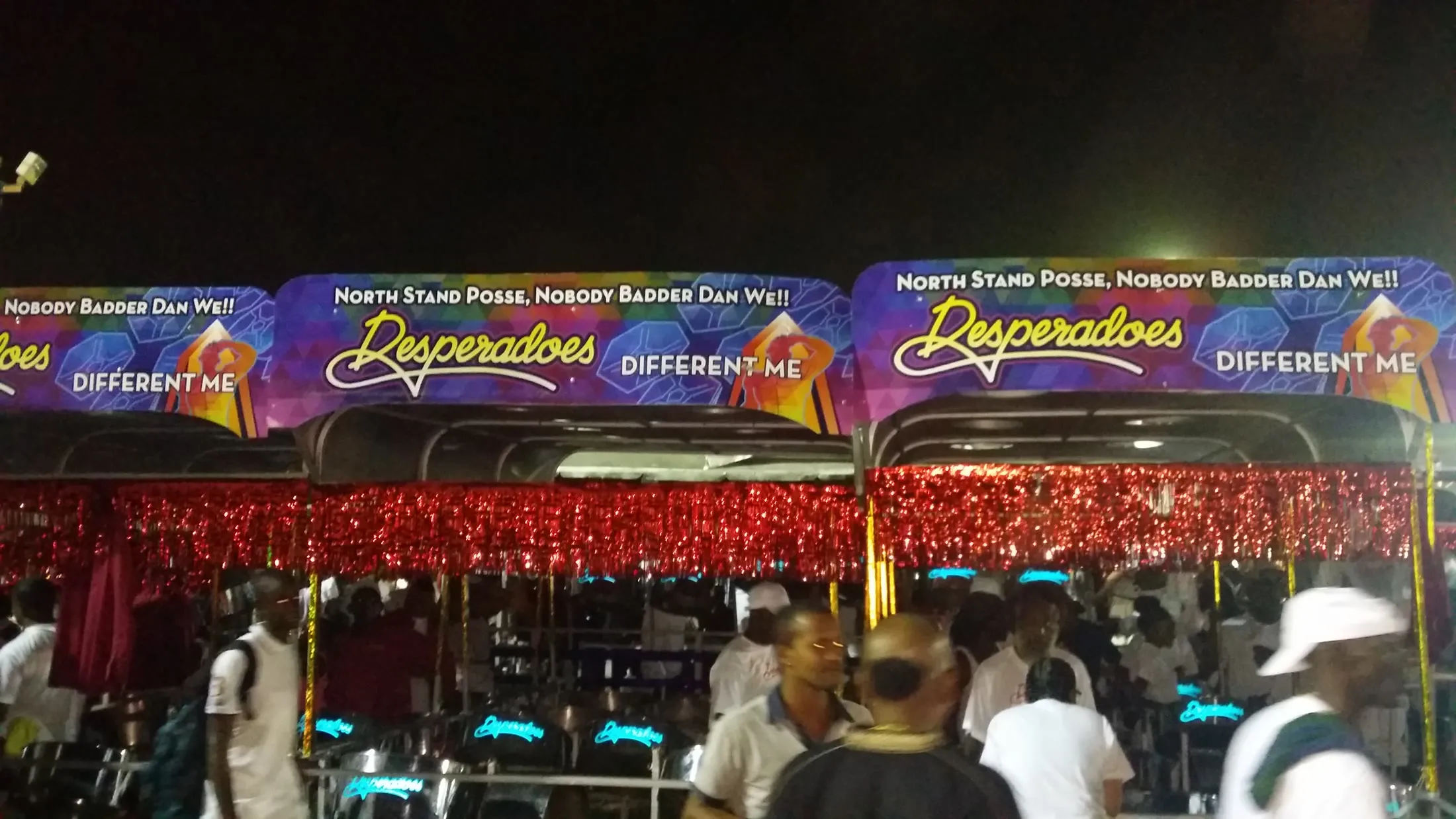
Competition did not remove the panyard from the music. Rehearsal still depends on section leaders passing parts to groups, tuners maintaining instruments, fabricators repairing stands, and supporters moving large racks. Sponsorship is visible on canopies and uniforms because a conventional steelband is also a logistical organization. The audience hears several minutes onstage; the arrangement contains weeks of repeated labor.
Recognition did not replace the workshop
Official descriptions now identify steelpan as the national instrument of Trinidad and Tobago. In 2024, the country’s Intellectual Property Office registered a geographical indication administered by Pan Trinbago, tying the protected designation to instruments made in Trinidad and Tobago under defined standards. The move recognizes that the value lies not only in the noun “steelpan” but in locally developed methods and knowledge. 4 9
Recognition can flatten a difficult history if it presents the instrument as an inevitable national symbol. Early bands faced class stigma, policing, conflict, and pressure to prove that pan belonged in formal music. The later concert platform and competition stage did not simply rescue a rough object. Pan communities had already built systems of training, rivalry, repair, arrangement, and mutual recognition. National status followed that work. 1 2
Nor has standardization ended invention. Makers use different drum stock, sinking methods, note geometries, coatings, and tuning practices. Researchers can model curvature and measure vibration, yet the acoustics of a stressed, hand-shaped bowl remain difficult to predict completely. The scientific description does not make the tuner obsolete; it shows how much linked information the tuner controls by ear and hammer. 5 6
Listen across the family
Begin with one tenor phrase and follow its transfers. When the melody moves down, notice whether a cello gives it more body or a bass turns its contour into harmonic direction. Listen behind the tuned parts for iron and percussion, especially when a break removes the engine room and then restores it. During a roll, hear the individual attacks inside the apparent sustain. On a final chord, separate the bright edge of the tenors from the wide low fields that take longer to speak.
The steelpan’s history is audible in those allocations. Tamboo bamboo survives as an idea of sections and register. The oil drum survives as bowl, skirt, and constraint. The workshop survives in the tuning of each partial. Carnival survives not as a colorful background but as the recurring public system that demanded volume, mobility, rivalry, and new arrangements.
Like Fela Kuti’s Africa 70 in The Band Was the Arrangement, a steelband makes authorship distributed and exact. No single part contains the whole method. The orchestra exists because makers, arrangers, and players keep deciding how one material should divide its labor.