
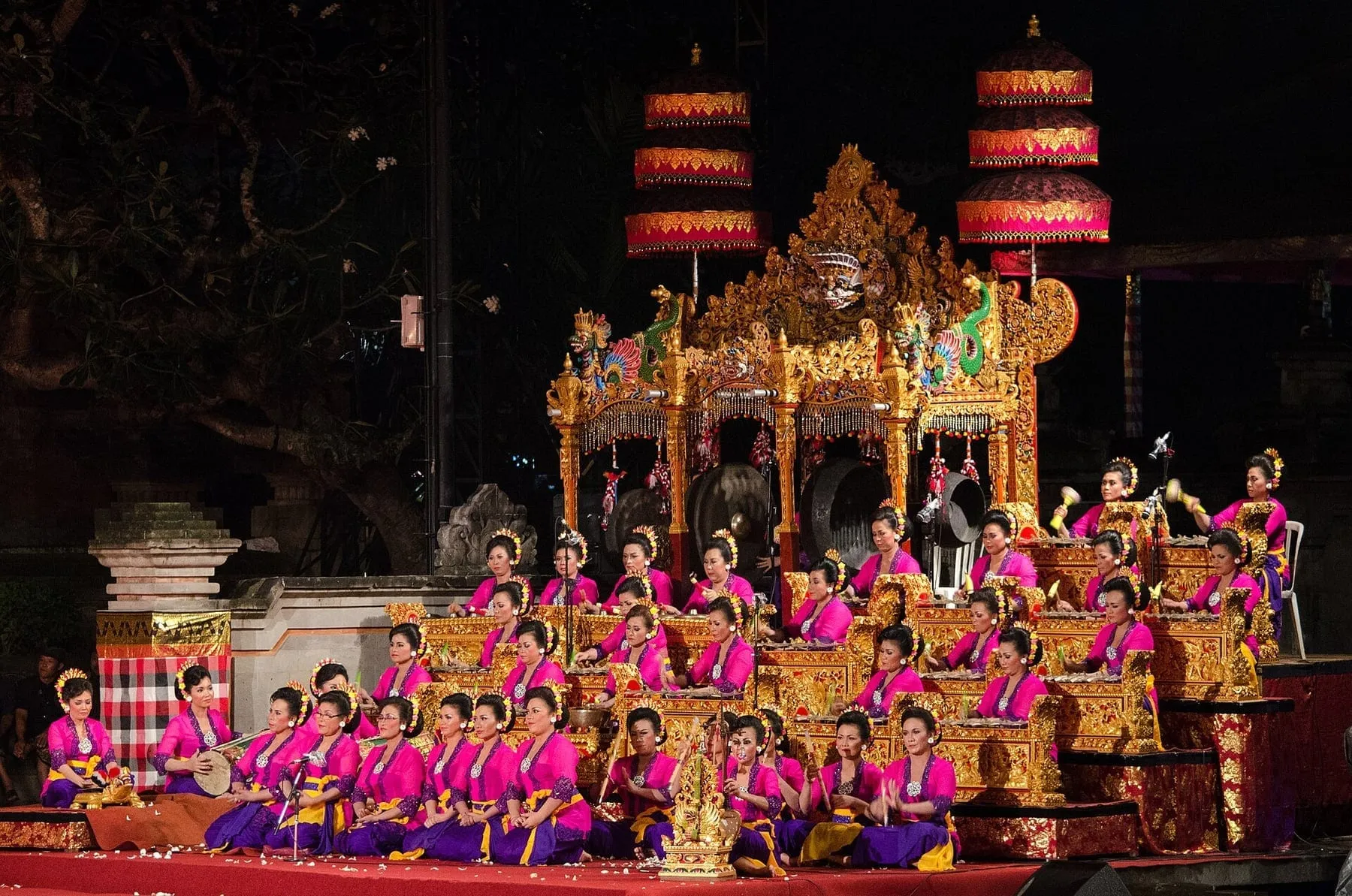
A gong kebyar begins before anyone strikes a key. Its bronze instruments already hold a relationship: many of the metallophones are made and tuned as pairs. Corresponding keys do not sound at exactly the same frequency. One instrument sits slightly lower, the other slightly higher. When players strike them together, their vibrations alternately reinforce and weaken each other. Together they produce ombak, a regular beating or wave in the combined sound. What can seem like a bright halo around one pitch is therefore the audible work of two pitches meeting. 4 7
The wave depends on a complete set. Its builders do not make a neutral inventory of instruments that can be replaced one by one from a universal catalog. They establish tuning relationships across registers, match resonators to keys, and decide how quickly paired tones should beat. Musicians then learn to place attacks, damping, interlocking parts, gong strokes, and drum cues inside that particular sound. The orchestra is built into the relations among its parts.
Gamelan gong kebyar is a large five-tone bronze ensemble that developed in north Bali in the early twentieth century. Bali also sustains older and newer gamelan types with different scales, instrumentations, ceremonial uses, and local histories. “Gamelan” does not name one fixed tuning or one unchanging style. Gong kebyar is a specific, influential answer to a broader question: how can an ensemble make extreme speed and contrast sound coordinated rather than crowded? 1 5
One tuning belongs to one set
A gong kebyar commonly organizes five pitches drawn from the seven-tone pelog system. Those pitches are not calibrated against equal-tempered piano keys. Nor does every ensemble have to agree on one absolute frequency for a given scale degree. The intervals and overall register can differ from set to set. A melody moved to another gamelan may therefore retain its contour while meeting a different field of exact pitches. The identity of a composition survives without requiring the tuning to become standardized. 4 6
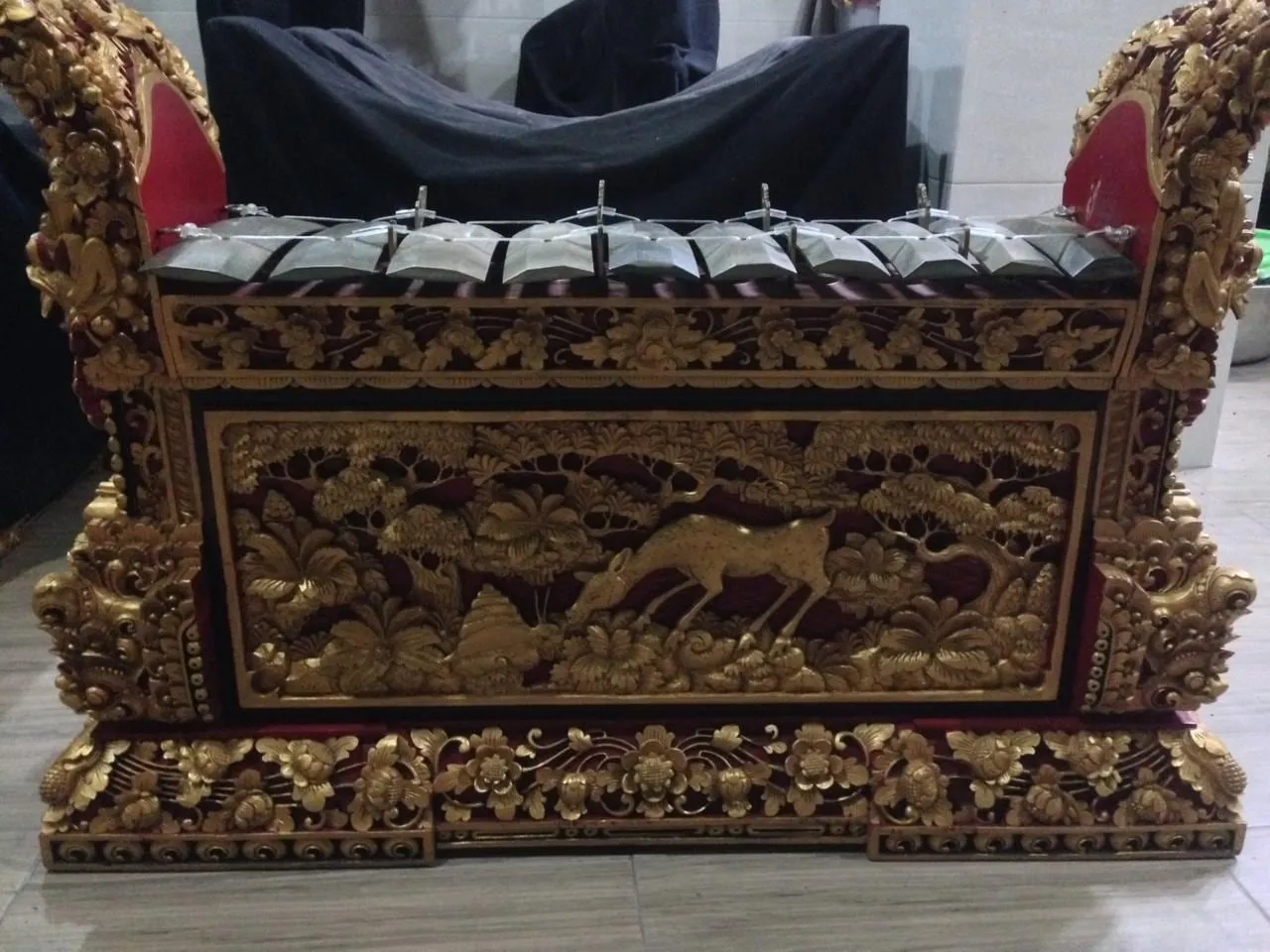
The instruments are cast and adjusted with that whole field in mind. A gangsa metallophone suspends bronze keys over tuned bamboo resonators. Removing metal from a key changes its vibration; adjusting a resonator changes which frequencies it supports. The maker must listen across several dimensions at once: the pitch of one key, its relation to the rest of the scale, its partner in the paired tuning, the register above and below, and the desired speed of the beating. Finishing a key in isolation would leave most of the musical problem unsolved.
Paired instruments are often described as pengumbang and pengisep. The lower member of the pair supplies one side of the wave and the higher member the other. The size of the gap determines the rate of ombak: bring the frequencies closer and the wave slows; move them farther apart and it quickens. Gong kebyar sets often use a conspicuous, active beat, while other Balinese ensembles may favor a different rate. The Smithsonian account of Balinese tuning practices stresses that these rates vary by gamelan type rather than serving as one rule for the island. 4
Octaves introduce another decision. If every paired instrument maintained the same difference in hertz across the full range, the interval would occupy a larger share of a low pitch than of a high one. Tuners can stretch or compress octave relationships so the ensemble balances pitch centers, beating rates, and the inharmonic spectra of bronze keys. This is not an imperfect copy of a Western octave. The tuning space follows the acoustic material and the ensemble’s desired motion. 4
A struck key must also be stopped
Bronze sustains. That quality creates the radiance of a gamelan, but it can also blur a fast passage. Gangsa players therefore divide labor between the hands. One hand strikes a key with a hard mallet. The other damps the previous key, usually at or just after the next attack. If the damping arrives too soon, the phrase loses resonance and weight. If it arrives too late, adjacent notes accumulate into a wash. Clean playing depends on shaping the end of each sound as deliberately as its beginning.
This technique turns a line into alternating gestures: strike, release, damp, move. A player has to know what the partner is doing and what the paired instrument is contributing to the wave. The audible note does not belong to a single hand. It includes the second player’s neighboring pitch, the resonators beneath both sets of keys, and the precise moment when each vibration is stopped.
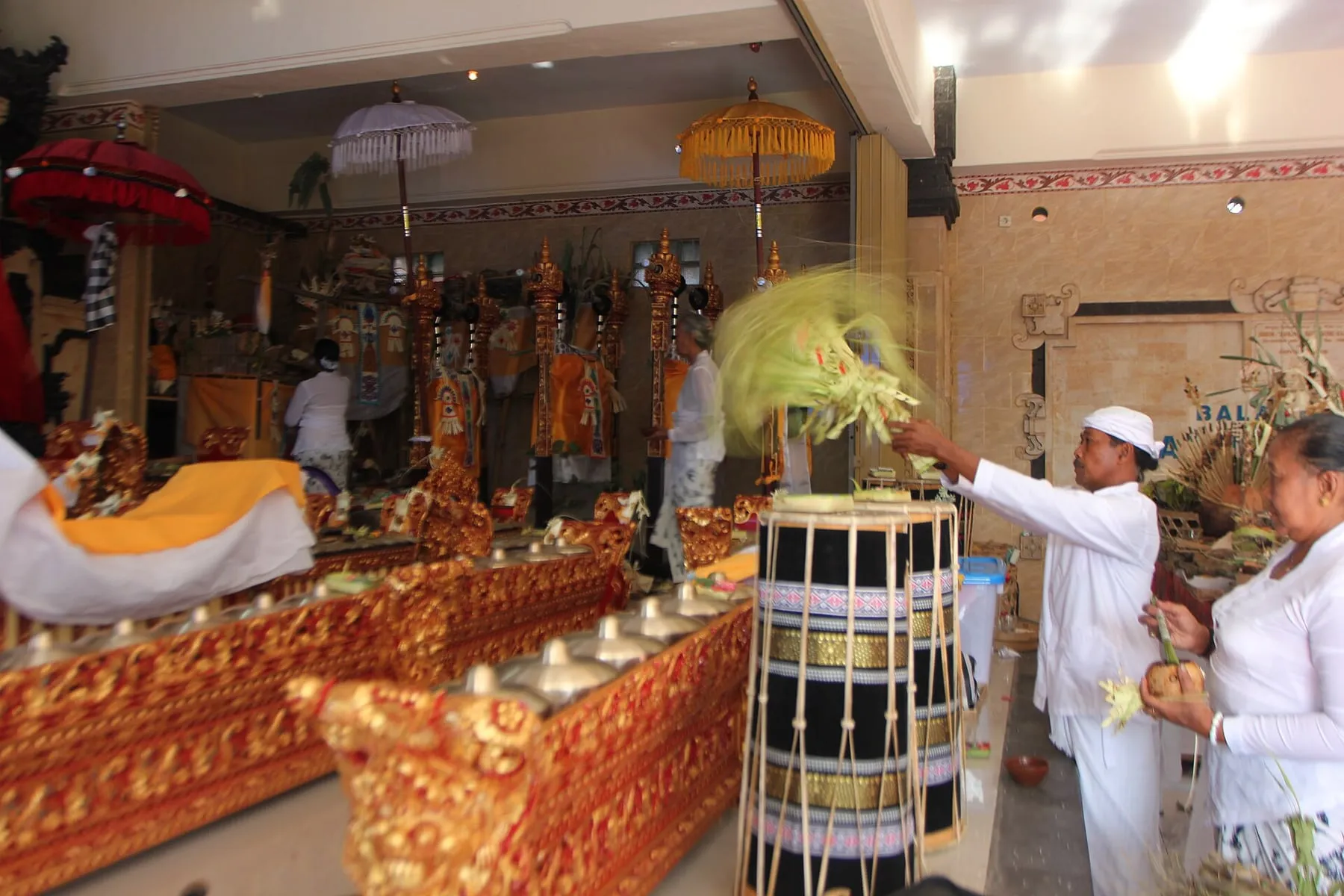
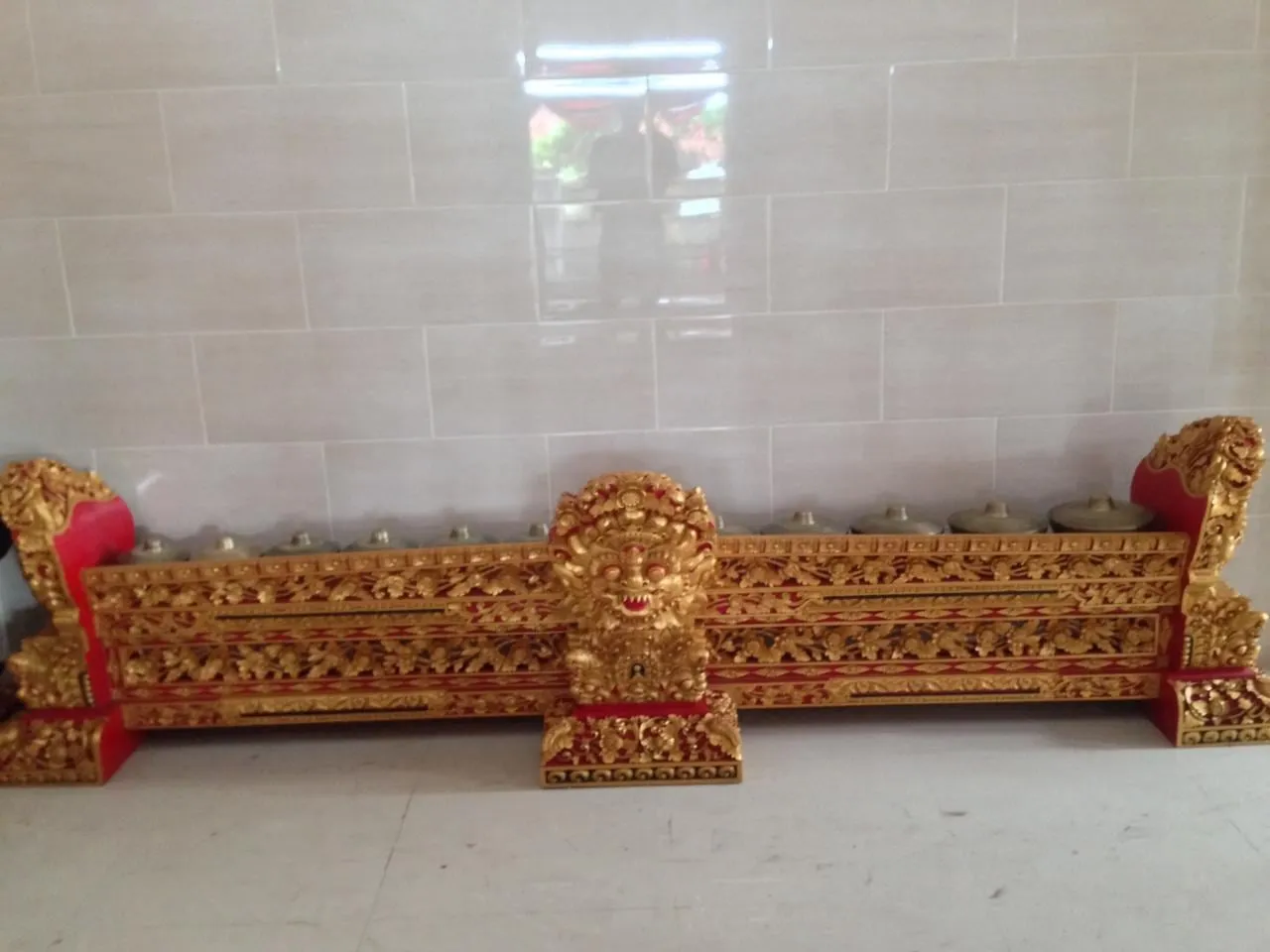
Different registers give that work different scale. The pemade and kantilan carry active figuration on compact keys. Lower metallophones use larger keys and move through slower parts. The reyong places a row of knobbed kettle gongs in one long frame and can be shared by several players. Its patterns pass across both the bronze row and the bodies seated behind it. Instrument design makes coordination visible: a phrase may travel because four people divide a line that no one of them plays alone. 3
Interlocking makes another tempo possible
Kotekan is often translated as interlocking figuration. Its defining feature is the division. One player performs a pattern with spaces; a partner performs a complementary pattern that enters those spaces. Heard separately, each part is incomplete. Heard together, the attacks form a denser line that can move faster than either player could produce alone with the same articulation. Smithsonian Folkways describes some kebyar passages as physically dependent on this cooperation between paired players. 2
The parts are not simply odd and even notes assigned by a machine. Patterns can cross, repeat asymmetrically, change direction, or momentarily converge. Their accents have to fit a larger melody and the changing energy of the composition. Players learn not only a sequence of strokes but the location of their partner’s strokes around it. Precision comes from hearing the composite line while performing only one of its components. 6
Kotekan also depends on damping. A rapid alternation would lose its contour if every key continued ringing at full strength. Each player clears space for the next attack while allowing enough resonance for the paired tuning to remain audible. Speed, timbre, and silence become the same technical problem. The ensemble’s brilliance does not result from unrestricted ringing. It is produced by many short decisions about what may continue.
The reyong extends the principle. Players share adjacent ranges of kettle gongs, but the musical boundary does not have to stop where one person’s physical reach ends. Patterns can be handed across positions or distributed so the line seems to occupy the whole instrument. The frame is one object, the hands are several, and the listener receives a single moving surface.
Gongs make a frame for the detail
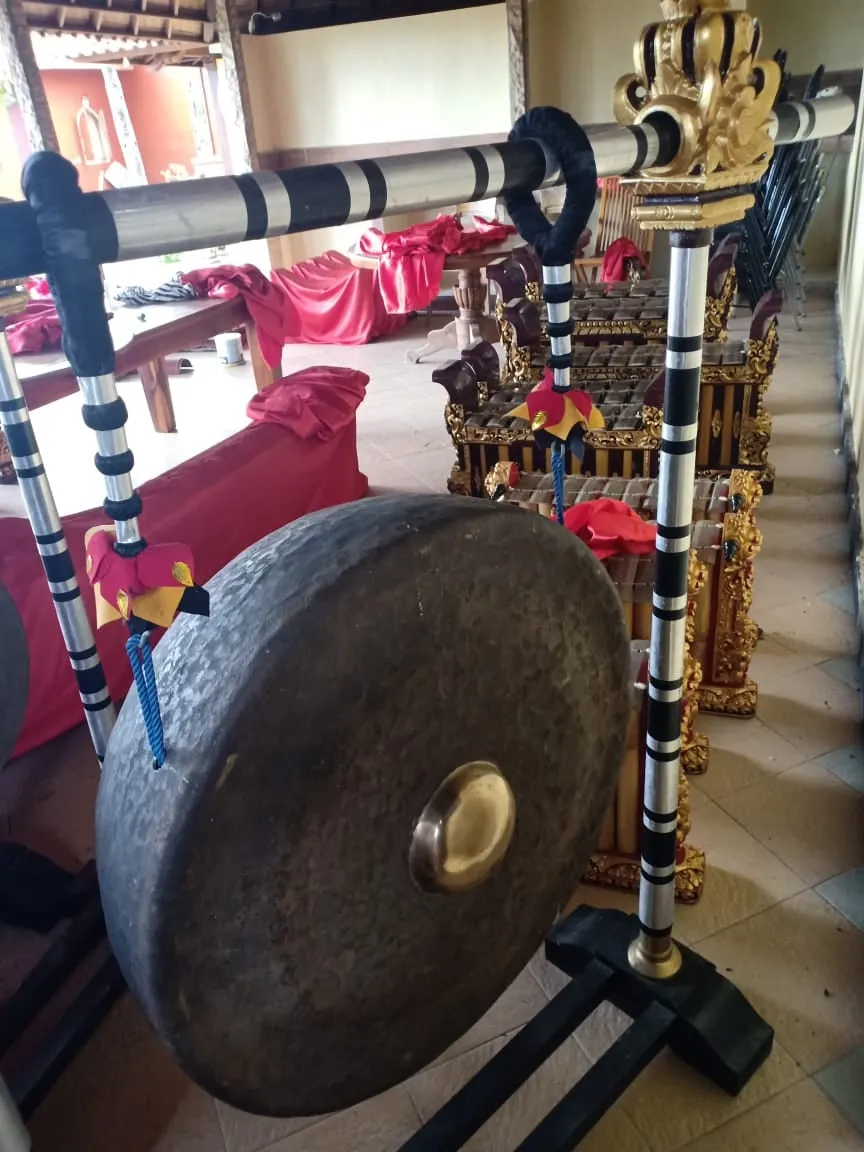
Fast ornament needs slower points of reference. Large suspended gongs and horizontally resting kettle gongs mark levels of the musical cycle. Their strokes do not behave like a continuous bass line beneath a melody. They arrive at structural points, dividing and confirming spans of time. A listener can hear the return of a large gong as both an ending and the start of another cycle. Between those arrivals, smaller gongs articulate shorter units. 3 6
Layered timing lets several speeds coexist. High metallophones may interlock in quick subdivisions while lower instruments carry a more stable melodic outline. The gong structure moves at a broader scale. Cymbals add sharply defined attacks, and flutes can draw a sustained line through the bronze decay. No layer has to imitate every other layer to belong to the same form.
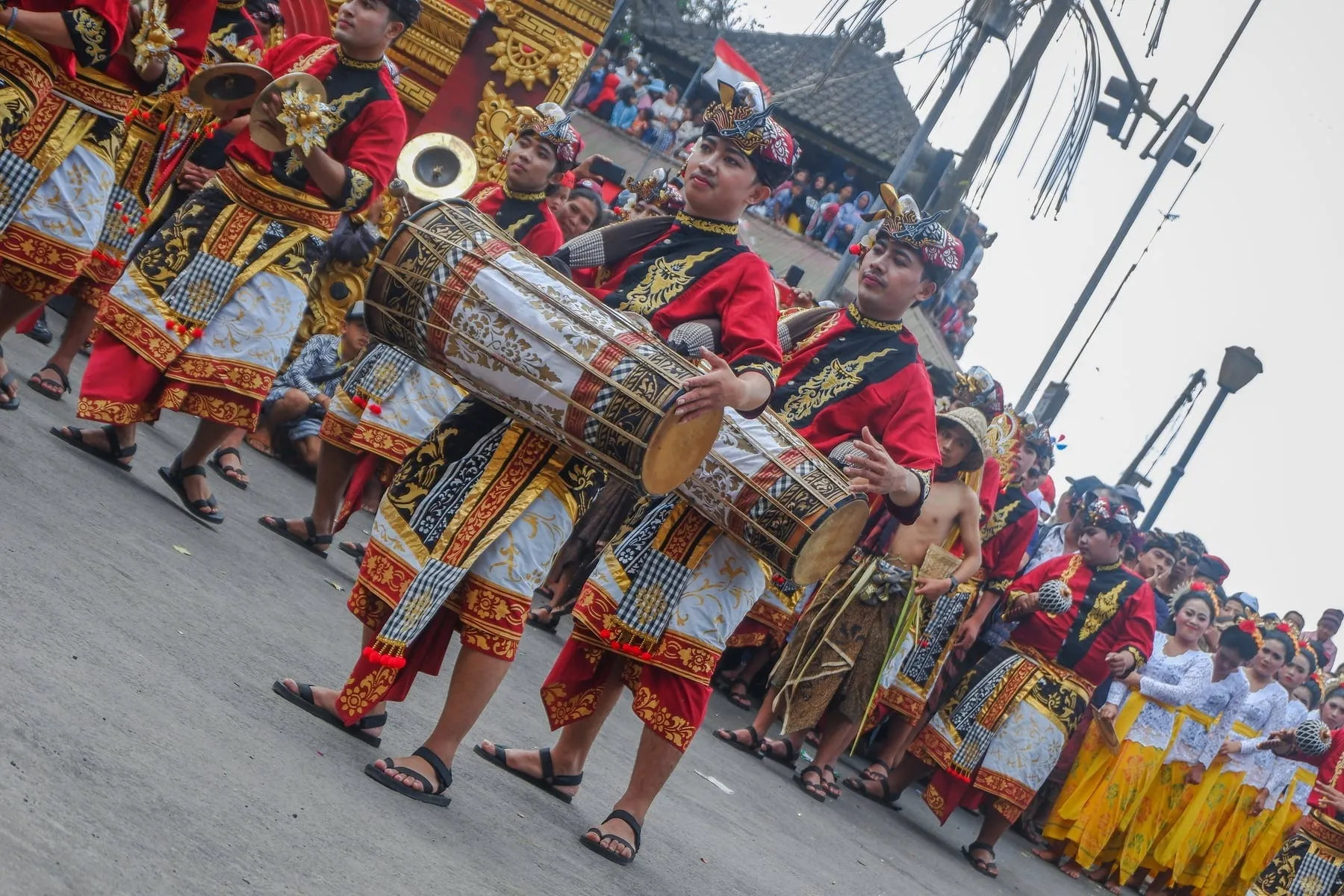
The kendang drummer connects those levels to change. Drumming sets tempo, shapes transitions, answers dance movement, and signals sudden breaks or coordinated attacks. In kebyar, leadership is not a conductor’s silent gesture placed outside the sound. It is a rhythmic voice within the ensemble. The other players have to recognize a cue through its stroke pattern, weight, and placement, then change together. Tenzer’s study treats drumming as both leadership and style because the cue cannot be separated from how it is played. 6
The instruments organize people too
Gong kebyar emerged in north Bali around the 1910s, but surviving accounts do not support a single uncontested birthday or inventor. Smithsonian sources describe claims ranging across several northern villages and dates around 1913 to 1915. What is clear is the speed of the form’s spread. Its abrupt changes, forceful attacks, dynamic range, and virtuosic interlocking offered a new musical language, and ensembles across Bali adopted or refashioned instruments for it. 1 5
That refashioning had consequences. Bronze is valuable, and an older set could be melted and recast rather than kept beside the new one. The rise of kebyar therefore did not simply add another style to an untouched archive. It changed which instruments remained active, which repertoires were taught, and which sounds communities could perform. Later revivals of older ensemble types show that this history did not move in only one direction.
The orchestra requires a social unit as well as bronze. Smithsonian’s notes connect village banjar organizations with musical groups that maintain instruments, rehearse, and perform together. A gamelan needs storage, repair, tuning, teaching, transport, and time. Its size makes private ownership by one virtuoso a poor model for understanding how it continues. The set concentrates collective resources, and the music returns that investment as coordinated public work. 2 3
Competition and exchange also shaped kebyar. Ensembles listened to rivals, memorized new patterns, and developed displays of speed and contrast. Dance entered the form early and changed how accents, pauses, and sudden turns were organized. This was not a sealed ritual music protected from invention. It was a modern Balinese practice made through argument, borrowing, rehearsal, local distinction, and the pressure to play something another group could not yet play. 5
The shimmer is an agreement
The defining sound of gong kebyar is easy to describe vaguely. “Shimmering” can become a decorative word that leaves the work hidden. Paired tuning gives it a mechanism. Bronze keys at neighboring frequencies produce audible waves. Tuners coordinate those waves across a set. Players place interlocking attacks inside them and use damping to keep the surface articulate. Gongs reveal the long cycle; drums change its pressure and direction.
Every stage depends on relationships that cannot be supplied by one object. The maker hears a key against its partner. The player hears one part against the missing strokes of another. The drummer turns a pattern into a cue because the ensemble knows how to answer. The community keeps a tuned set together long enough for those agreements to become musical knowledge.
Substituting a single “correct” scale for Balinese tuning would remove more than local color. It would erase the decisions that make a particular gamelan cohere. The orchestra is tuned in pairs, but the pairing is only the beginning. Its sound comes from a larger practice of building difference carefully enough that many players can move as one.