

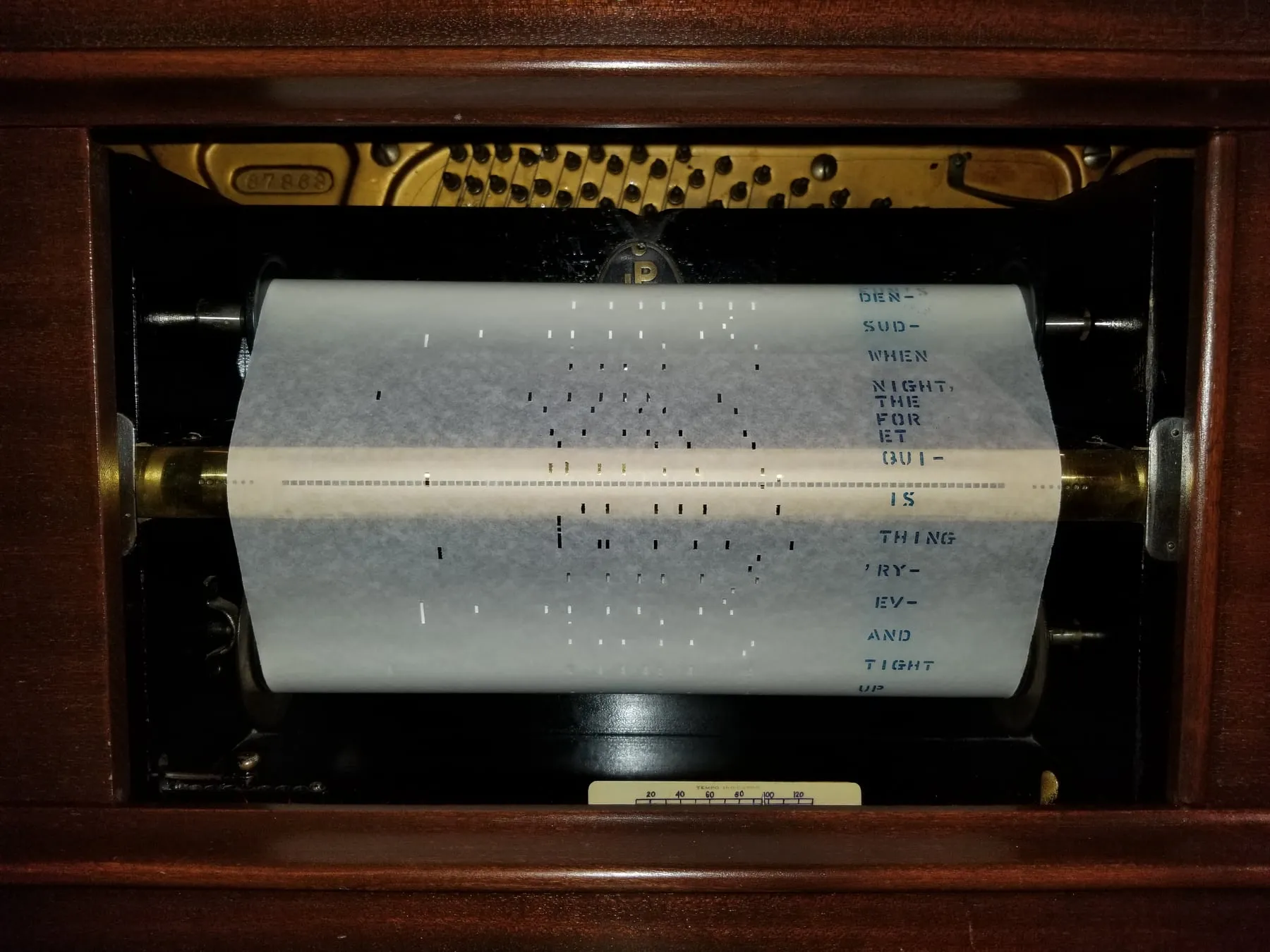
A piano roll looks readable until a person tries to read it. Holes form vertical clusters and long broken lines across a spool of paper. Printed words may run down the center, while arrows and instructions ask for changes in tempo or loudness. The page resembles notation only at a distance. Its actual reader is a tracker bar: a row of ports that detects when a moving hole opens an air path. 1 2
The difference between human- and machine-readable music reached the law. In 1908, the United States Supreme Court held that a perforated roll was not a copy of a musical composition under the law then in force. It was a component of a machine, unintelligible as music to the eye. Congress answered in 1909 by bringing mechanical reproductions into copyright law and creating a compulsory license. A strip of paper had exposed a gap between music as something people could read and music as instructions a machine could execute. 2 3
The roll did not make the piano electronic. Strings, hammers, soundboard, pedals, and room remained acoustic. It inserted a programmable layer between a composition and the keys. Paper controlled when the mechanism should act; air pressure supplied motion; the piano turned that motion into sound. Depending on the system, a person still pumped, shaped, and corrected the result. The performance was distributed across code, mechanism, instrument, and operator.
The player first stood outside the piano
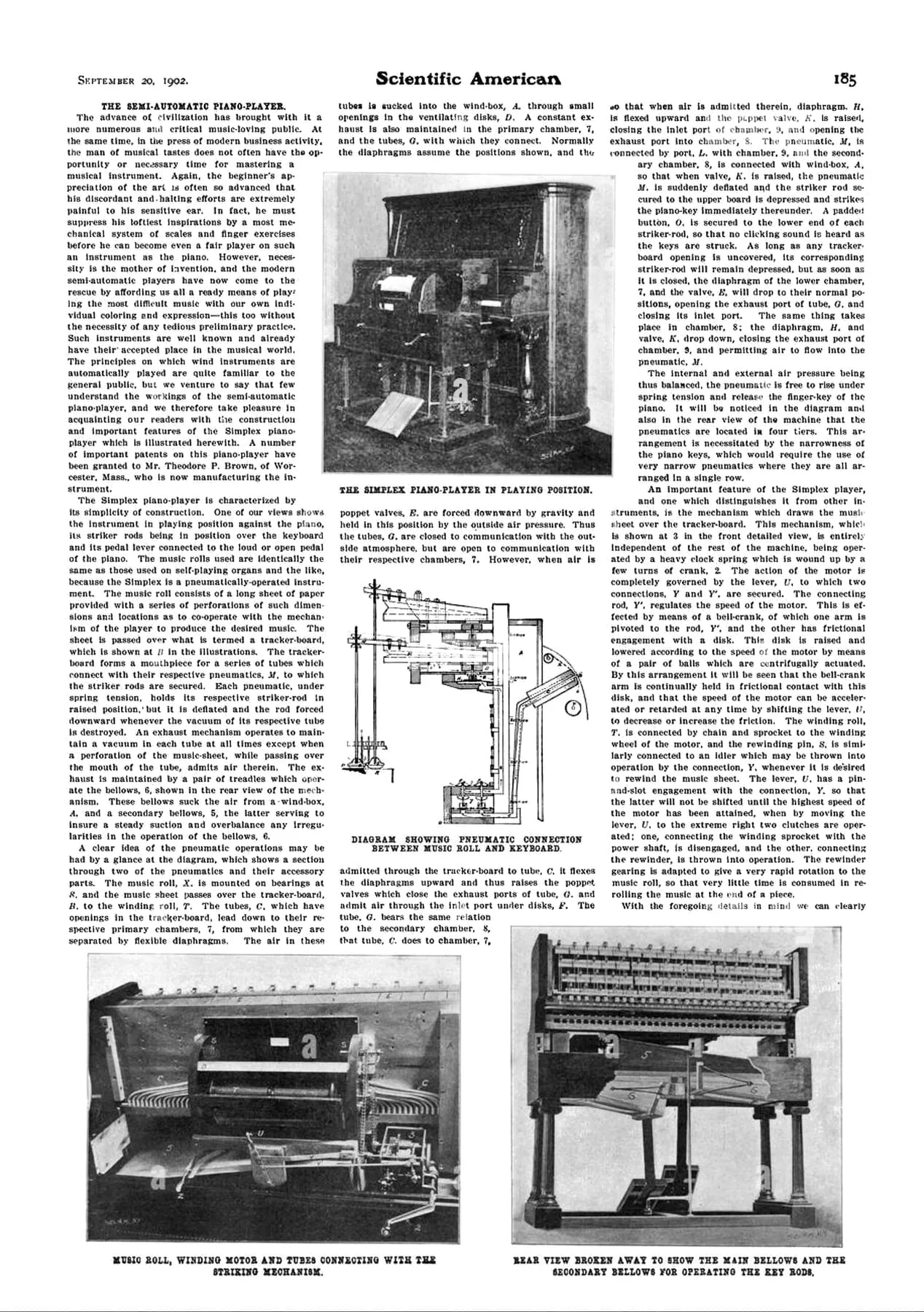
The names are confusing because the machinery changed position. Late nineteenth-century “piano players” were cabinets rolled up to an ordinary piano. Felt-covered mechanical fingers sat over the keyboard, and a lever reached the sustain pedal. The cabinet read the roll and physically pressed the same keys a pianist would use. Photographs make the arrangement look awkward, but its logic was practical: the owner did not need to replace the piano to add mechanical playback. 1 8
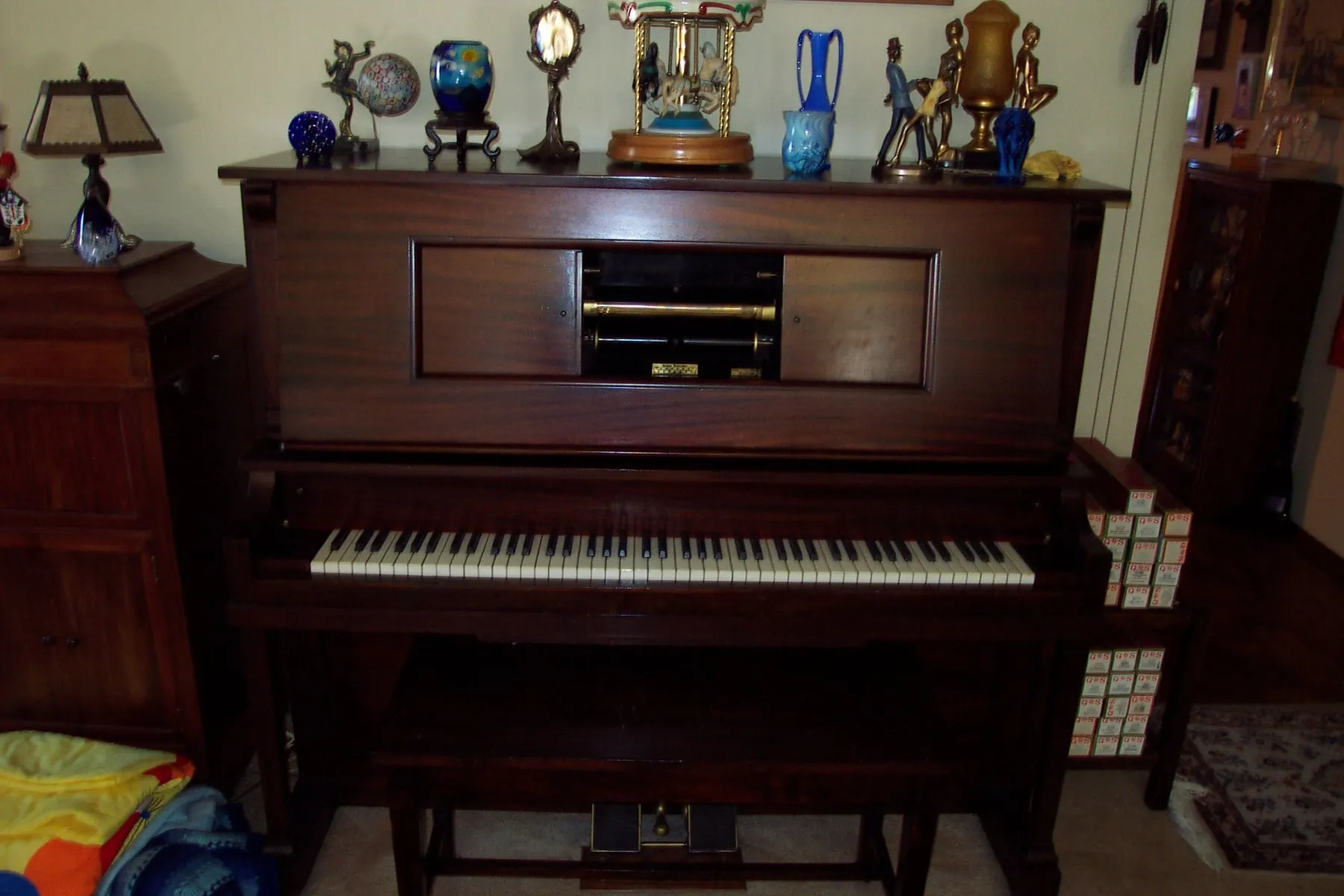
By the turn of the twentieth century, manufacturers were putting the pneumatic apparatus inside an upright piano. The “player piano” looked more conventional because the stack of valves, tubes, small bellows, and roll transport disappeared behind the front panels. A door above the keyboard exposed the spool and controls. Foot pedals powered the suction, while levers let the player alter speed, loudness, and phrasing.
This was not simply a start button. Standard rolls generally encoded pitch and duration, but they did not settle every expressive decision. The operator watched markings on the paper, changed tempo with a control lever, managed dynamic devices, and kept the roll tracking correctly across the bar. Pedaling supplied both energy and interpretation. The Library of Congress calls this person a “player-pianist”: the machine reduced one kind of keyboard labor while creating another kind of performance. 1
The player could lean into a cadence, hold back a phrase, or make a printed accent audible. Different operators could therefore produce different results from the same roll. A song had been separated from the finger movements needed to strike individual notes, but it had not been separated from judgment. The roll fixed a sequence. The person made that sequence inhabit time.
A hole became a pneumatic instruction
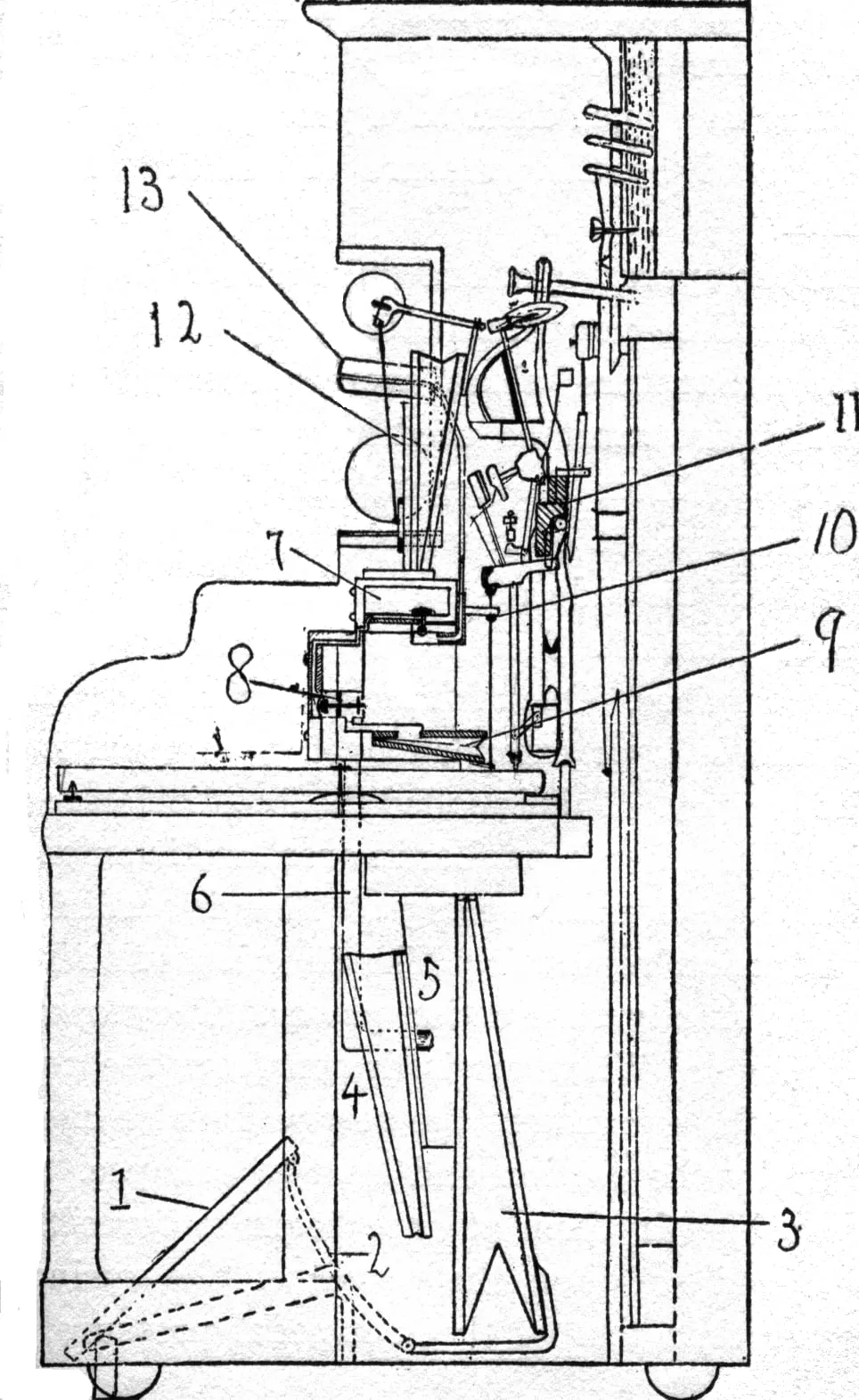
The tracker bar converts the paper pattern into separate control channels. While unbroken paper covers a port, the corresponding tube remains in its normal pressure state. When a perforation passes over that port, outside air enters. A small pressure change moves a valve, which admits or exhausts air elsewhere in the system. That larger change collapses or expands a pneumatic connected to the piano action. The key moves, the hammer strikes, and the string vibrates. 1 2
The roll is therefore not a sequence of holes tugging directly on keys. It is the first stage of a pneumatic amplifier. A tiny opening can control enough force to operate a piano action because valves relay the signal. Reservoirs smooth the suction produced by the pedals. A pneumatic motor advances the paper. Other channels can operate the sustain or soft pedal and divide dynamic control between bass and treble.
Position across the paper selects the channel; distance along the paper represents time. A long perforation keeps one note active. Vertically aligned holes produce a chord. Closely spaced events create a fast passage. Roll speed changes how quickly every event reaches the tracker bar, so it changes tempo without rewriting the pattern. This spatial logic made music reproducible with the manufacturing methods of punched paper, but small physical errors remained musical errors. A torn edge, swollen paper, blocked port, air leak, or misaligned roll could disturb notes and timing.
Standardization made catalogs possible, yet formats were not completely interchangeable. Roll width, tracker layout, expression coding, and manufacturer-specific systems could divide the market. A box label did more than name a piece. It identified the mechanism that could turn that paper into a performance.
The roll could be arranged, played, and edited
The word “recording” can conceal several production methods. Some rolls were cut from a notated score by editors who planned the holes and adjusted the arrangement for the mechanism. Some began with a pianist’s performance and were prepared through a recording apparatus. Even then, the commercial roll could be corrected, expanded, or altered before manufacture. The Supreme Court’s 1908 decision described score-based cutting, direct performance recording, and combinations of the two. 2
That editability was an advantage, not merely a defect. A roll could contain passages wider than two hands could reach or notes denser than one pianist could comfortably play. Errors could disappear. An interpretation could be reshaped into an idealized performance that had never occurred from beginning to end in one room. Stanford researchers emphasize that rolls complicate the wish to hear an untouched historical event: they preserve performance information, but they also preserve decisions made by editors, technicians, manufacturers, and proprietary systems. 4
Reproducing pianos pursued a more ambitious version of the problem. Welte introduced the Welte-Mignon in 1904, using additional coding and an electrically powered mechanism to recreate dynamics and pedaling with less intervention from an operator. Competing systems followed. Their advertisements promised the presence of celebrated pianists in the home, but “reproducing” did not mean a transparent copy. Companies kept parts of their recording and coding methods proprietary, and the roll still passed through a particular restored or maintained piano. 1 5
Attribution depends on those production differences. A standard arranged roll stores a playable version of a composition. A hand-played or reproducing roll may carry evidence of one pianist’s timing and dynamics. Neither should automatically be described as an unedited sound recording. The paper contains instructions for generating a new acoustic event each time it runs.
A boxed song became a retail system
The piano roll changed what a music shop could sell. Sheet music asked someone to read and play at the keyboard. A roll let a household buy a mechanically performable arrangement. Catalog numbers, branded boxes, tempo instructions, lyrics, and performer names turned paper programs into a repeatable product line. Shops could stock walls of titles, and owners could build libraries organized for a machine in the parlor. 8
That market widened access to complex keyboard textures while directing attention toward the models publishers chose to issue. Classical repertoire, dances, popular songs, novelties, accompaniments, and ragtime circulated through the same format. A roll could carry music into a home without a professional pianist, but the catalog still reflected commercial decisions about genre, audience, arrangement, and whose name appeared on the box.
The medium also reorganized musical labor. Arrangers translated scores for the roll. Performers supplied timing data or endorsement. Editors repaired and intensified performances. Punching and duplicating equipment produced copies. Sales staff demonstrated systems whose controls needed explanation. Technicians maintained leather, rubber cloth, tubing, valves, and alignment. “Automatic piano” compressed that chain into a convenient phrase, although nothing about the chain was automatic to build or sustain.
Machine-readable music forced a copyright answer
The dispute in White-Smith Music Publishing Co. v. Apollo Co. concerned rolls made for copyrighted compositions. Under the existing statute, the Court treated the perforated paper as part of a machine rather than a copy readable as notation. That result meant a roll manufacturer could use a composition without the authorization expected for printed sheet music. The decision was narrow, but it made the legal category look poorly matched to mechanical playback. 2
Congress’s 1909 act recognized mechanical reproduction rights and created the first US compulsory mechanical license. Once the copyright owner had authorized an initial mechanical reproduction, others could make similar use of the composition if they followed the statutory process and paid the set royalty. The U.S. Copyright Office identifies the player-piano dispute as a direct impetus for that structure. Phonograph records were also covered, and the word “mechanical” remained attached to music licensing long after piano rolls stopped leading the consumer market. 3
Technology did not wait for the law to supply a clear definition. Manufacturers built a market, publishers challenged it, a court applied the available statute, and legislators constructed a new compromise. The roll was both music product and legal test because its holes performed a composition without looking like the kind of copy copyright law already knew how to see.
Scanning the paper creates another interpretation
Historic rolls now present a different mechanical problem. Paper shrinks, tears, drifts, and becomes brittle. Playing a rare roll on an original mechanism can damage the object that preservation is meant to protect. Stanford Libraries built a custom scanner that captures long rolls as images without sending them through an ordinary player piano. The scan preserves hole positions and physical condition before software tries to turn those marks back into musical events. 7
The Stanford University Piano Roll Archive links high-resolution roll images with catalog records, derived MIDI, and rendered audio. Its published data distinguishes “raw” MIDI, where detected holes remain separate events, from “expressive” files that merge bridged holes, extend durations, and interpret expression channels. Those steps are useful, but they are not neutral. A crease can resemble a hole; lateral drift can move an event toward the wrong channel; proprietary expression codes need system-specific knowledge. 6 9
Digitization still requires an interpreter. Information does not move from one medium to another by itself. The original operator interpreted printed markings while pumping the piano. A reproducing system interpreted its own coded channels. Today’s software interprets pixels as holes and holes as MIDI events. At every stage, a useful performance depends on knowing what the machine assumes.
The paper remains valuable because it holds more than a song’s notes. It records an industrial format, an arrangement, an editorial process, a performance claim, and the wear left by playback. Its holes are precise, but their meaning is relational. They need a tracker layout, a pneumatic system, an acoustic piano, and a history of how that particular roll was made.
A piano roll made performance portable by refusing to store sound itself. It stored a set of openings through which another machine could act. That separation gave the medium its commercial power, its expressive uncertainty, and its legal importance. The piano played again each time; the paper told it where to begin.


.jpg)

_p.185.jpg)


