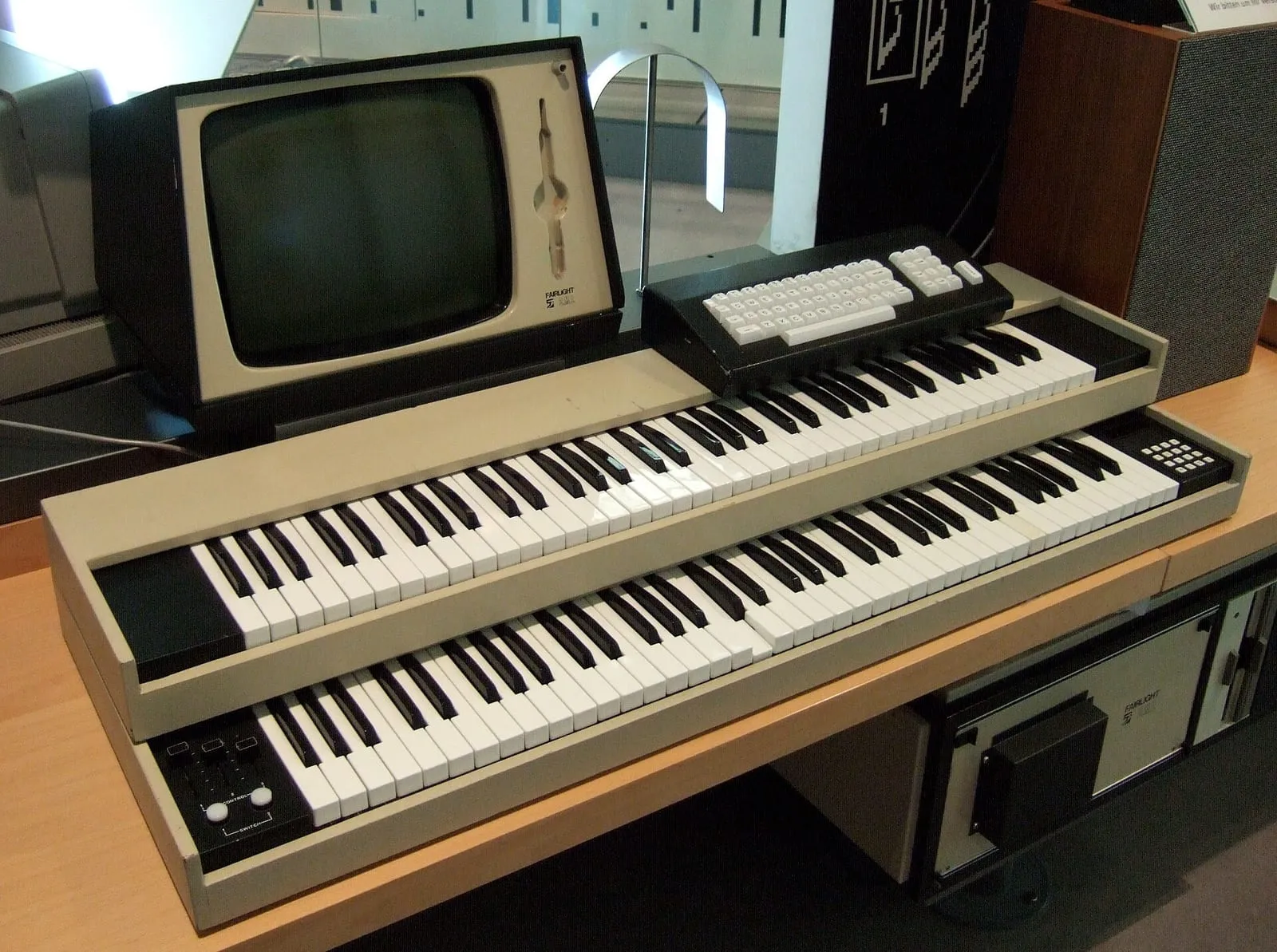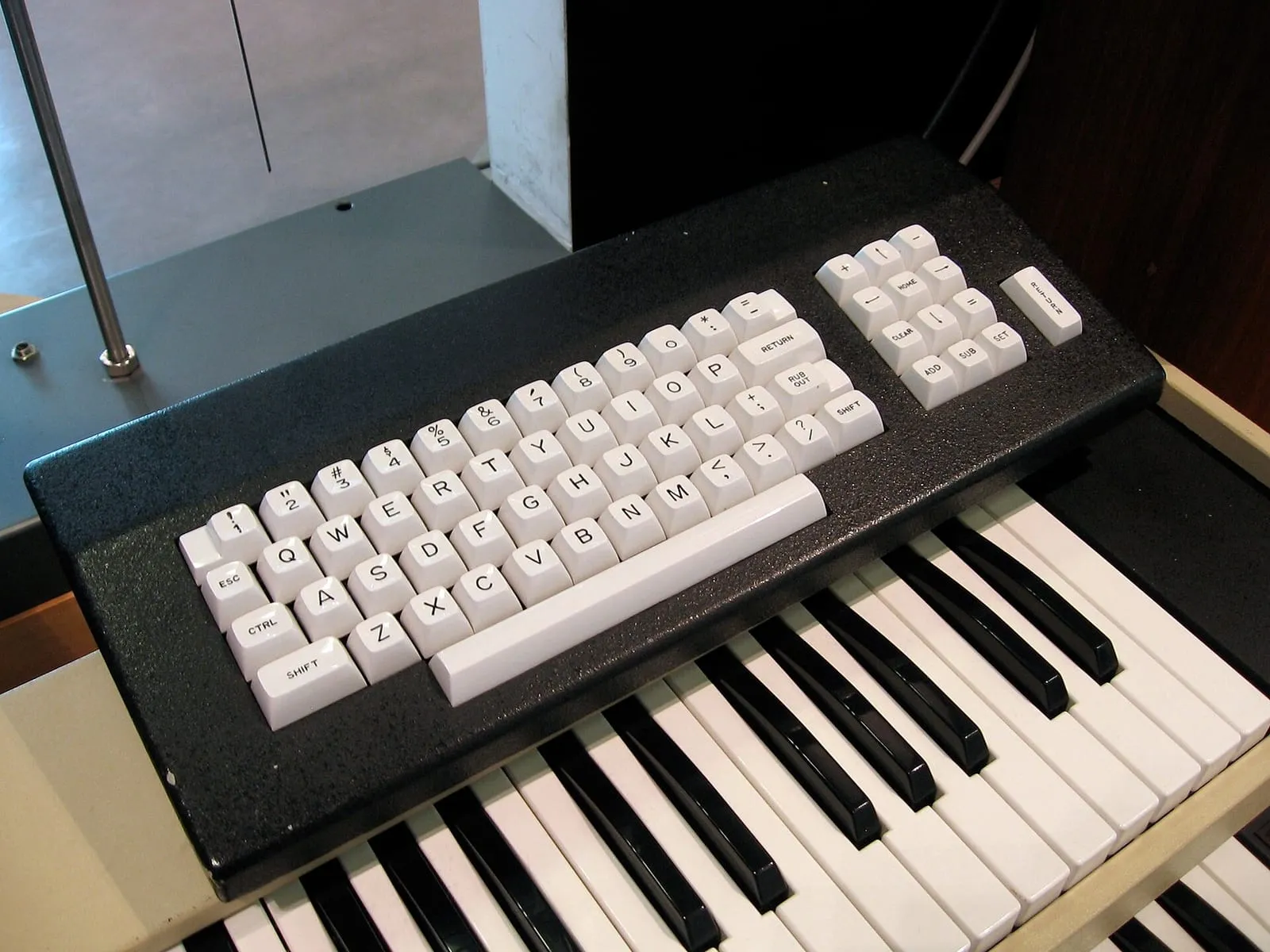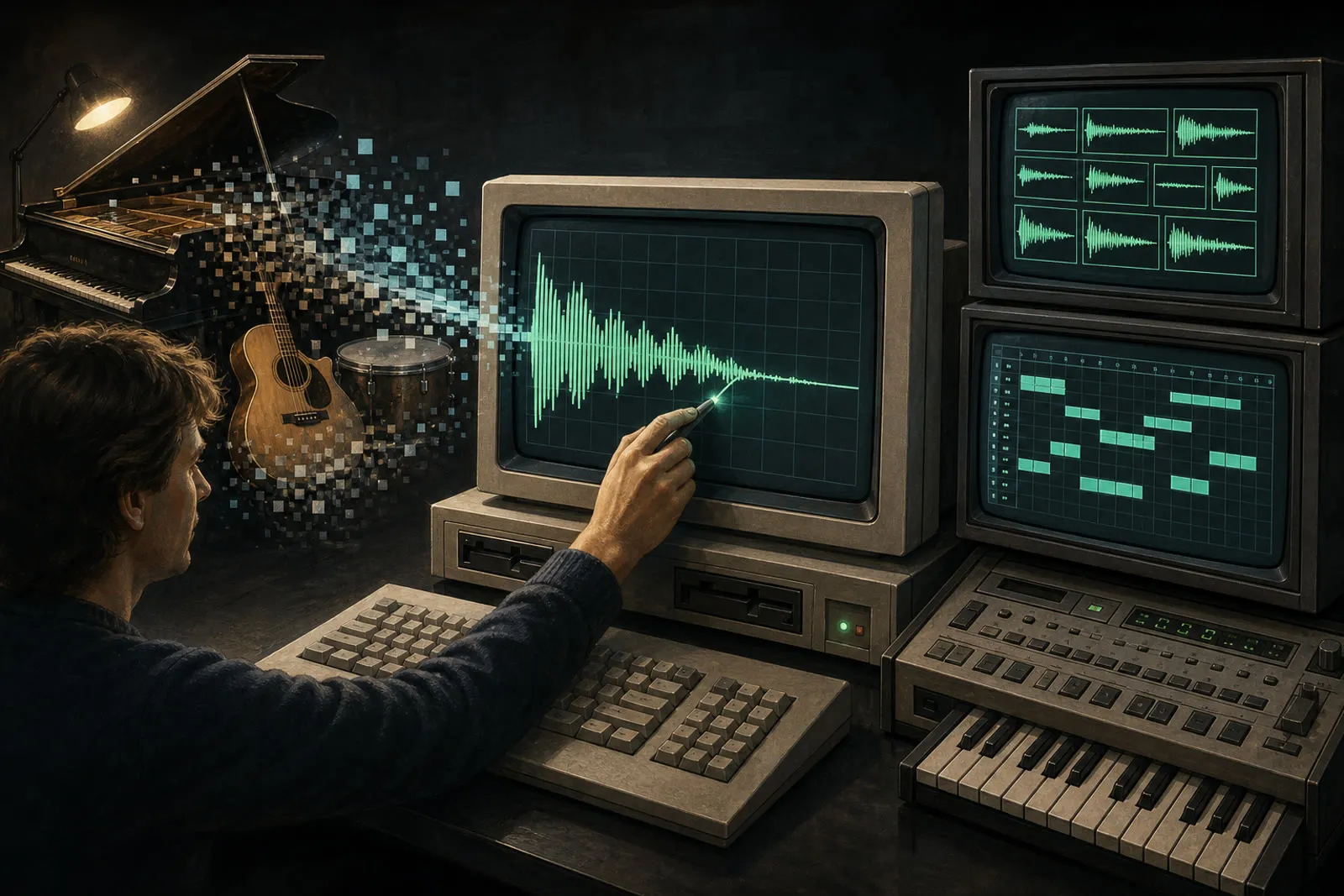

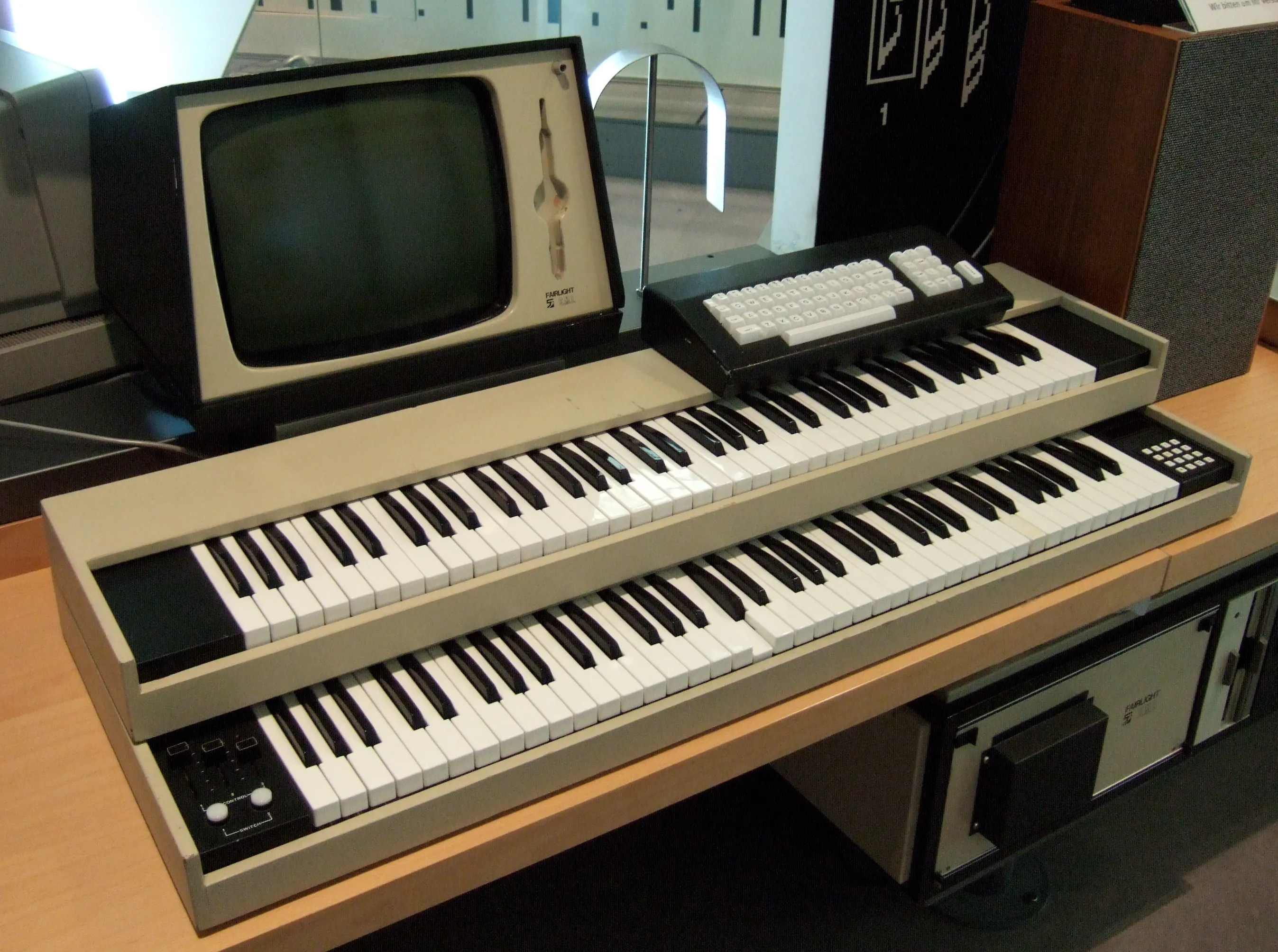
The Fairlight CMI did not hide the computer. A complete system placed a musical keyboard beside an alphanumeric keyboard, a processor, disk drives, a monitor, and a light pen. To use it was to move between familiar and unfamiliar kinds of work. A musician could play a key, type a command, point at a waveform, load a floppy disk, and wait for the machine to finish a task.
That visible machinery is central to the Fairlight’s history. Digital sampling is now cheap enough to disappear inside a phone. In 1979, recording a sound into memory and playing it chromatically from a keyboard required an expensive Australian computer music instrument. Its limits were audible. Short samples, low resolution, imperfect loops, and pitch changes produced timbres that users did not always intend. The Fairlight sold access to recorded reality, then changed that reality as soon as it entered the machine. 2
A synthesizer that failed productively
Kim Ryrie and Peter Vogel began by trying to build a digitally controlled synthesizer. Analog instruments could produce useful electronic tones, but Ryrie and Vogel wanted more control over complex acoustic timbre. Their earlier Qasar work led toward a system that represented sound as numerical data.
The attempt to construct convincing sounds from mathematical descriptions proved difficult. Sampling offered another route: record a short sound, convert its changing voltage into numbers, store those numbers, and read them back at different rates. A piano tone no longer had to be modeled from a set of oscillators. The machine could capture a piano—or a voice, breaking glass, a dog, an orchestra—and make the recording available at the keyboard.
Sampling changed the object being sold. The CMI became a general instrument whose raw material could come from outside its cabinet. Every microphone offered a possible new oscillator. The user did not have to accept a fixed factory library, though factory disks helped make the costly system immediately useful. 5
A sound becomes data
Sampling begins with measurement. The Fairlight’s analog-to-digital converter took repeated readings of an incoming signal and stored numerical approximations. Early CMI voices used 8-bit data and limited sample rates and memory. Those numbers matter, but not as a simple quality ranking. They established what could fit, how much high frequency detail survived, and how obviously noise or aliasing appeared when a sample was moved away from its original pitch.
Playing a sample higher reads its data faster. Duration shortens and artifacts move with the pitch. Playing it lower stretches both the sound and its imperfections. A single recorded note spread across the keyboard therefore did not behave like a multisampled piano library. It became a family of related distortions.
Vogel later described the Fairlight as imposing frequency coloration and other changes. Modern software that simply replays a clean recording of one Fairlight note cannot reproduce every behavior, because the old system transformed sounds during pitching and playback. Its character was partly an engineering limit and partly a repeatable method. 3
Draw what cannot be held
The monitor and light pen made the conversion visible. Users could select pages, inspect waveforms, and alter data by pointing directly at the screen. Museums Victoria’s preserved system includes two musical keyboards, an alphanumeric keyboard, the interactive display, and software for editing, looping, mixing, drawing, and sequencing sound. This was not graphical audio editing in the later drag-and-drop sense, but it joined listening to a visual representation in a strikingly direct way. 2
Drawing a waveform promised control at the level of the sound itself. In practice, a line on a screen did not teach a musician why a timbre felt convincing. The gap between image and hearing remained. A smooth shape could sound plain; a jagged one could become useful only after filtering, looping, or layering.
The light pen also imposed posture. The user reached toward a curved display, selected small regions, and worked page by page. This physical interface encouraged a different pace from turning a knob or cutting tape. It made the computer an instrument, but it also made computer operation part of musicianship.
The loop exposes its join
Memory made sustained sounds a practical puzzle. If a full note could not fit, the user captured its attack and repeated a portion of the later waveform. A good loop needed compatible start and end points. Otherwise each return produced a click, a wobble, or an obvious cycle.
Those seams were not always failures. A choir sample with a short loop could acquire a mechanical breath. An orchestral stab, cut away from its original room and harmony, could become percussion. Sounds entered the Fairlight with documentary origins and left with new functions.
The famous factory library helped establish a recognizable vocabulary: breathy voices, struck metal, orchestral attacks, and sounds whose names appeared on disks rather than in a score. Once distributed, the same sample could appear in unrelated studios. Recognition shifted from the instrument model to the data file. A timbre could circulate like a preset and like a quotation at the same time.
Floppy disks made that circulation physical. A library occupied labeled media that could be carried, misplaced, copied, or loaded during a session. Choosing a sound therefore included file management and waiting alongside auditioning. The disk was part instrument case and part archive.
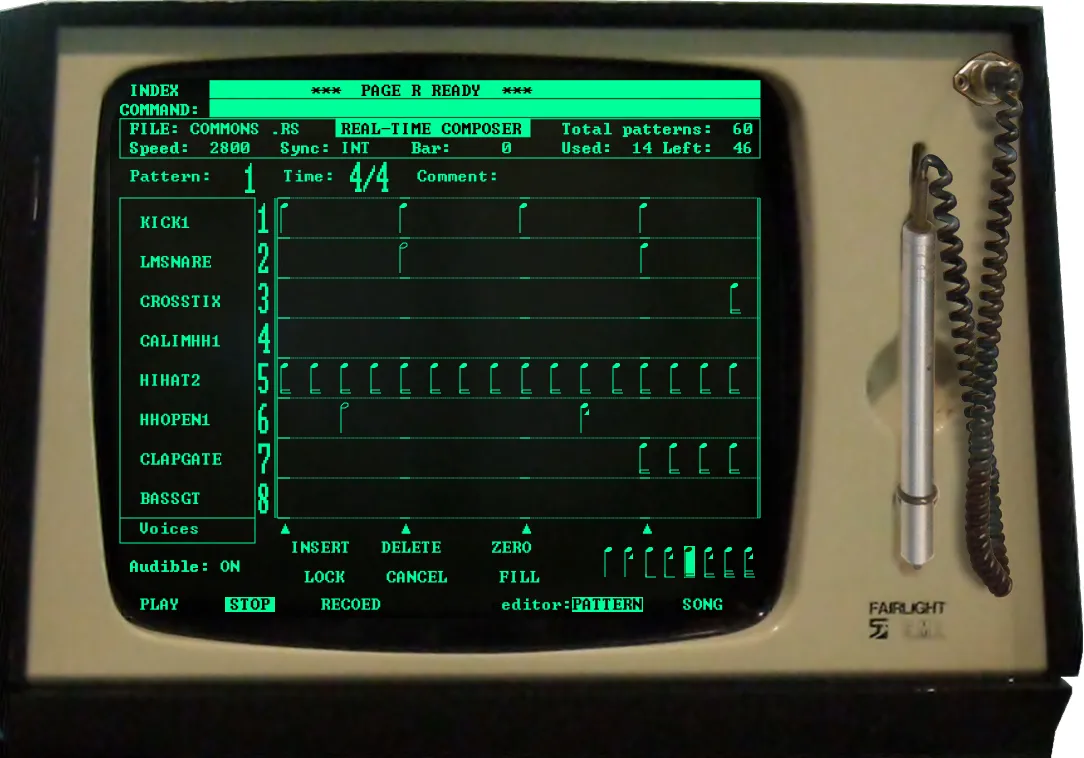
Page R makes time visible
Sampling receives most of the attention, but Page R altered the working day. Added to the Series II, the sequencer presented parts as rows of repeated events on a grid. Users could build patterns, copy them, and hear an arrangement without performing all of it continuously. The screen did not display a modern audio waveform timeline. Instead, it offered a compact rhythmic plan.
This made repetition cheap in one sense and expensive in another. Copying a bar no longer required replaying it, but selecting the right sound and placing the event still took judgment. A visually regular pattern could expose any weak sample choice. Page R encouraged musicians to think in blocks, cycles, and layers because those structures were easy to see and revise.
Vogel later argued that the sequencer made certain rhythmic structures easy and therefore encouraged users to compose with them. He did not claim that a machine single-handedly invented a genre. Interfaces have tendencies, not intentions. Page R did not force anyone to write mechanical pop, but it reduced the effort needed to repeat and rearrange short events. 3
The family resemblance to later digital audio workstations is clear. Tracks run across a screen; events occupy measured positions; arrangement becomes something a producer can inspect as a whole. Melbourne Electronic Sound Studio traces modern computer sequencing and DAW practice back through this interface. The lineage is not one straight invention story—other sequencers and computer music systems mattered—but Page R gave commercial musicians an influential early view of time as editable data. 4
Entry was priced like a studio
The Fairlight was never a democratic instrument in its first life. Its price placed it with wealthy artists, large studios, institutions, and composers working in film, television, or advertising. The National Film and Sound Archive records a Series III price of roughly £50,000 in 1985. That figure varied by configuration and market, but the scale is enough: this was capital equipment. 1
Cost shaped the credits. Owners could become specialists who programmed sessions for other artists. Hiring a Fairlight often meant hiring someone who knew its pages, storage, synchronization, and failures. The instrument redistributed studio labor as much as it replaced instruments. A vocalist might supply a sound, a programmer trim it, a producer sequence it, and an engineer route the outputs to tape.
The price also distorts later memory. Lists of famous users—Peter Gabriel, Kate Bush, Stevie Wonder, Herbie Hancock, Jean-Michel Jarre, and others—can make the CMI appear to have been everywhere. It was highly visible, not universally available. Most musicians encountered its sounds through records long before they could touch the machine.
Neither orchestra nor theft machine
Marketing could present sampling as an orchestra on demand. A producer could trigger strings or brass without booking players, and novelty demonstrations made almost any noise seem available. Yet one short sample did not contain an orchestra’s phrasing, dynamics, intonation, or interaction. It contained a recording that could be transposed and repeated.
That artifice became creatively useful. Kate Bush and Peter Gabriel did not need the Fairlight to impersonate a neutral acoustic ensemble. They could use attacks, voices, and environmental sounds as shaped events. Herbie Hancock’s electronic work placed digital timbre beside turntablism and live performance rather than treating the sampler as a total replacement for musicians. The machine was strongest when its artifice remained audible.
Sampling also carried questions of ownership that the hardware did not solve. A sound could be recorded directly, taken from a licensed library, or lifted from another record. The CMI made reuse technically manageable for its buyers; it did not determine whether that reuse was credited, paid for, or legally permitted. Later, cheaper samplers expanded both the creative field and the disputes.
Obsolescence was part of the design
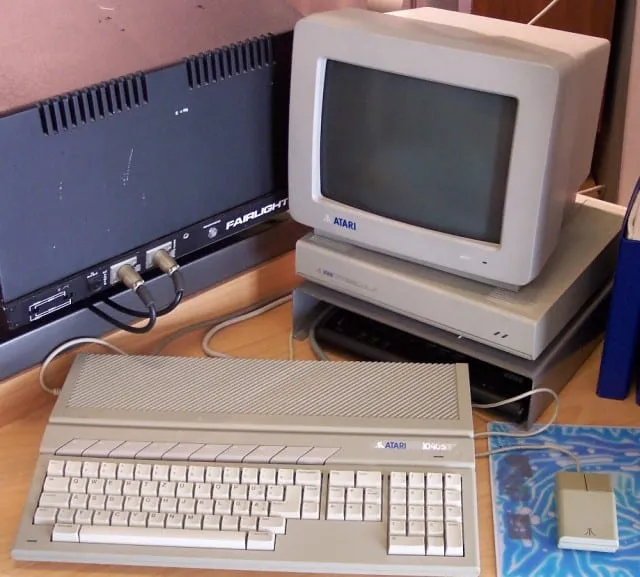
Fairlight’s early advantage could not remain exclusive. Competitors offered sampling for less money, while MIDI let different devices exchange performance instructions. Memory grew, interfaces changed, and personal computers absorbed sequencing. The company moved through new systems and financial difficulty; the original CMI became a historical object even while its working concepts spread.
The NFSA preserves a Series III used by screen composer Peter Best, including the configuration in which he left it. Restoration involved physical problems as ordinary as decayed foam. A sampler may turn sound into numbers, but the numbers remain dependent on aging drives, monitors, connectors, disks, circuit boards, and documentation. 1
Emulations can preserve libraries and imitate coloration. Museums can keep original machines operational. Neither approach recreates the exact economic and temporal conditions of a 1980s session, when storage was scarce and the machine’s presence in a room could redirect the budget.
Listen for the boundary
The Fairlight’s importance is easiest to hear at the boundary between recording and instrument. A captured sound points backward to a real event: a breath, strike, word, or ensemble. The keyboard and Page R point forward to performances that event never gave. Between them, conversion leaves a grain.
That grain was once a compromise. It became an aesthetic. Limited memory encouraged short attacks. Pitching exposed digital artifacts. Page R made repetition visible. The light pen made editing look immediate while the computer still demanded patience. Price restricted access, and specialists translated between musicians and machine.
The Fairlight did not invent every practice later grouped under sampling or computer music. Its achievement was to bind several of them into a commercial workstation: get a sound in, see it, alter it, play it, sequence it, and store the result. The sample had a screen, and once musicians could look at recorded sound as editable material, the studio’s idea of an instrument became harder to contain.