
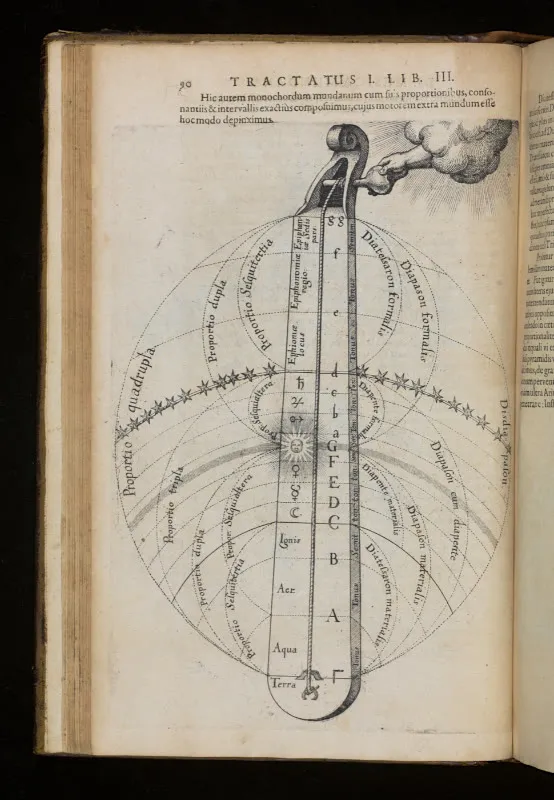
The image on Harry Smith’s Anthology of American Folk Music does not show a singer, a landscape, or an old instrument from the recordings. It shows a theory of order. A hand reaches from outside the frame toward one long string. Notes, intervals, elements, planets, and stars gather around it. Robert Fludd published the engraving in 1617 as a cosmic monochord: a universe explained through musical proportion. Smith placed it on three sets of records in 1952. 2 5 7
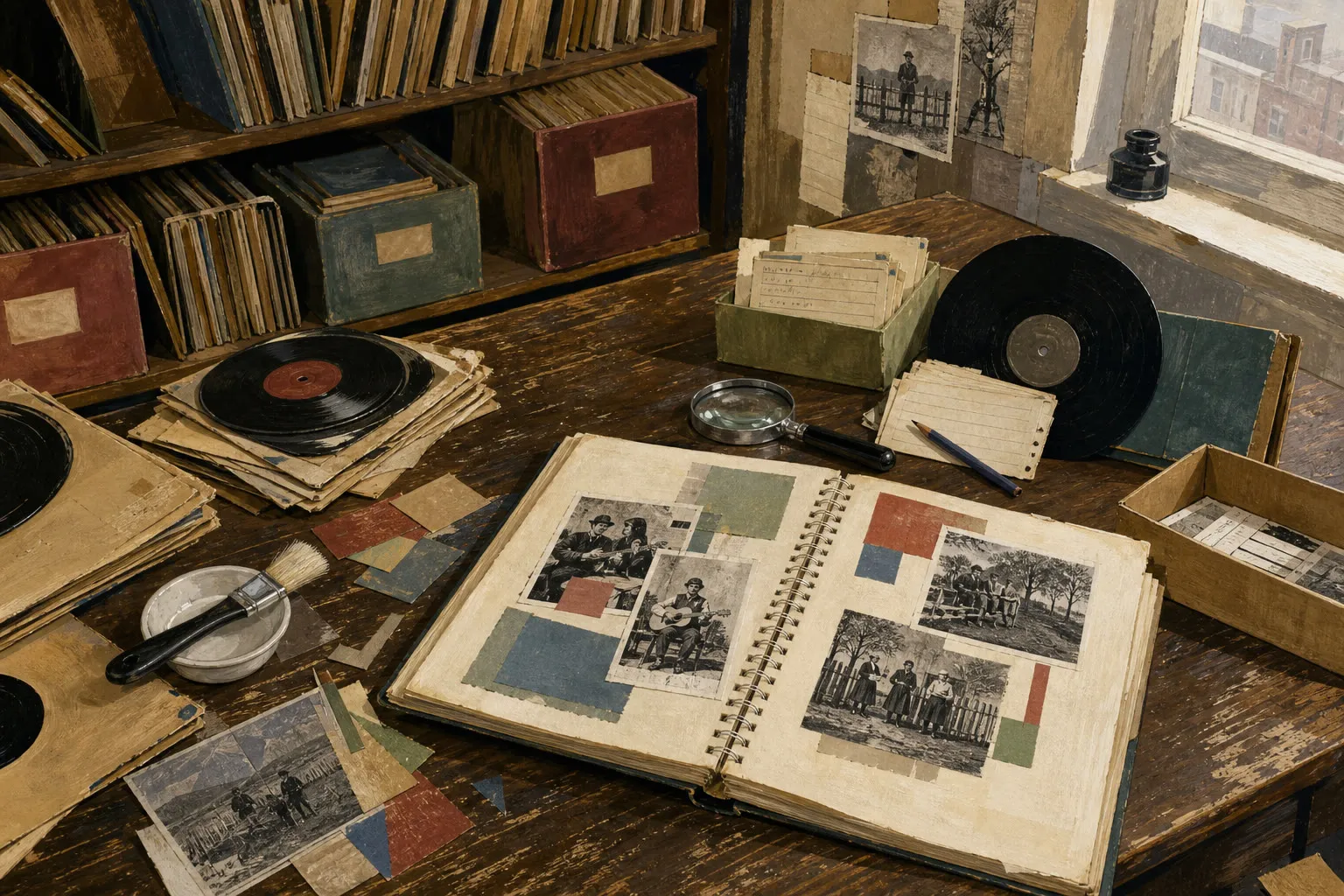
That choice gave the package an argument before a listener heard a side. The 84 performances inside had been made for the commercial 78 rpm market during the late 1920s and early 1930s. They included ballads, fiddle tunes, blues, gospel, Cajun music, dance pieces, and topical songs. Smith did not present them as a neutral survey. He selected them from his collection, transferred them to LP, divided them into three broad volumes, wrote compact notes, and arranged one record after another so that distant voices appeared to answer. 1 2 4
The monochord makes that curatorial work visible. One string can hold many divisions. One set can hold many recordings. Neither becomes a system without someone deciding where the marks go.
The source was the record business
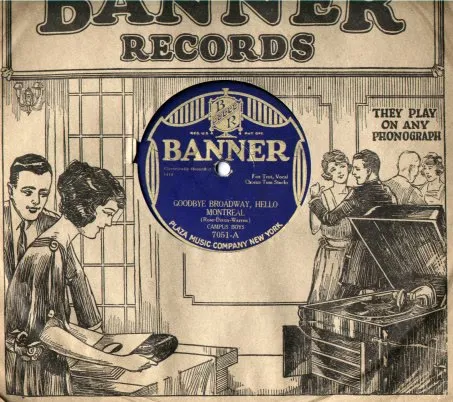
The Anthology is often called a folk collection, but its source objects were not field recordings gathered outside commerce. They were records made for sale. Companies had recorded regional performers, marketed music through racially separated “race” and “hillbilly” catalogs, printed labels and sleeves, and distributed discs to particular audiences. Smith encountered that music through the afterlife of the market. Unsold stock became cheap during the Depression; wartime shellac drives destroyed many other discs. Collecting was already an act of selection under material pressure. 2 4
Its commercial origin changes what “preservation” means. Smith did not recover every performance from a community, nor did he document the conditions of a recording session firsthand. He saved particular commercial issues that had survived long enough to reach him. A three-minute side was shaped by the capacity of a 78, the priorities of a label, the performer’s choices, and the technical limits of recording. The Anthology preserved those compressed encounters, including the industry’s categories and omissions even when Smith rearranged them.
Moses Asch of Folkways gave the collection a new carrier. Instead of selling part of his 78 collection, Smith produced three double-LP sets: Ballads, Social Music, and Songs. The LP allowed several old sides to be heard without changing discs after each performance. More important, it made sequence a practical design material. A collector’s shelf became six continuous record sides with beginnings, endings, and adjacencies. 2 3
Smith’s dates were narrow enough to create a historical pressure point. The recordings came from the period after electrical recording improved the capture of voices and instruments and before the Depression contracted the regional record market. The set therefore did not define an ancient America untouched by technology. It assembled music that microphones, pressing plants, catalogs, rail networks, and stores had already made portable. 2 3
Three labels, many routes
The volume names sound stable until the records begin. Ballads emphasizes narrative, but narratives travel between British-derived song forms, local events, murder accounts, and religious warning. Social Music places dance and sacred performances in the same larger category, split across two records. Songs catches material that does not submit neatly to the first two labels. These are containers, not a complete taxonomy.
Smith made sequence do the more interesting work. A lyric image can recur several tracks later. A fiddle rhythm can sit near a vocal performance that uses a different market label but shares a structural turn. Sacred intensity can answer dance energy without being declared its opposite. Research on the Anthology describes this as reissuing through selection, sequencing, and annotation: interpretation carried out with existing records rather than a new performance. 4
The approach resembles film montage. Smith was also an experimental filmmaker and visual artist; he understood that placing two fragments together produces a third idea that neither fragment contains alone. The records remain credited to their performers, but the transitions belong to the compiler. A listener is invited to compare accent, guitar pattern, fiddle attack, stanza shape, and subject across tracks that the record trade had kept in different bins. 3 6
Not every proposed connection is equally strong. Some transitions are audible; others depend on Smith’s private symbolic systems or on later critics finding a plot. Treating the sequence as a single hidden narrative can give the compiler too much authority. Whatever the larger plot, order changes attention. After one record establishes a rhythmic or verbal expectation, the next one is heard in relation to it.
The notes behave like compressed headlines
The accompanying booklets do not read like conventional ethnographic entries. Smith combined discographic facts with clipped images, catalog material, photographs, instruments, symbols, and short synopses. A song’s action could be reduced to a blunt sequence of events. The result places a murder ballad, a sermon, and a dance tune on the same graphic plane without pretending they have the same purpose. 1 6 8
Compression produces speed. A reader can scan performer, label, issue number, place, and an eccentric summary before playing the track. It also produces risk. A witty synopsis can turn a complicated performance into plot. Regional practice, authorship, and social context may disappear behind a collectible object. The booklet is Smith’s interface to the records, not the final account of the people who made them.
The design repeatedly crosses registers. Discography suggests factual control; collage interrupts it. Old commercial advertisements sit beside esoteric diagrams. Typography makes the package resemble a reference work, while the wording refuses academic calm. Scholarship on Smith’s method connects this mixture to postwar interests in pattern, data, and systems as well as to his occult and artistic practice. The Anthology measures and destabilizes at the same time. 5
Removing race labels changed the comparison
The commercial recording industry had sold Black and white Southern performers through separate categories. Smith declined to use race as an organizing label in the Anthology. He later explained that he wanted listeners and critics to confront how unreliable their assumptions could be when a catalog heading was removed. Mississippi John Hurt could be heard beside performers marketed as white “hillbilly” acts without the package telling the listener which racial test to apply first. 4
That refusal was a real editorial intervention, but it did not erase the history of segregation. The companies’ categories had affected who was recorded, how a disc was advertised, where it circulated, and which archives later valued it. Black and white musicians did not occupy interchangeable positions in the 1920s record business or in American life. Removing the label can open an attentive comparison; treating the removal as proof of a culture without racial power closes it again.
Smith’s booklet sometimes reproduced the old trade language in order to expose it, and the 1997 Smithsonian reissue had to decide how to frame such material for another public. Research into that reissue shows that remastering, new essays, marketing, and editorial choices did not merely preserve the 1952 object. They interpreted it again, elevating Smith’s authorship while adding context that the original package lacked. 4 8
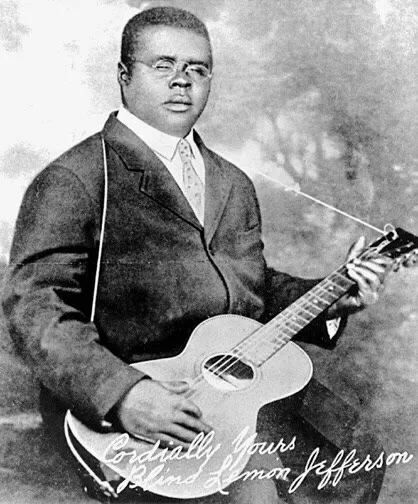
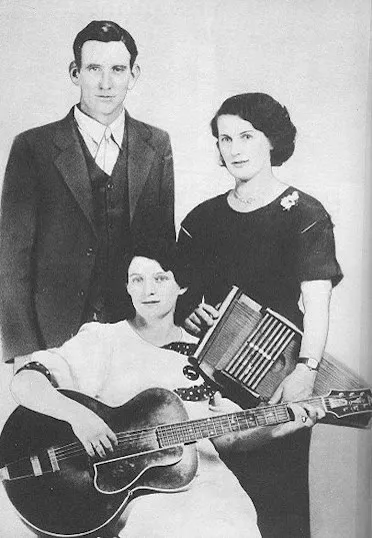
The performers can also disappear when influence is narrated only through the compiler. Blind Lemon Jefferson, the Carter Family, Mississippi John Hurt, Dock Boggs, and the many other named artists were not raw material waiting for Smith to create meaning. Their timing, repertoire, instrumental technique, and recording decisions are the reason comparison yields anything. The Anthology’s achievement is relational, and so is its debt.
The cover proposes a scale larger than genre
Fludd’s monochord turns ratios on a string into a model of the cosmos. Smith used the same engraving across the three volumes, changing the surrounding color. Red, blue, and green linked the issued sets to fire, air, and water; a fourth earth volume was planned but not released with them. The design makes each box a part of a larger scheme while leaving that scheme incomplete. 2 5
The image is not a period illustration of American folk life. It is European, learned, and metaphysical. That distance is productive. Instead of promising authenticity through a cabin, field, or anonymous rural face, the sleeve admits that the records have been placed inside an intellectual construction. A hand tunes the universe; an editor tunes the sequence.
There is also a difference the analogy cannot solve. A monochord reduces pitch to ratios along one string. The Anthology’s performances do not share one measurable social scale. A Cajun song, a Black Baptist sermon, an Appalachian ballad, and a commercial blues side carry histories that a cosmic diagram cannot reconcile. The cover proposes a shared scale; it cannot prove one.
The surviving book page makes the act of appropriation clearer than the cropped sleeve alone. Margins, type, and binding show that the famous cover image had a previous argument. Smith took it from one system of knowledge and made it front another. That gesture repeats the Anthology’s basic method: extract, preserve enough identity to invite recognition, then alter meaning through a new frame. 5 7
Listen at the joins
The set rewards a listener who resists treating it as background atmosphere. Play two adjacent tracks and name the relation before reading Smith’s synopsis. Is the link rhythmic, verbal, tonal, dramatic, or only imagined? Then compare the booklet’s compressed account with what the performance spends time doing. A plot summary may miss a guitar’s alternating bass, a congregation’s response, or the way one repeated line changes under pressure.
Move across the volume boundaries too. The broad headings remain useful when they stay open to contradiction. Dance music carries social history; a sacred performance has arrangement and groove; a ballad can be a commercial recording by a professional musician. The Anthology matters because it makes those crossings easy to hear, not because it discovered a pure national voice.
The edition itself has more than one audible layer. Its performances survive on commercial shellac discs that carry groove wear, surface noise, and the limits of recording in the late 1920s and early 1930s. Every later transfer also involves choices: which surviving copy to play, which stylus fits its groove, how to stabilize pitch, and how much noise to reduce. Those decisions do not alter Smith’s sequence, but they affect the timbre through which listeners encounter it. Preservation here is not neutral playback. It is another careful mediation between a particular object and a new audience. 2 4 8
Like the scientific plot on Unknown Pleasures, Fludd’s engraving arrived on a record sleeve after leaving its first technical context. The two covers behave differently. Peter Saville removed explanation until the plot became an austere signal. Smith surrounded his borrowed diagram with more classification, more notes, and more records. One image became silence around a band; the other became a promise that 84 voices could be heard as a designed field.
The cover does not prove that field is harmonious. It tells the listener that someone built it.