
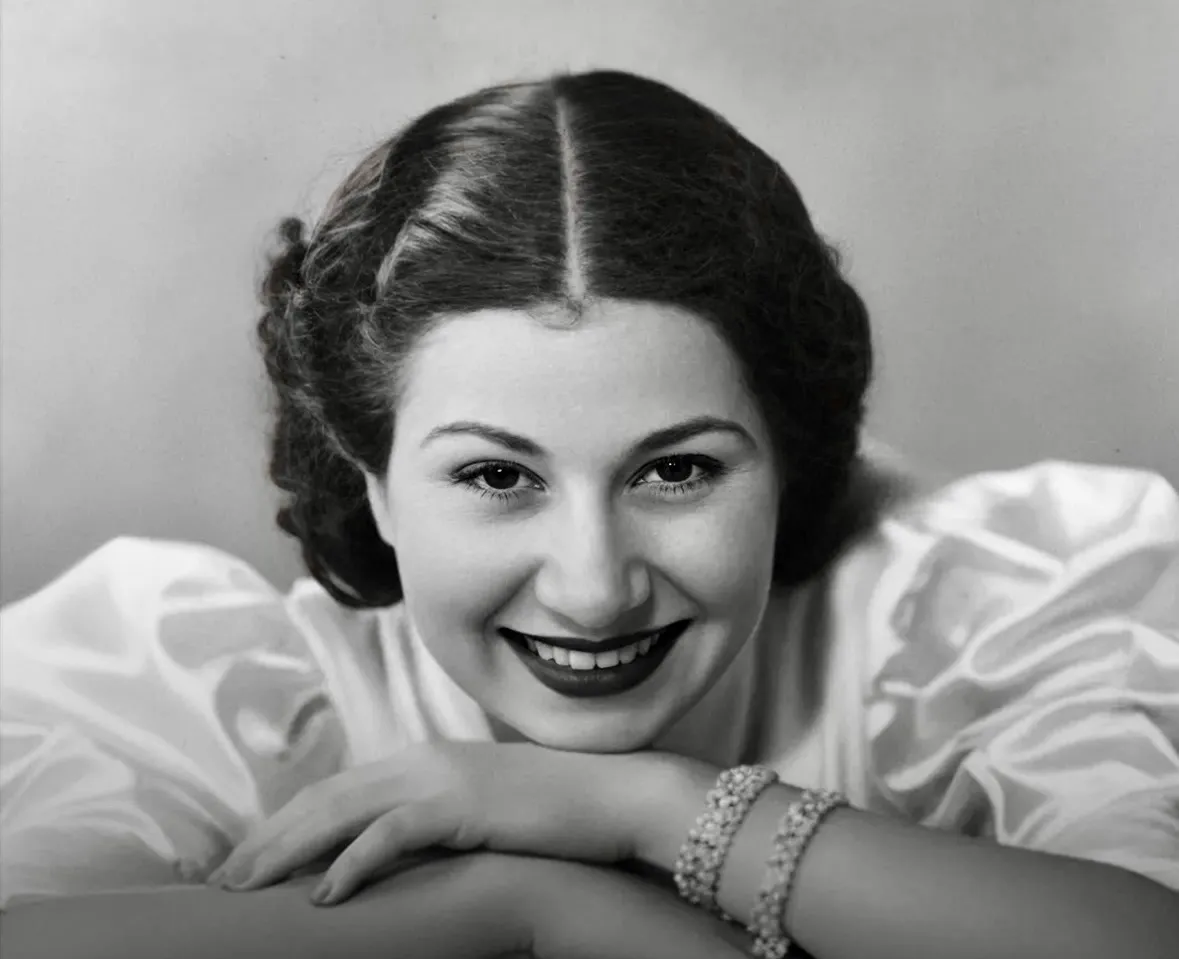
The applause arrives before the musical thought is finished. Umm Kulthum has reached a line that the room recognizes, and recognition does not produce silence. A listener calls out. Others answer. She pauses long enough for the response to become part of the timing, then returns to the line. The words are the same, but their balance has changed. A syllable carries longer; a turn in the melody tightens; the destination comes later. The orchestra follows because it is listening to her as closely as the audience is.
A concert recording is not merely an unusually long version of a finished song. The composition supplies words, melodic material, sections, and routes between them. Performance decides how much space those materials can hold. Umm Kulthum could repeat a phrase without treating repetition as duplication. The next pass tested what the previous one had opened. Audience response was neither an interruption nor a command that she mechanically obeyed. It was information inside a live negotiation. 1
A song was not a sealed text
Umm Kulthum’s mature repertory joined modern institutions to older principles of Arabic performance. Record companies, cinema, state radio, large theaters, microphones, and expanded ensembles changed the scale of her work. Yet the AMAR Foundation identifies continuities with the wasla, the flexible sequence of pieces associated with the nineteenth-century Nahda, and with the takht, the smaller ensemble in which individual players retained room to respond. Melody remained material to be shaped, not a text that had to be reproduced with identical measurements. 1
Flexibility depended on preparation. Umm Kulthum worked with major poets and composers, rehearsed closely, and exercised unusual control over what entered her repertory. Virginia Danielson’s study treats concert production, recordings, radio, stylistic direction, and the negotiation of a public as parts of the same career. The authority heard onstage was built before the curtain rose: choosing language that could sustain attention, testing a setting against her voice, and making an ensemble capable of moving when a performance did not match a stopwatch. 2
The composed framework mattered precisely because variation needs something recognizable to work upon. A return could only register as bolder, more restrained, more intimate, or more urgent if listeners remembered the line from moments earlier. Long form made that memory active. Instead of hurrying from verse to chorus, the performance could remain with one emotional proposition and examine how its pressure changed.
The voice organized the ensemble
Descriptions of Umm Kulthum often isolate the size or power of her voice. Those qualities were real, but volume alone does not explain the records. Her control lay in diction, placement, pacing, and the ability to make a small alteration legible across a large room. The text remained intelligible while melody stretched around it. A consonant could give a phrase its edge; a vowel could delay release. Ornament was not decoration pasted onto an otherwise complete line. It was one way of thinking through the line in public.
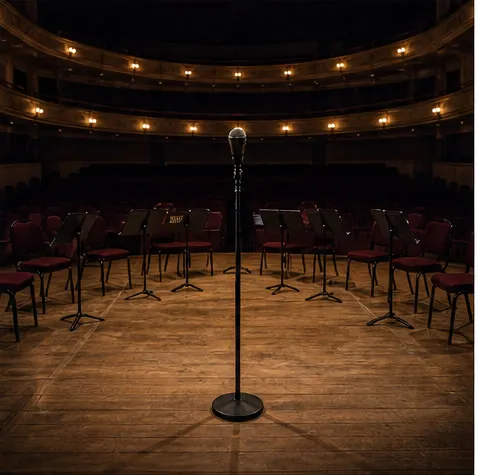
The orchestra therefore had a demanding job. It established introductions and transitions, returned recurring material, and supported changes of register and density. It also had to leave enough room for the singer to redirect a phrase. AMAR emphasizes that the expanded ensemble preserved a measure of the older takht’s individual and collective freedom rather than submitting every detail to a fixed score and conductor. 1 The singer stood at the center of attention, surrounded by trained responders rather than passive accompaniment.
Listen to the spaces after a climactic line. The ensemble does not always rush to fill them. A held silence can admit the audience, allow a word to settle, or make the return of an instrumental phrase feel necessary. When the players answer, they confirm the shape she has just made. The relationship is disciplined without being rigid: collective memory supplies the map, and close attention decides the pace.
Repetition measured the room
In much recorded pop, an exact repeat reassures the listener that a formal unit has returned. Umm Kulthum’s repeats could do almost the opposite. They asked whether a line still contained unused expressive space. The first statement might clarify the words. The second could enlarge one interval or displace an accent. A later return might pare the phrase back after applause had made further intensification unnecessary.
The audience participated audibly in this process. AMAR describes listeners as lively partners who offered acclamation, requests, and encores while the singer answered, innovated, or resisted. 1 The exchange was not a simple vote in which noise automatically earned another repeat. Umm Kulthum controlled when to stay, when to alter direction, and when to move on. Her authority included refusing to turn responsiveness into formula.
The Arabic term tarab is often translated as ecstasy or musical enchantment. A single English noun can make it sound mysterious and instantaneous. In these concerts, tarab was also practical work: a shared knowledge of language and melodic convention, a room allowed to answer, performers able to read that answer, and enough time for feeling to accumulate. A study of her performance culture notes that the ensemble’s flexibility was essential to facilitating that experience. 6 Nothing here requires pretending that every listener reacted alike. The form made collective reaction available without making it compulsory.
Radio enlarged a live event
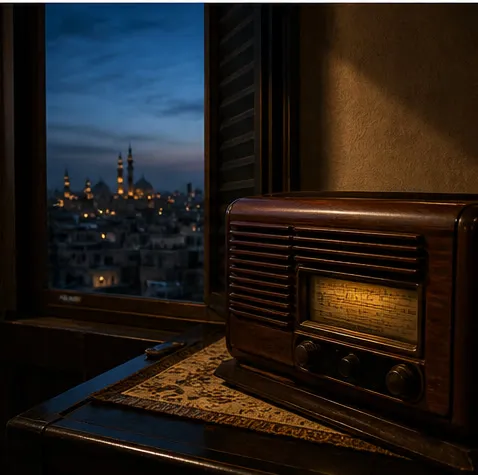
Umm Kulthum sang at the inauguration of Egyptian state radio in 1934 and developed a concert practice whose broadcasts became fixtures across Egypt and the Arabic-speaking region. The United States Naval Academy’s cultural materials describe public concert seasons, broadcast performances, her leadership roles within the musicians’ union and Egyptian Radio, and the monthly concerts as pan-Arab occasions. 4 Radio did not merely distribute a product after the event. It changed the dimensions of the event itself.
The visible audience occupied one theater; the listening public occupied homes, cafés, and streets far beyond it. They could hear the calls from the room and the singer’s response, evidence that the supposedly one-way medium was carrying an interaction. Broadcast sound made a local performance feel simultaneously public and domestic. It let a distant listener hear the delay between a line, the theater’s response, and the next phrase, carrying the room’s timing beyond its walls. It also gave timing social force: listeners arranged an evening around a concert whose length was not compressed to a conventional broadcast slot.
Archival radio material at the American University in Cairo preserves discussion not only of Umm Kulthum’s fame but of her care for the conditions of singing—her voice, health, preparation, and ability to sustain performance late in life. 5 That focus corrects the idea of effortless inspiration. The long evening depended on a working musician managing a fragile physical instrument while meeting enormous public expectation.
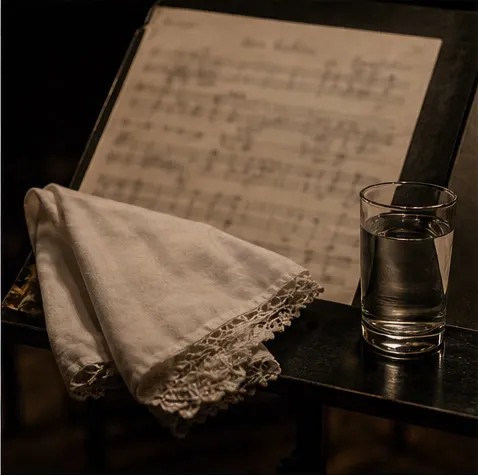
Breath and stamina therefore shaped interpretation without announcing themselves as a separate subject. A long introduction could establish the mode while also delaying the voice’s first expenditure. Instrumental answers distributed effort across the ensemble. A repeated line demanded judgment about what could be intensified now and what had to be reserved for a later section. The handkerchief and water glass familiar from performance photographs belong to this practical economy: ordinary tools beside an extraordinary public task, not props in a legend.
Modernization did not erase flexibility
The scale and timbre of Umm Kulthum’s repertory changed over decades. Larger string sections joined oud, qanun, violin, nay, and percussion. Amplification altered how a voice could occupy a hall. Composers brought different harmonic colors, instrumental textures, and approaches to form. The celebrated collaboration with Mohamed Abdel Wahab on “Enta Omri” placed electric guitar within an extended orchestral introduction before the voice entered. The National Library of Israel’s catalog identifies Abdel Wahab as composer and Umm Kulthum as performer, preserving the collaborative authorship often flattened by star biography. 8
Modern instruments did not automatically turn the music into a fixed Western orchestral object. The performance could absorb a new sonority while retaining its dependence on modal development, textual delivery, and responsive duration. Each addition received a specific job. An electric guitar could announce a phrase inside an Arabic long-song architecture; strings could broaden a transition without eliminating the singer’s freedom to reshape the next return.
“Al-Atlal,” composed by Riyad al-Sunbati from poetry by Ibrahim Nagi, shows another side of that late repertory. Its scale supports instrumental passages, contrasting sections, and repeated verbal points whose meaning can shift under performance. Linguistic analysis of the song emphasizes the relationship between its poetic discourse and its enduring public life. 7 Follow how the performance makes a known line newly consequential rather than hunting for the longest note.
Public meaning remained unstable
Umm Kulthum’s public position cannot be separated from twentieth-century Egyptian politics, but neither can it be reduced to a slogan about “the voice of a nation.” She worked through monarchy, revolution, Nasser’s republic, war, and shifting media institutions. Patriotic repertory, official roles, benefit concerts, and pan-Arab broadcast reach all mattered. So did love poetry, professional bargaining, commercial recording, and the audience’s investment in particular composers and songs.
Danielson treats popularity as something produced and negotiated, not as proof that a population spoke with one mind. 2 Listeners could attach political meanings to romantic lines without those meanings exhausting the poem. A performance gathered private memory and public circumstance in the same room. The singer’s precision let a phrase bear that weight without announcing a single authorized interpretation.
The recordings preserve more than a canonical voice after the original occasion has passed. They hold a relation among prepared material, physical risk, ensemble knowledge, and social response. The crackle, applause, and uneven duration are not defects around the song. They are evidence of what the song became that night.
Hear the decision inside the repeat
Begin with one returned phrase. Ignore, for a moment, the scale of the legend and the length of the track. Notice what stays stable: the words, the modal center, the ensemble’s point of return. Then notice what moves: the attack, the length of a vowel, the amount of silence before the answer, the audience’s volume, the instrumental response. The musical event lies in the difference between those two lists.
Umm Kulthum did not make spontaneity valuable by opposing it to composition. She made composition durable enough to invite choice. Nor did she dissolve authorship into the crowd. Poets, composers, players, singer, and listeners held unequal but connected parts of the evening. Her particular mastery was to keep those parts audible while deciding, in real time, how far a line could travel.
The title “long song” can sound like a measurement. In practice, length was a result. Time accumulated because words were worth returning to, because an orchestra could wait, because a radio network could carry a theater beyond its walls, and because the room’s answer changed the next decision. The song endured not by remaining identical, but by revealing how much identity could survive variation.