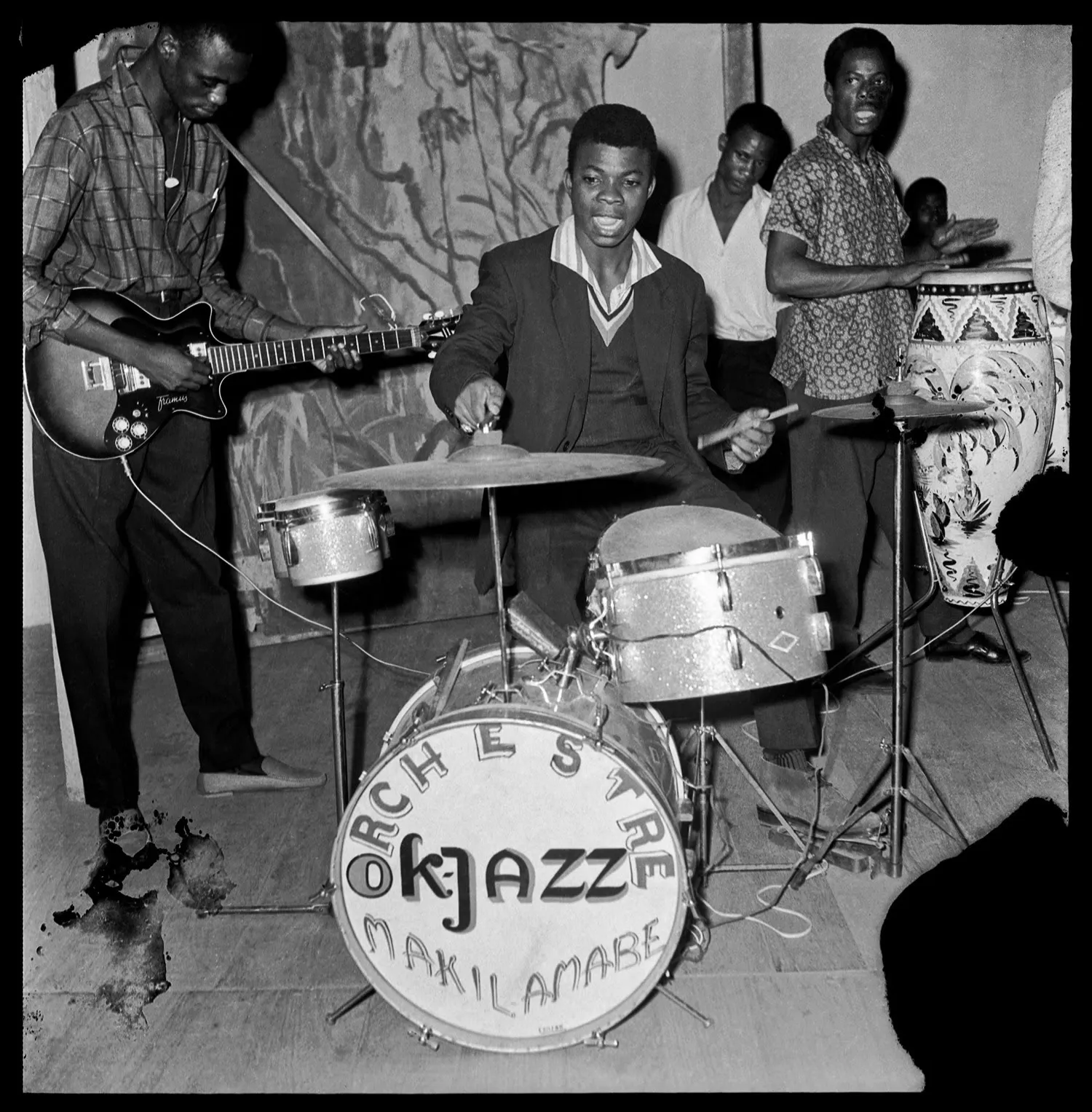

A Congolese rumba can change its job while the record is still playing. The opening section may carry a story through long Lingala lines, choral answers, and guitar replies. Then the arrangement turns. Short guitar figures begin to repeat, percussion exposes another layer, horns answer in blocks, and dancers receive more room than the narrative. The transition is not an exit from the song. It is the song opening into its sebene.
That turn became one of the defining devices of popular music in the Democratic Republic of the Congo and the Republic of the Congo. UNESCO describes Congolese rumba as an urban musical and dance practice used for celebration and mourning, in public, private, and religious spaces. Professional orchestras matter, but so do amateur performers, neighborhood clubs, schools, community groups, dancers, and audiences. The scene has always been larger than a shelf of famous records. 1
To hear how that scene works, listen past the lead guitarist. The force of a sebene comes from several musicians accepting narrower roles, repeating them, and changing them at the right moment.
The Atlantic did not carry a one-way influence
The word “rumba” can suggest that a Cuban form was simply imported into Central Africa. The history is more circular. Musical practices from the Congo region had already traveled to the Americas through the violence of the slave trade. Commercial recordings later carried Cuban son and other Afro-Cuban styles to African port cities. Musicians in Leopoldville, now Kinshasa, and Brazzaville heard those records alongside local dance music, church music, brass bands, and other regional currents. They did not preserve the imports unchanged. They built new ensembles around local languages, rhythmic knowledge, dancing, and electric guitars. 1 6
Calling the result a return to Africa is useful only if the return is understood as transformation. A record crosses the ocean without the social setting that made it. New players decide which phrase to retain, which instrument should carry it, and how long it must last for a local dance floor. Cuban-derived patterns could become material for a distinct Congolese orchestra rather than proof that one tradition owned the other.
The exchange also continued. Congolese rumba and its later related styles traveled across Africa and back into diasporic music. A practice-based SOAS study of Grupo Lokito examines contemporary links between Congolese and Cuban musicians precisely because the traffic did not stop after one historical encounter. 6
Two cities made an industry of movement
Kinshasa and Brazzaville face each other across the Congo River. Their colonial histories were different, yet musicians, records, broadcasts, dances, and reputations crossed the water. UNESCO identifies rumba as shared heritage of both Congos rather than the property of one capital. That recognition fits a form shaped by circulation even while particular bands and schools developed strong local identities. 1
Kinshasa’s growth concentrated studios, labels, performance spaces, and large audiences. The UNESCO Creative Cities profile names Olympia, Ngoma, and Loningisa among the studios where groups including African Jazz and OK Jazz began recording. A studio made a song repeatable beyond one night; radio and records made a local arrangement available for study elsewhere. A successful band could become an employer, a school, a touring company, and a public institution at once. 2
The city did not merely provide infrastructure around a finished genre. Its distances, languages, patronage systems, political pressures, and appetite for dancing affected how orchestras were organized. The scene’s scale encouraged specialization. A guitarist did not have to alternate between every possible function if three players could divide the neck into distinct registers and rhythmic jobs.
Three guitars divide the grid
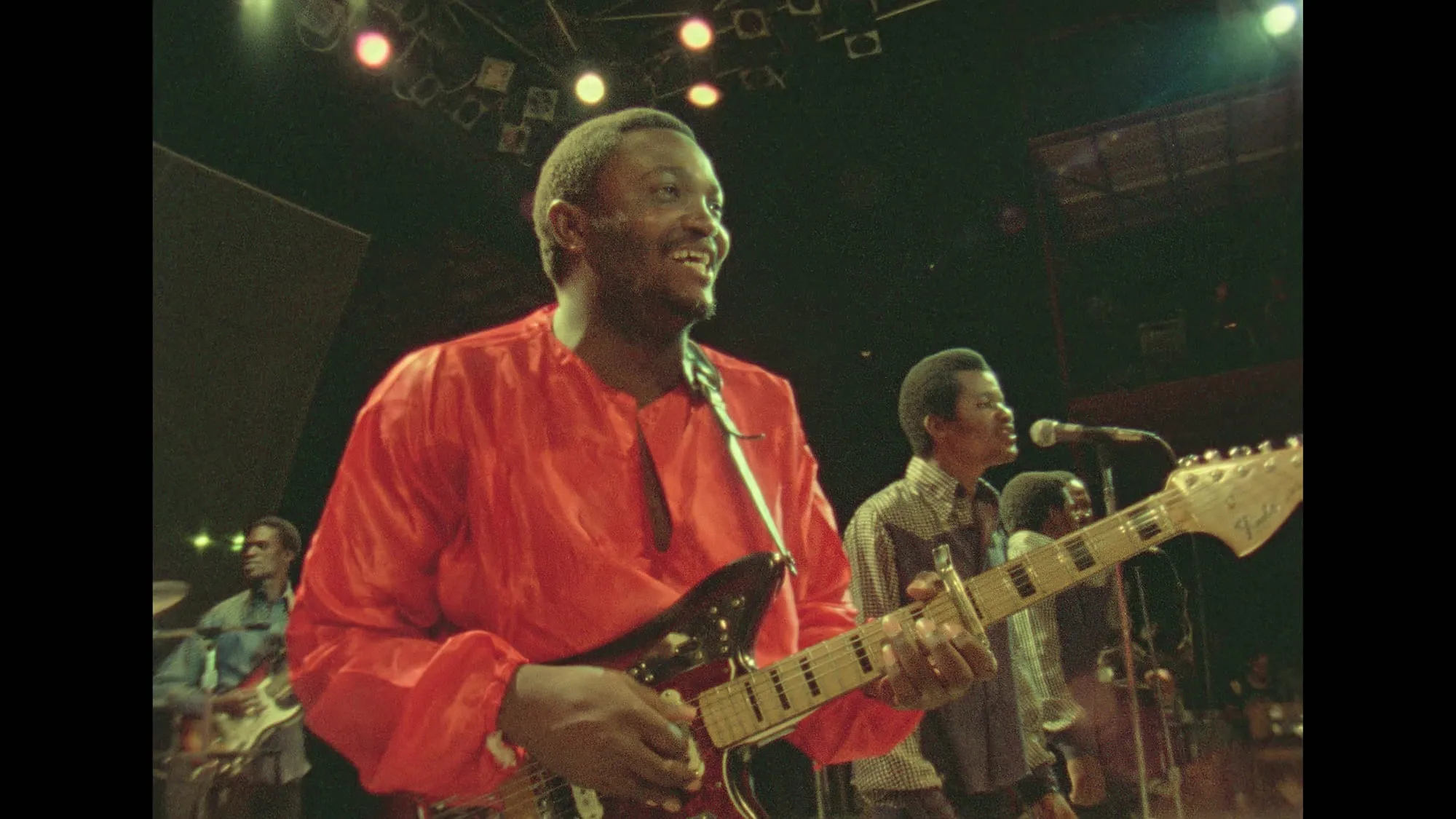
In the classic large rumba orchestra, rhythm guitar maintains a cyclic foundation. The mi-solo, literally “half-solo,” occupies an intermediate register and function. The lead guitar can answer a singer, vary a melodic figure, or direct attention toward a new section. Congolese scholars André Yoka Lye Mudaba and Manda Tchebwa identify the third, mi-solo role as a distinguishing feature of the music’s electric-guitar language. 7
The names can mislead if they are treated as a ranking. “Lead” does not mean the other two parts are generic accompaniment. Kasongo Musanga’s account of TPOK Jazz describes the rhythm guitar laying down a basic cycle while mi-solo and lead create intertwining lines. The mi-solo bridges high lead figures and the lower rhythmic part. Remove that middle and the arrangement loses a moving joint, not a layer of filler. 4
Bass, drums, congas, shakers, and other percussion give those guitar lines a floor and a set of gaps. Early ensembles could work without a drum kit, using hand percussion to produce overlapping pulses. Later kits did not simply replace that practice; the rhythm section was redistributed. Horns and reeds could answer voices, mark transitions, or enter as antiphonal blocks near a climax. 4
The principle resembles Africa 70 in The Band Was the Arrangement. Fela Kuti’s ensemble and a Congolese rumba orchestra do not sound alike, but both make a useful argument about scale. A large band becomes clear when each player owns a precise piece of time.
Repetition makes the sebene mobile
The sebene often follows a more text-centered rumba section. Several guitar ostinatos repeat against one another with small variations; strummed blocks may be less important than lines that interlock. A band can cycle one configuration, introduce another response, thicken the horn writing, or let a lead phrase become a cue. The listener hears continuity and acceleration even when the important change is density rather than a simple jump in tempo. 4
This is repetition used as coordination. Because a part returns, dancers know where its weight will land. Because it is short, another player can alter the composite without destroying orientation. Because the ensemble can remain inside the section, small changes gain force: a new bass answer, a drum accent, a shouted name, or a horn phrase feels large against a stable grid.
The break extension in Two Copies Made One Break uses a different technology to reach a related social result. A Bronx DJ moves between duplicate records to keep dancers inside one passage. A rumba orchestra composes and performs its dance passage collectively. Both reveal that duration is not empty space around musical content. Extending the right configuration creates another kind of event.
The record had to learn the band’s length
Congolese orchestras outgrew the short side of a disc. Musanga notes that as TPOK Jazz songs expanded during the 1960s and 1970s, releases sometimes divided one work across two sides: the vocal rumba on one and the instrumental sebene faded into the other. The medium did not invent the two-part design, but it made the join visible and occasionally inconvenient. 4
Longer formats let the architecture spread out. TPOK Jazz could sustain a sung argument, open the arrangement, and let several instrumental cycles accumulate. “Bina Na Ngai Na Respect,” discussed by Musanga as a major example, runs for more than seventeen minutes. Length here is not progressive-rock prestige or an unedited jam. It gives social narrative and dance mechanics enough room to coexist. 4
Studio development also allowed Franco to multiply guitar parts beyond the live three-role model. Musanga points to the 1983 album Missile, where some tracks use extensive guitar overdubbing. The studio could thicken the orchestra, but the basic intelligence remained one of differentiated lines. More tracks were useful when they had separate work to do.
Independence entered the repertoire immediately
In early 1960, musicians associated with African Jazz and OK Jazz traveled to Brussels during the political negotiations that preceded Congolese independence. Accounts of who organized and financed the group differ, a disagreement the Royal Museum for Central Africa’s exhibition booklet preserves instead of smoothing away. The resulting “Indépendance Cha Cha” named delegates and parties while events were still unfolding. 3
The song became an anthem beyond the Congo because it turned political names and a complex negotiation into portable collective memory. It did not offer a neutral report. It made independence singable and danceable at the moment a nation was being argued into existence. The museum describes Congolese political song as an instrument of communication; that function complicates any division between serious history and popular entertainment. 3
Rumba could carry romance, satire, praise, warning, fashion, grief, and public news because the vocal section allowed language to remain central. The sebene did not cancel those words. It changed how bodies held them after the narrative had been delivered.
A bandleader’s power was audible and political
Large orchestras needed leaders who could recruit musicians, secure work, distribute money, choose repertoire, manage factions, and maintain public relationships. Those duties made the band a place where authority was practiced, not merely represented in lyrics. Bob W. White’s ethnography Rumba Rules examines how leadership and dependence inside Kinshasa’s music scene echoed political power during Mobutu’s Zaire. 5
The relationship was not simple propaganda. State promotion could make music a national resource while censorship, patronage, and economic insecurity constrained musicians. White also documents libanga, the calling of wealthy or powerful names during performances in exchange for support or protection. A shout inside a dance passage could therefore work as rhythm, public acknowledgment, and economic transaction at once. 5
Franco and TPOK Jazz became exceptionally visible within that system, but a history built only around commanding male bandleaders reproduces their hierarchy. UNESCO’s heritage record stresses that women played major roles in the development of religious and romantic styles. Singers such as Mbilia Bel made voice, phrasing, image, and stage presence central to later rumba. Dancers, patrons, composers, chorus singers, and listeners also determined which arrangements lived beyond rehearsal. 1
Heritage status did not close the form
UNESCO inscribed Congolese rumba on the Representative List of the Intangible Cultural Heritage of Humanity in 2021. The listing describes transmission through neighborhood clubs, formal schools, community organizations, and apprenticeship. That emphasis matters more than a ceremonial label. Living heritage requires people who can still assemble the parts, teach the transitions, repair instruments, negotiate work, and bring dancers into the next cycle. 1
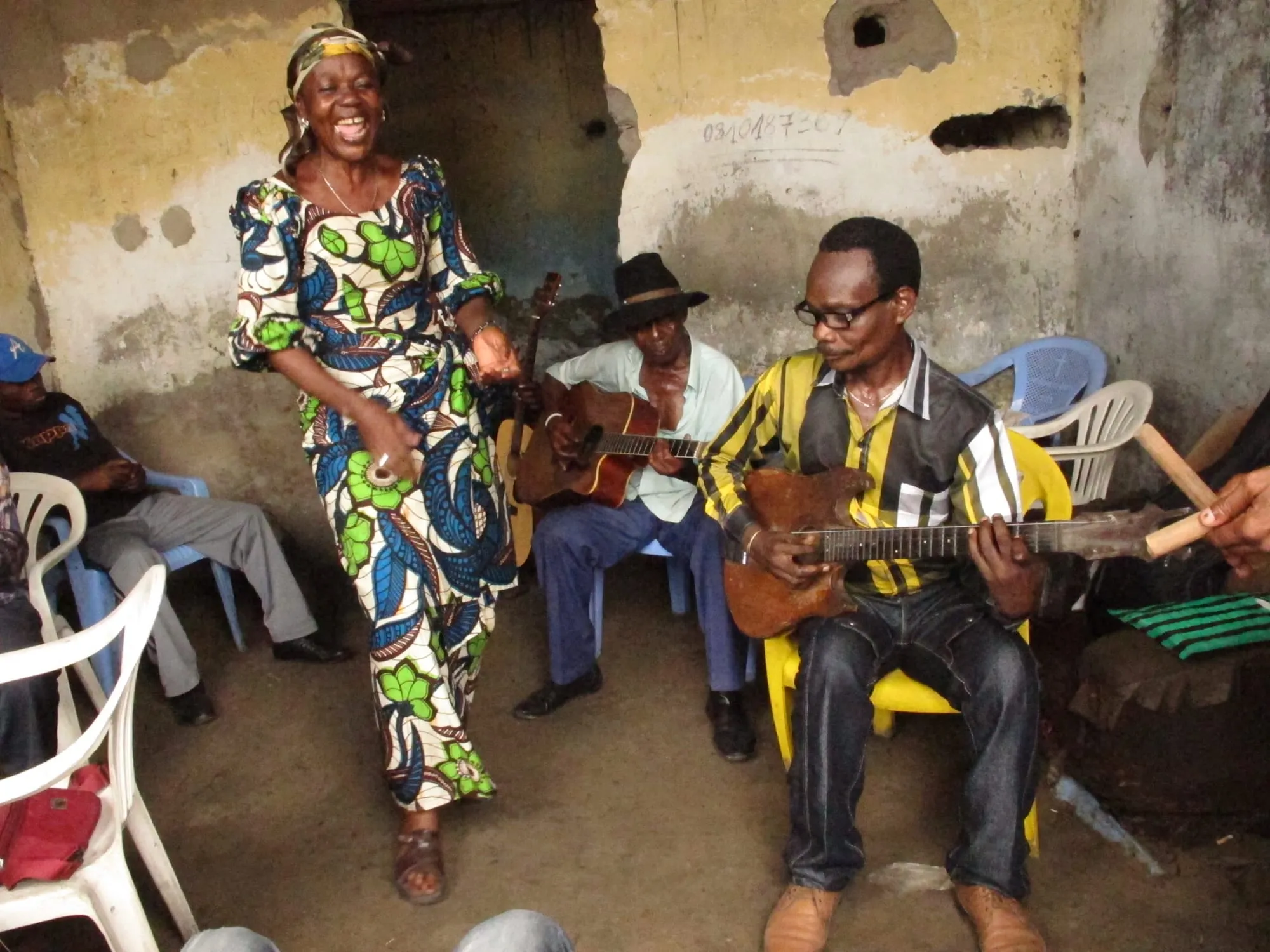
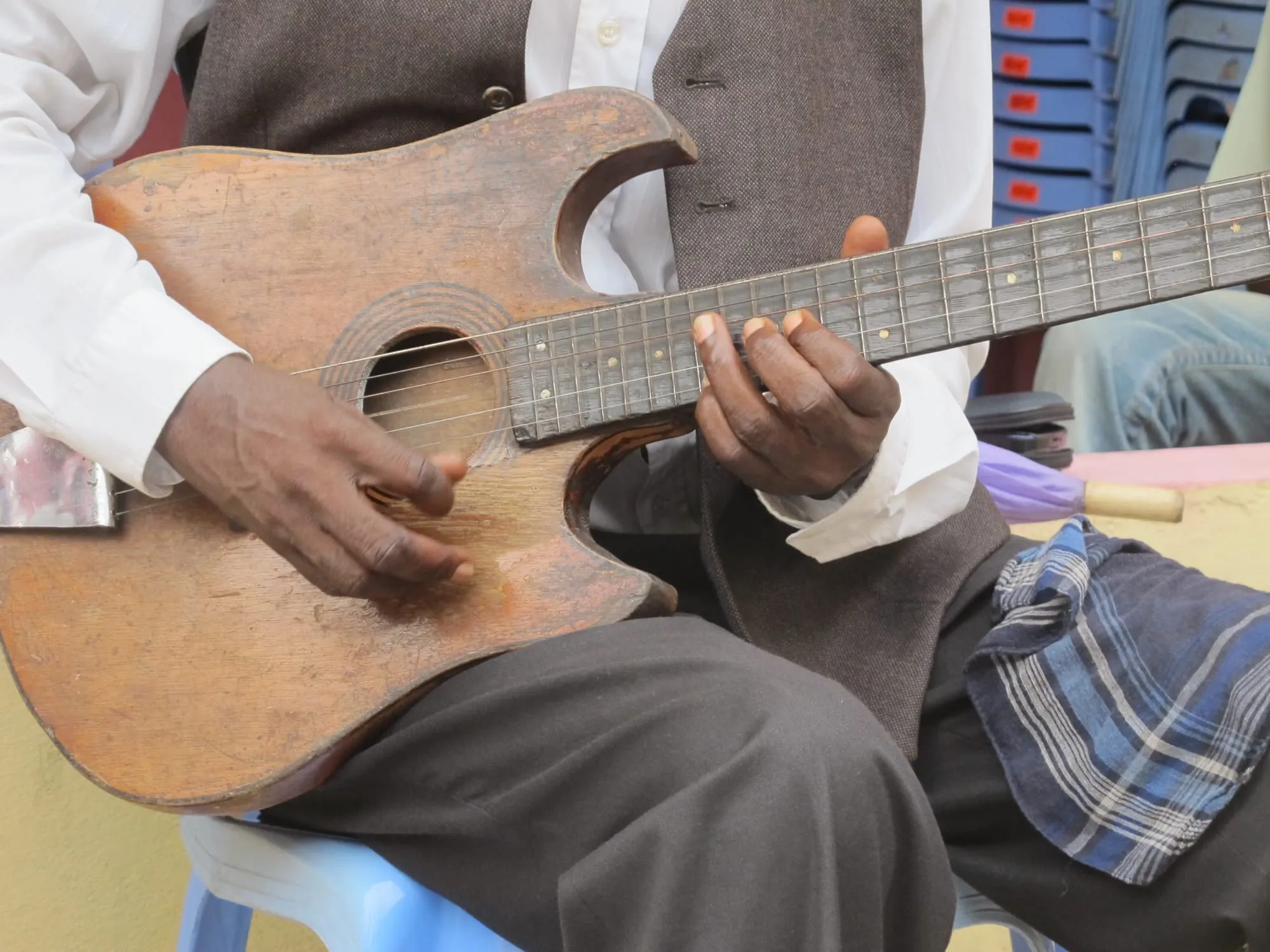
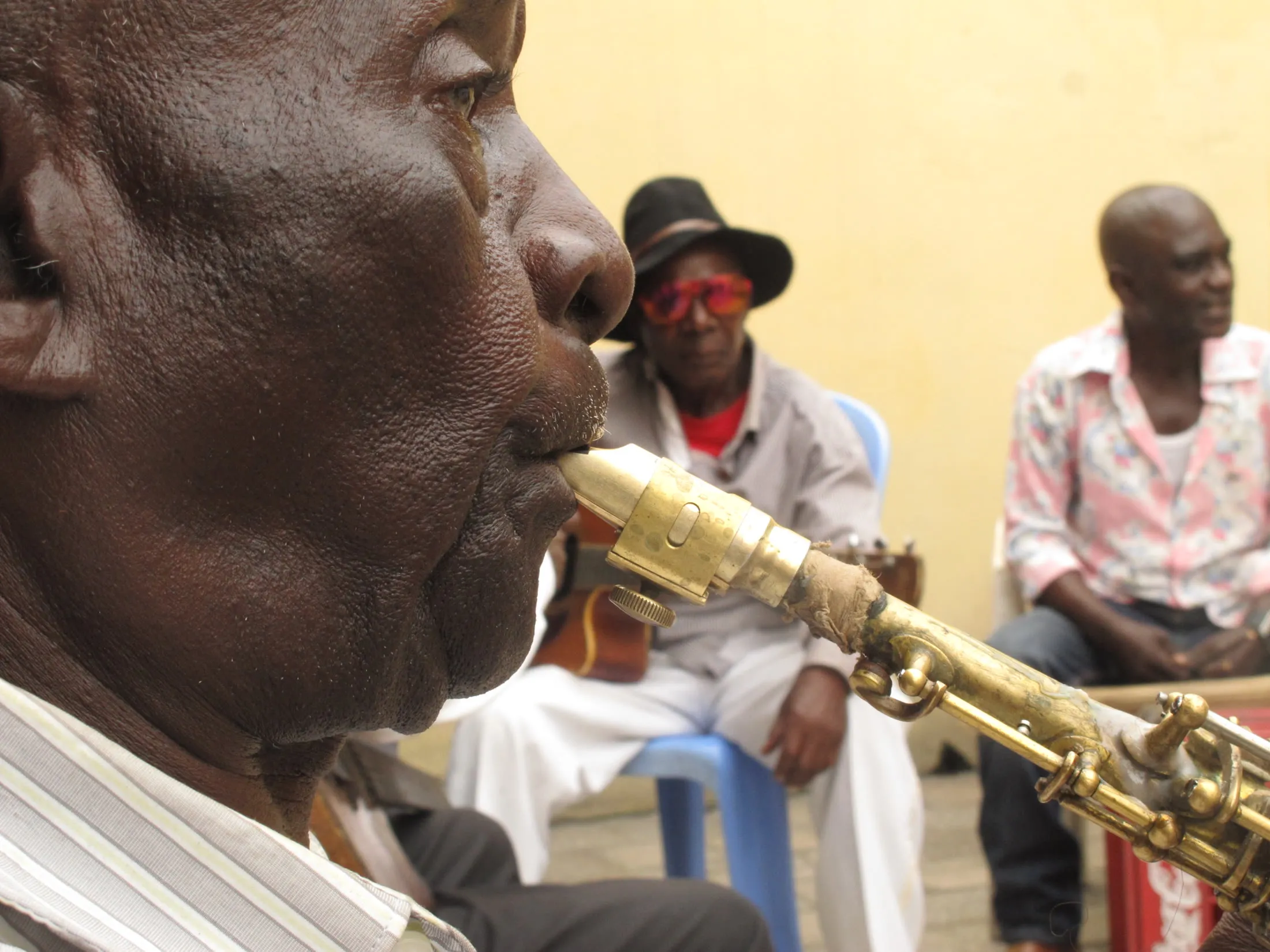
A rehearsal by Bakolo Music International shows the scale at which survival often happens: musicians close enough to watch hands, exchange cues, and correct a figure before it reaches a stage. An artisanal guitar can carry the music because the decisive specification is not printed on a headstock. It lies in how a player places a repeated line among the others.
The form also keeps changing. Preservation should not freeze one 1960s arrangement as the only authentic rumba. UNESCO’s account includes professional and amateur practice across two countries and a diaspora. The stable inheritance is partly a method: turn circulation into local language, divide the ensemble intelligently, and let repetition support both memory and motion.
Listen for the hinge
Start with “Indépendance Cha Cha.” Follow the names and chorus, then notice how compactly the guitars and percussion make political information move. The record is short compared with later TPOK Jazz works, but it demonstrates that communication and dancing were never separate departments. 3
Then hear Franco and TPOK Jazz’s “Bina Na Ngai Na Respect.” Do not wait only for a heroic solo. Choose the lowest repeating guitar figure, locate a middle answer, and let the bright lead line arrive last. When the texture thickens, ask which part actually changed. Often the climax comes from a new relationship among repeated lines rather than from everyone playing more notes. 4
Finally, put the voice back at the center with “Kinshasa Mboka Ya Makambo.” Musanga hears Franco’s delivery there as closer to preaching than smooth crooning, followed by a guitar release. The contrast shows why “vocal section” and “dance section” are descriptions, not value judgments. Rumba needs the pressure of the story for the opening of the sebene to mean something. 4
When that hinge arrives, the song has not run out of words. The orchestra has translated their weight into a system that dancers can occupy.