

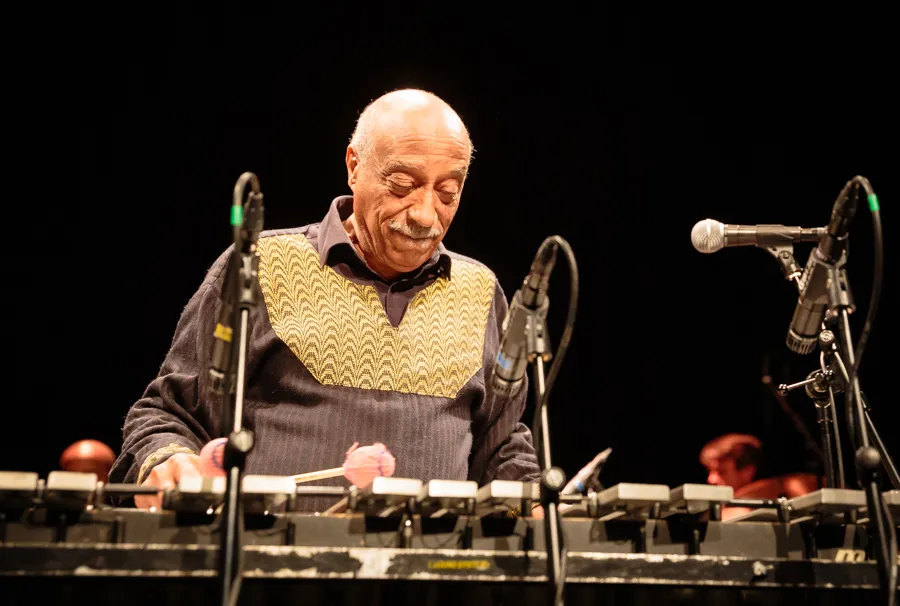
On “Yekermo Sew,” the vibraphone does not float above the band. Its struck metal bars place bright, short notes inside a darker arrangement of horns, electric keyboard, bass, drums, and percussion. A note blooms, but its attack remains audible. The line can answer a saxophone, mark a harmonic turn, or leave space for the rhythm section to continue without it. Mulatu Astatke made that balance one of the signatures of Ethio-Jazz: resonance with edges, melancholy carried by an ensemble that keeps moving. 4 8
The route to that sound ran through Addis Ababa, North Wales, London, Boston, and New York, then back to Addis. Travel mattered, but not because each city donated a genre to an international collage. Astatke studied how bands were organized, how harmony could support a melody, how Latin percussion sat against bass and drums, and how the vibraphone could lead without imitating a singer or horn. He returned to Ethiopian modes as the foundation on which those techniques could operate. 2 4 5
Calling Astatke the father or inventor of Ethio-Jazz recognizes a real act of naming and sustained compositional work. It can also shrink the field around him. Addis already had singers, arrangers, theatre bands, military ensembles, nightclub musicians, recording technicians, and audiences accustomed to hearing Ethiopian melodies alongside imported dance forms. His records depended on that musical society. The distinct achievement was not creating modern Ethiopian music from an empty room. It was building a durable method inside an active one.
Addis already had an orchestra
Astatke remembered the National Theatre band as an early musical stimulus. By the 1940s and 1950s, Addis ensembles had accumulated a complicated history: brass instruments brought through diplomatic exchange, school and military bands, theatre orchestras, and urban groups performing Ethiopian tunes alongside mambo, boogie-woogie, and big-band repertory. This was not yet Ethio-Jazz, but it meant that arranged instrumental music and musical translation were present before Astatke left the country. 4
“Traditional” and “modern” were not two sealed boxes waiting for one composer to connect them. Ethiopian singers worked with institutional bands. Brass and reed players carried melodic practices into new ensemble sizes. Nightlife created practical demands for dance sets, accompaniment, amplification, and repertory that could move between local and imported forms. Astatke’s later use of electric keyboard or conga therefore entered an environment that already knew adaptation, even when particular combinations met resistance.
His own memories also began with arrangement. He recalled hearing the National Theatre band perform Ethiopian tunes and other music at large social events, paying attention to singers and to the way the material had been organized for ensemble. That focus would remain. Astatke became known as a vibraphonist, but he worked as composer, arranger, bandleader, percussionist, keyboard player, educator, and club founder. The record was never only the sound of his mallets. 4 6
Study changed the route
In 1956 Astatke went to North Wales with the expectation that he would study engineering. Music lessons redirected him. He learned trumpet, then continued at Trinity College of Music in London. During visits and study in the city he encountered West African and Caribbean musicians performing their own repertories for British audiences. In interviews, he described their cultural confidence as a challenge: an Ethiopian musician traveling abroad should develop work grounded in Ethiopian music rather than disappearing into imported forms. 3 4
Boston supplied another kind of training. In 1958 he enrolled at the institution then called the Schillinger House of Music, shortly before it became the Berklee School of Music. Berklee identifies him as its first African student and records that he studied vibraphone and percussion there. The vibraphone was an unusual choice for a musician whose later project would be identified with Ethiopia. Its metal bars, motor-driven resonators, pedal-controlled sustain, and capacity for chords offered a different problem from trumpet: how could one player combine line, harmony, attack, and decay? 1 4
New York added work rather than just influence. Astatke performed, arranged, recorded, and formed the Ethiopian Quintet. He moved through jazz and Latin-music settings, hearing congas and bongos function as structural voices rather than exotic additions. His Afro-Latin Soul records placed Ethiopian identity in the title while drawing on musicians working in New York. The sessions were not the final formula imported intact to Addis. They were a laboratory in which instrumentation, rhythm, and naming began to align. 2 4
Four modes are not a shortcut
Astatke has repeatedly described Ethiopian modes as the base of his work. Tizita, Bati, Ambassel, and Anchihoy are commonly introduced as four pentatonic qenet, or modal families. The summary is incomplete. A five-note collection does not by itself specify a composition’s contour, tuning inflection, rhythmic placement, register, ornament, or emotional association. Musicians learn modes as living repertory, not four scale diagrams detached from songs and performance. 5 7 8
Astatke’s compact explanation is architectural: put the Ethiopian modes underneath and “the world” above them. Taken literally, that image can make the parts sound too neatly stacked. On record, they interact. A horn voicing can emphasize the distances inside a mode. A bass line can make one degree feel like a center. Congas and drum kit can divide the pulse differently without erasing the melodic identity. Vibraphone sustain can blur an interval that a plucked instrument would state sharply. 5
Ethio-Jazz is more than pentatonic melody over a jazz rhythm section. Astatke studied harmony and large-ensemble writing, but he also worried that conventional jazz harmony could pull the music away from its Ethiopian character. The problem was one of balance. Chords had to support modal identity rather than treating it as a surface tune awaiting familiar changes. The method took time because the techniques could not simply be added; they had to be made to constrain one another. 4 5
The vibraphone found a job in Addis
When Astatke returned to Ethiopia in the later 1960s, the vibraphone gave his arrangements a recognizable center. Its attack could double a melodic fragment with horns; its sustain could occupy the gap between organ and percussion; its range allowed bass-adjacent figures and bright upper-register replies. He also used electric keyboards, wah-wah guitar, congas, and bongos in arrangements whose rhythm sections drew on Latin music without abandoning Ethiopian melodic organization. These sounds were absorbed gradually and were sometimes rejected as foreign. 1 2
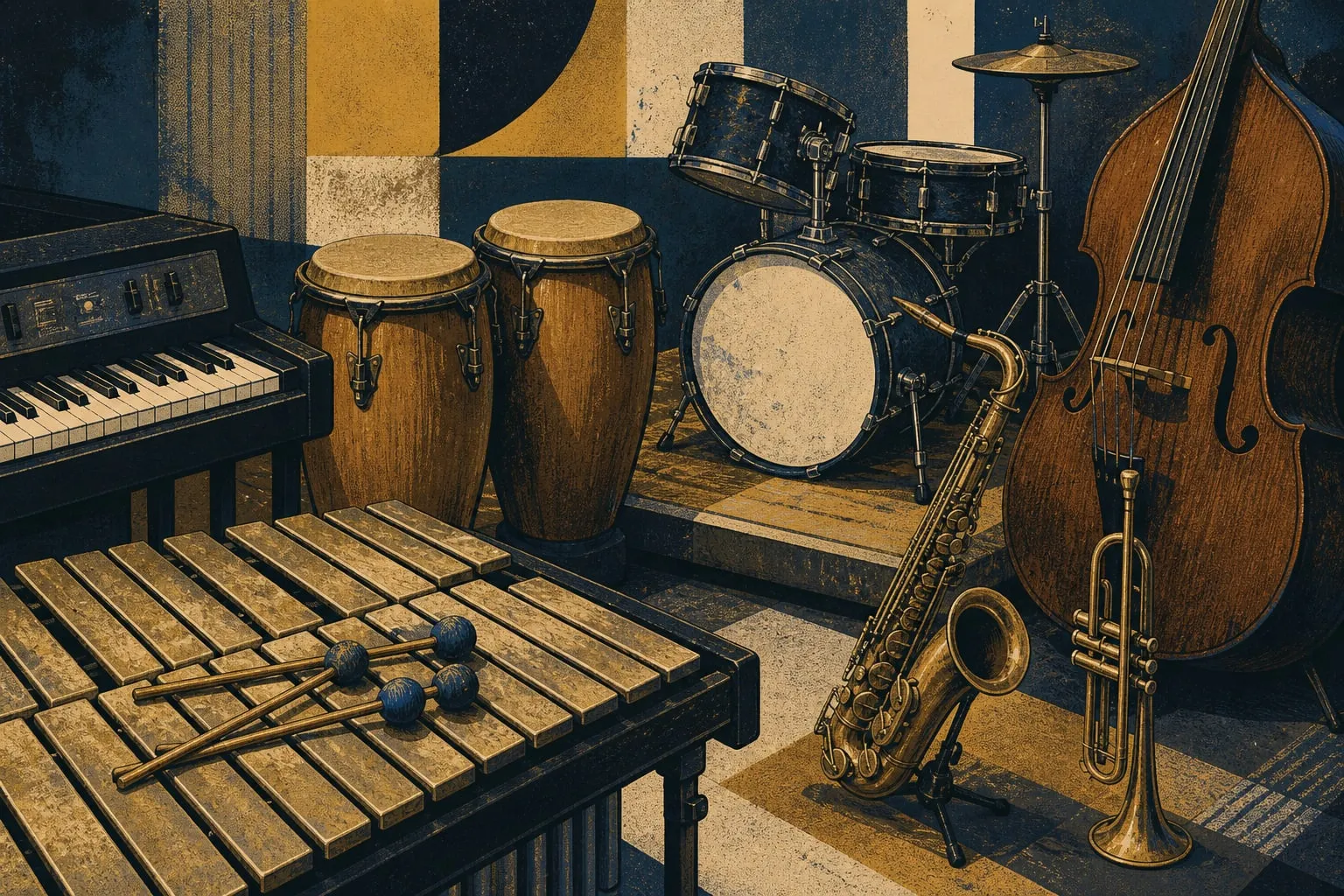
The 1972 recording “Mulatu” offers a compact inventory without sounding like one. Berklee’s account identifies vibraphone, tenor saxophone, horn section, wah-wah guitar, congas, bass, and drums. The significance lies in allocation. Wah-wah guitar supplies moving texture rather than a rock solo; percussion broadens the beat rather than replacing the kit; the vibraphone can state a figure and then release it to the horns. No instrument has to stand for an entire country or genre. Their functions create the identity of the arrangement. 1
That functional approach also distinguishes adoption from decoration. A conga added for one accent would signal Latin music from the outside. Congas working continuously with bass and drum kit alter the internal division of time. A vibraphone used for a brief shimmer would be a color; one entrusted with recurring melodic and harmonic work becomes part of the grammar. Astatke’s combinations lasted because the borrowed tools were given jobs.
Partnership with Amha Eshete’s independent Amha Records helped move the work into circulation. The label connected composers, singers, bands, studios, pressing, and buyers during a fertile period of Ethiopian recording. Astatke arranged for other performers as well as leading instrumental sessions under his own name. Authorship therefore spread across functions: he could provide the composition and voicing, while particular horn players, rhythm sections, engineers, and label decisions determined the recorded event. 2 4
Discography alone gives an incomplete view. An arranger can change another singer’s record without appearing as the name on its cover. A label can make a session possible and decide which side of a single reaches shops. A theatre or police band can supply musicians whose institutional employment sits far from the independent record through which listeners later know them. Ethio-Jazz was audible on particular releases, but its labor network exceeded the artist line.
“Yekermo Sew” shows how much can happen without overcrowding the frame. The title comes from a phrase associated with experience and a blessing for reaching the next year. Astatke connected the composition to older people and to hours spent listening to azmari musicians. The performance does not illustrate those references with a quoted folk tune announced as proof. It builds gravity through melodic shape, measured tempo, low instrumental color, and a vibraphone line that sounds reflective because the whole arrangement gives reflection a pulse. 4
A band made the method audible
The language of individual invention can hide the musicians who made Astatke’s arrangements work. A vibraphone phrase needs a bass placement beneath it and a drummer who knows whether to close or open the space after the attack. Congas can reinforce a pattern or pull against it. Horn voicings depend on differences among trumpet, tenor, baritone, and the players’ control of articulation. Electric guitar and organ can thicken the middle until the vibraphone disappears, or leave a narrow lane in which it reads clearly.
Ethio-Jazz emerged from those choices in rehearsal rooms, clubs, theatres, radio, and studios. Astatke supplied an unusually coherent method and a name, but he did not perform every layer. The term “father” is most accurate when it identifies responsibility for an enduring compositional project. It becomes misleading when it turns colleagues into anonymous carriers or treats other Ethiopian modernists as branches of his biography.
The 1973 visit of Duke Ellington’s orchestra made the exchange public at another scale. Astatke performed with the band in Ethiopia, an event often used as a convenient meeting of American jazz stature and a new Ethiopian form. The daily work was already underway. By then, Astatke had studied and recorded abroad, returned, written arrangements, worked with Ethiopian musicians, and established sounds that did not require external confirmation to exist. 2 4
The night closed early
The 1974 revolution and the Derg military government transformed musical life in Addis. Astatke recalled a 10 p.m. curfew and official scrutiny of lyrics before recording sessions. Instrumental music did not escape the broader contraction of nightlife, recording, movement, and public culture. A scene built partly through clubs and social gathering could not continue under the same conditions when the night itself was shortened. 3
Astatke remained active, but innovation did not lead smoothly to international success. Musicians left, careers were interrupted, and recordings became difficult to find outside Ethiopia. Astatke’s ability to travel gave him connections unavailable to many colleagues. Later recognition was not simply delayed applause for records that had always circulated evenly. It depended on diaspora, reissues, festivals, film, and new collaborations that moved a partial archive through different markets. 4
The records traveled again
The Éthiopiques reissue series made Astatke’s work from 1969–74 available to many listeners who had not encountered the original Ethiopian releases. Jim Jarmusch then used several compositions in the 2005 film Broken Flowers. The soundtrack placed the music inside a story of travel and belated discovery, while the film’s reach created another round of travel for the recordings themselves. Astatke’s international visibility increased because distribution changed. Music can appear newly invented when access is what changed. 4 6
Reissue also rearranges context. Tracks originally distributed across labels, singles, albums, and collaborations can return as one coherent retrospective sequence. That coherence helps a listener hear recurring methods, but it can flatten the differences among original sessions and detach Astatke from the wider field of Ethiopian singers and bands. The later route made his achievement easier to recognize; it did not make the surrounding history unnecessary.
Collaborations with the Either/Orchestra and the Heliocentrics did more than reproduce old arrangements for new audiences. They tested what remained essential when personnel, studios, and decades changed. The Harvard Gazette documented Astatke performing alongside Ethiopian musicians and the Either/Orchestra during his Radcliffe year; MIT teaching material placed his compositions beside Ethiopian modes, traditional instruments, and new arrangements. The work was presented as a continuing practice of comparison, not a sealed 1970s style. 7 8
Research on instruments extended that practice. At Radcliffe, Astatke proposed work on an electronically developed krar and on the historical roles of Ethiopian instruments. These interests complicate the image of an artist defined by bringing a Western vibraphone home. The longer project moves in both directions: adopting an instrument, protecting modal identity, studying indigenous technologies, and asking how an ensemble might change without making its sources interchangeable. 6
Listen for what holds the route together
Begin with the vibraphone attack, then listen past it. Which instrument completes the phrase? Does the bass confirm the note or create tension beneath it? Are the congas doubling the drum kit, dividing the beat, or occupying a separate layer? When horns enter, hear whether they announce a new section or change the color of a line already present. Ethio-Jazz lives in these negotiated functions more than in a checklist of Ethiopian, jazz, and Latin elements.
Astatke’s route was long because each stop altered the work. Addis provided an arranged urban music before departure. London sharpened the question of cultural purpose. Boston supplied formal training and the vibraphone. New York supplied band work, Latin percussion, recording, and a name. Return turned those studies into a public practice with Ethiopian musicians and audiences. The result belongs beside Mary Lou Williams’s history at the keyboard: not a clean march between styles, but a musician using arrangement to show that the borders had never been as fixed as the labels suggested.

.jpg)
_-_Primavera_2013.jpg)

