
The black X began as a practical mark. At the Mabuhay Gardens in San Francisco, the Teen Idles saw club staff draw it on the hands of underage customers. The mark told the bar not to serve them. Back in Washington, the band proposed the same arrangement to clubs that otherwise excluded teenagers. A restriction became a way through the door. The X later accumulated meanings around straight edge, but its first useful work in this story is simpler: it separated admission from alcohol sales. 1
That small negotiation shows how Washington hardcore repeatedly turned limits into procedures. When clubs would not admit young listeners, bands looked for another admissions policy or another room. When no label existed to document them, they paid for a record themselves. When newspapers ignored the music, participants made zines. Years later, when hundreds of live tapes sat in storage, they organized an archive. None of those moves guaranteed good music. They did change who could make it, hear it, and remember it.
Before Dischord had a catalog
Washington already had a radical musical example before Dischord. Bad Brains formed in the capital in the late 1970s and joined exceptional speed to abrupt rhythmic control. They could pivot between compressed hardcore and reggae without treating either as a novelty. Their musicianship made the emerging local punk vocabulary sound less like a copy of records arriving from London or New York. The city had its own pressure and its own players. The Smithsonian’s account of D.C. music places punk beside go-go and other local practices rather than presenting it as the city’s only underground culture. 7
The Teen Idles were younger and less technically commanding. A 1980 West Coast trip showed them practices they could bring home. They encountered the hand-X policy, saw independent punk operating at close range, and returned with a clearer idea of what could be built at home. When the band broke up, it had $600 in savings. Ian MacKaye and Jeff Nelson used that money to press the eight-song Minor Disturbance EP. The release became Dischord number one. It was not launched with a business plan for a durable label; it was a way to stop one band’s work from disappearing. 1
The money that came back from the record was assigned another job. Instead of being divided as a final payment, it helped finance a release by State of Alert. The same principle could repeat: one record might create enough capacity for the next. Dischord therefore began as a modest revolving mechanism, not as a gatekeeper waiting for a finished scene to present itself. State of Alert did not wait for that mechanism and financed its own No Policy EP, but Dischord distributed it within the growing sequence. 2
A room without a protected stage
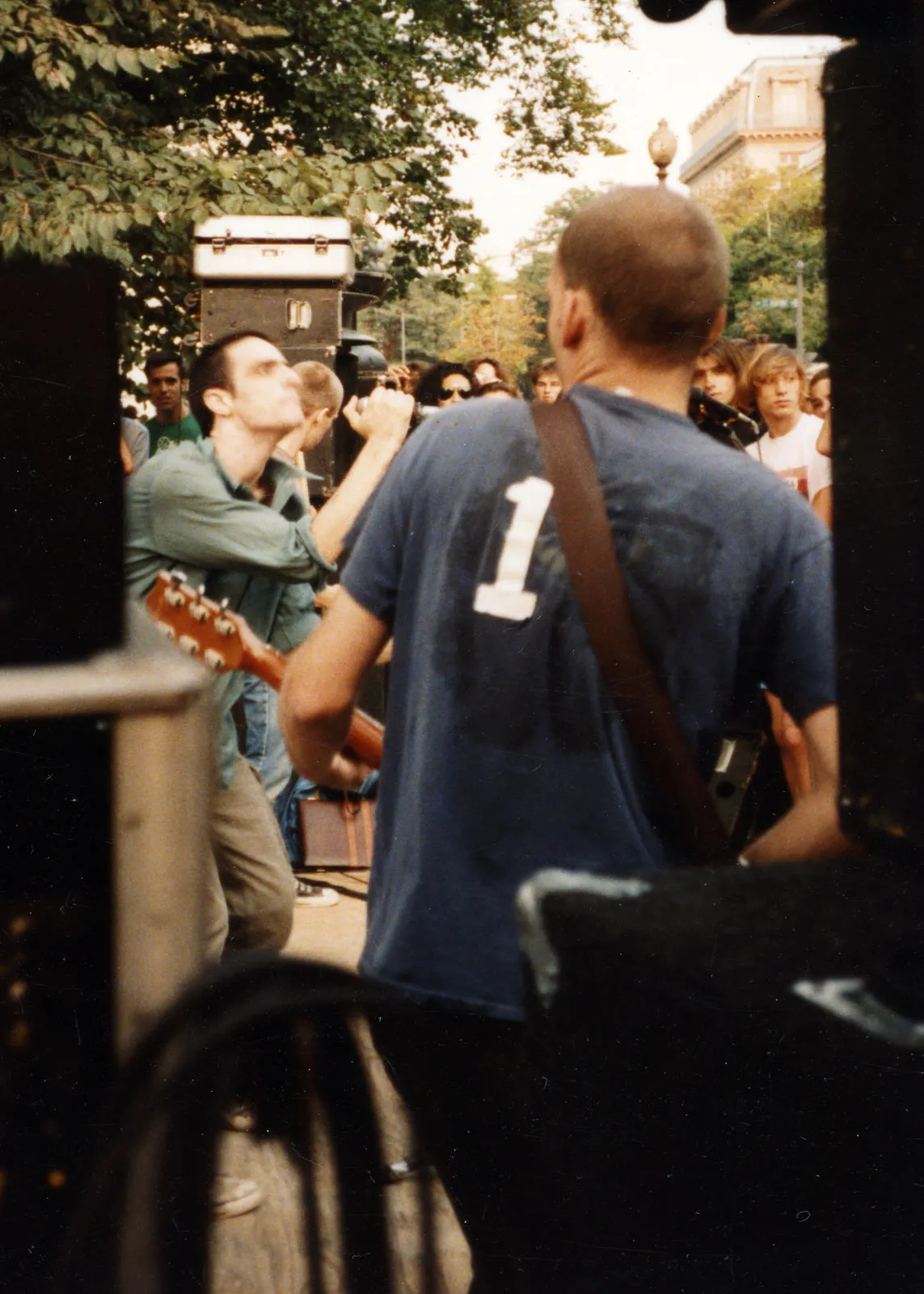
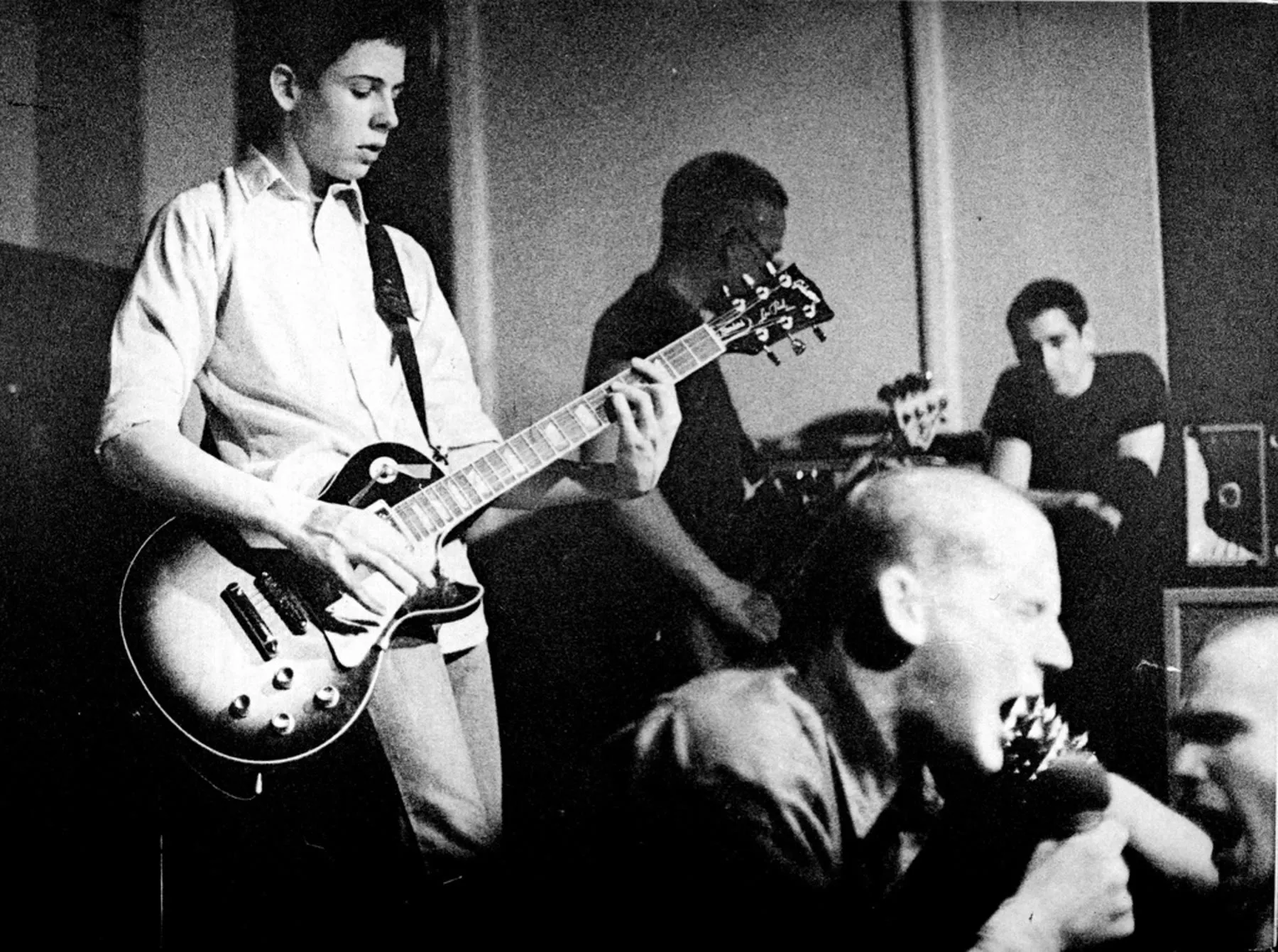
The early photographs look crowded because the spaces were crowded. At the Wilson Center, a hall in the basement of a former church, the edge of the performance area could be only a step away from the audience. That proximity was not automatically democratic; small scenes can be cliquish, violent, and difficult to enter. But the room did not hide the labor of performance behind a large production. Cables, amplifiers, bodies, and the people keeping the show together remained visible.
All-ages access changed the time horizon of the scene. Teenagers did not have to wait until twenty-one to become regular listeners, learn how shows worked, meet potential bandmates, or volunteer. A younger audience could move quickly from watching to doing. The policy also complicated booking. A promoter could not rely on alcohol revenue, and a band that insisted on all-ages admission often had to use church halls, community rooms, or other temporary spaces. The Smithsonian’s oral history describes early D.C. shows as places where children could attend because alcohol was absent from the event rather than the reason for it. 9
Those agreements functioned as infrastructure. Someone had to rent the room, negotiate with its owner, assemble a bill, borrow a public-address system, make a flyer, collect a small door charge, and leave the building usable. A hardcore show depended on that entire chain of decisions. Failure at any link could cancel the night. Success created knowledge that the next group could reuse.
The X did not settle every argument
The hand mark traveled farther than the specific admission policy that inspired it. Minor Threat’s brief song “Straight Edge” gave a name to MacKaye’s refusal of alcohol and drugs, and listeners elsewhere developed that statement into an identity with its own symbols and rules. The transformation was larger and less controllable than one band’s intent. Treating the whole D.C. scene as straight edge, however, flattens its disputes and its musical range. It also mistakes a famous lyric for the entire operating system.
The underlying dispute concerned control over conditions. D.C. bands argued about behavior, politics, violence, gender, and the limits of the scene itself. The “Revolution Summer” period in 1985 pushed some musicians toward more openly personal writing and explicit criticism of macho conduct at shows. Rites of Spring, Embrace, and other bands did not sound identical to the first hardcore burst. A local network mattered because it could hold disagreement and change, not because everyone followed one program. 8
Zines made those arguments portable. Titles such as Truly Needy, Greed, and Thrillseeker covered local groups from the viewpoint of participants. Later D.C. publications continued that work and challenged the scene’s assumptions. A zine could mix interviews, reviews, letters, graphics, and practical information without waiting for an editor outside the community. Its rough production was not proof of honesty, but it gave writers direct responsibility for what they printed. 8
The pages also reveal what a record label cannot. A catalog tends to make a scene look orderly: release numbers advance, bands receive concise biographies, and surviving music can be placed in sequence. Zines retain unfinished arguments and information that mattered for only a week. They show which groups shared bills, which behavior was being criticized, and which people felt excluded from the dominant version of punk. Read beside the records, they replace a clean family tree with a busier social record.
D.C.’s identity as a majority-Black city also complicates the familiar picture of white suburban hardcore. Bad Brains were central innovators, while go-go filled local rooms through a different performance economy built on sustained rhythm and audience exchange. The scenes were not interchangeable. Their coexistence shows that hardcore developed inside a city with musical systems beyond the small punk circuit. The Smithsonian’s D.C. programs place those histories alongside one another without forcing them into a single genre narrative. 7
Price as part of the composition
Fugazi formed in 1987 after several earlier D.C. bands had ended or reorganized. Its music made room for silence, dub-informed bass movement, overlapping guitar parts, and two contrasting vocalists. The band’s administrative choices were equally deliberate. It managed itself, released its recordings through Dischord, required all-ages concerts, and tried to keep admission inexpensive. Dischord describes the usual ticket range as five to seven dollars during the band’s active years. 3
A low price limited which promoters and venues the band could accept. An all-ages requirement ruled out some clubs. Refusing conventional merchandising removed a familiar source of touring income. Those decisions did not place Fugazi outside commerce; records and tickets were still sold. They made price and access part of the production brief, alongside the sound system and the length of the set.
That position also depended on accumulated capacity. By then Dischord had a catalog, a mail-order operation, knowledge of pressing and distribution, and an audience that understood the label’s local identity. Fugazi could work independently because earlier records had built tools and relationships. Here, DIY meant keeping that network answerable to the people using it, with many people still doing the work.
The label’s plain presentation reinforced that accountability. Catalog numbers and a Washington address made records easy to identify as related without requiring the bands to share a logo or a fixed sound. Mail order extended the counter beyond the city. Someone who could not attend a Wilson Center show could still order an EP, read the insert, and write back. That correspondence did not reproduce the local room, but it allowed procedures developed there to travel with the music.
The show becomes a record
Fugazi’s sound engineers recorded more than 800 concerts. The recordings vary because rooms, equipment, tapes, and live mixes varied. Instead of presenting only a few polished performances, the Fugazi Live Series set out to make the working archive available with dates, venues, flyers, photographs, recording notes, and audience corrections. The suggested download price followed the familiar five-dollar figure, with a sliding-scale option. 4
An archive at that scale shifts attention beyond canonical albums and professionally filmed concerts. A poorly balanced cassette from an ordinary night can document how arrangements changed, how a room responded, and how touring actually sounded. Gaps and mistakes remain audible, making the band’s labor inspectable across hundreds of nights. Repeated versions of the same song also expose choices that a studio album fixes in place: altered tempos, longer transitions, and responses to different rooms.
The Library of Congress described MacKaye’s work in terms of citizen archiving: people close to an activity preserve material before an institution knows what will matter. That description fits the line from the Teen Idles’ eight-song EP to the live series. The first record saved a band that had already ended. The later project organized a thousand-show career without pretending that only its cleanest nights deserved memory. 6 5
What remained after the ink faded
The black X washed off. Its procedure did not. An event could admit young people and still protect a venue’s license. A defunct band could use its remaining cash to press a record. Sales from that record could support another. A cheap show could be difficult to book yet possible to repeat. A box of tapes could become a public catalog rather than a private remainder.
Washington hardcore is often compressed into speed, shaved heads, straight edge, and a handful of revered sleeves. Behind those images ran a set of practical questions: Who is allowed in? What does admission cost? Who owns the recording? Where does the money go next? Who keeps the evidence? The answers were never perfect or final. They were concrete enough to test in the next room.
The method continued from one task to the next. The savings from one short-lived band became a pressing. The pressing became a label entry. The label supported another group and later a touring band. Engineers kept recording those tours. Decades afterward, the tapes became an archive with room for corrections from listeners. At each stage, preservation followed participation rather than arriving after the scene had been declared historically important.