

The address in the title is not the Brill Building. Aldon Music occupied offices at 1650 Broadway, one block north and across the street from the more ornate building at 1619. Carole King and Gerry Goffin worked at Aldon. So did Barry Mann and Cynthia Weil. Ellie Greenwich arrived there with songs and became part of the same close network. The historical label covers both addresses, though their geography is easy to blur. 1
“Brill Building pop” describes an arrangement of labor spread through Midtown Manhattan: publishers, songwriters, demo singers, arrangers, producers, musicians, labels, managers, and artists working within walking and elevator distance. The buildings mattered because the next necessary person was nearby. No facade wrote a song.
An office with a piano
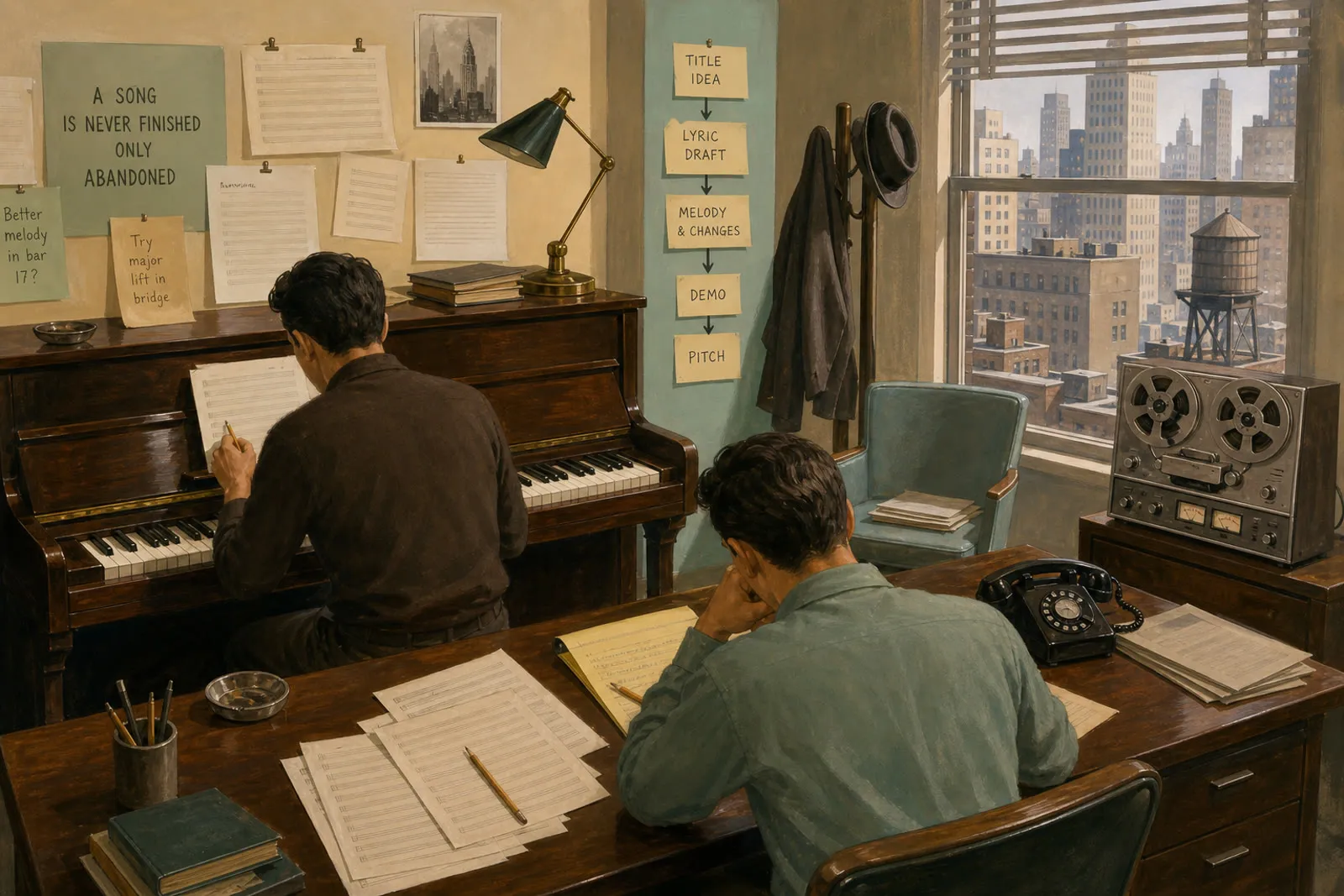
Al Nevins and Don Kirshner founded Aldon Music in 1958. Its small writing rooms were plain enough to resist romance. Mann later remembered cubicles with an upright piano, a bench, one chair, and an ashtray. Sound passed through the partitions. A pair working on one song could hear competitors trying to finish another. 8
This was creative work conducted as office work. A publisher might know that a singer needed a follow-up single and ask several teams to provide one. The assignment fixed some of the problem: probable audience, vocal range, subject, duration, and deadline. It did not supply the melody or the words.
Competition and proximity reinforced each other. Goffin and King worked near Mann and Weil, listened to them, and wanted the same record placement. The couples were also friends. Rivalry entered the daily acoustics of the floor as each pair heard the other working toward the next placement.
Writing for a voice not in the room
The singer was often absent while the song was being composed. That distance required a particular imagination. A writer had to make a line specific enough to sound lived and open enough for another person to inhabit. The resulting record would carry the performer’s name, while the writers’ names appeared in smaller print.
Goffin and King divided the work broadly between lyric and music. Their first major success, “Will You Love Me Tomorrow,” was recorded by the Shirelles. Its question is grammatically simple and emotionally exact: does present intimacy imply public or lasting commitment? The song gives a young woman uncertainty without treating her as naive. 3
Shirelles member Beverly Lee later emphasized that the group recognized a story in the song. Carole King also took an active role in the session, including its percussion. Writers, performers, and session choices all shaped the record. The composition moved through the Shirelles’ voices, the session, and the group’s public identity before listeners knew it. 4
The demo is an argument
A sheet of music could register chords, melody, and words. A demo proposed behavior. It suggested where a singer might breathe, how firmly the rhythm should move, whether a response vocal should feel conversational or ceremonial, and how quickly the title ought to return.
Ellie Greenwich was especially valuable because she could write and make forceful demos. Her layered voice helped a publisher or producer hear a prospective record rather than an abstract tune. Greenwich and Jeff Barry wrote songs including “Be My Baby,” “Da Do Ron Ron,” and “Leader of the Pack,” then worked across writing, production, and label activity. The couple’s catalog belongs to the Brill shorthand, but its records also bear the strong decisions of producer Phil Spector, arranger Jack Nitzsche, engineer Larry Levine, session musicians, and the performing groups. 6
The demo sat between composition and record. It could win an assignment while also constraining the artist who received it. A persuasive vocal might establish inflection before the named singer entered the studio. Authorship was distributed, but power was not distributed evenly.
A title every few seconds
Early-1960s pop singles had little time to identify themselves. Radio programmers and record buyers encountered a large supply of new releases. A song needed an entrance, a memorable title, and enough contrast to make return feel necessary.
The craft is audible in the placement of hooks. A title can arrive as a question, command, name, dance, or fragment of nonsense syllables. Repetition does not merely repeat information; harmony, backing voices, or orchestration can alter the pressure around the same words. The listener learns the phrase while the record changes what the phrase means.
Goffin’s conversational lyrics and King’s melodic control worked because neither needed to advertise complexity. “Up on the Roof” moves from crowded street life toward a private elevation. “One Fine Day” places confidence in a phrase that the surrounding voice can make hopeful or defensive. Their songs were written to order without sounding interchangeable. 5
The publisher owns movement
A publishing company did more than provide rooms. It registered compositions, collected and divided royalties, placed songs with artists, printed sheet music, and kept a catalog available after the first record had left the charts. The business treated a song as an asset that could move between voices and return in a new version.
That mobility separated composition from recording. “Will You Love Me Tomorrow” belonged to Goffin and King’s catalog while the Shirelles’ performance belonged to a particular master recording. Another artist could record the composition without recreating that master. Listeners often experience the two as one object because the first successful performance defines the song so strongly.
The distinction created income for writers whose faces never appeared on a sleeve. It also rewarded the company that controlled publishing rights. A hit could produce royalties through radio play, sales, cover versions, film use, and later formats. Contracts determined who received those payments. The cheerful image of adjacent pianos therefore sat inside a business concerned with ownership and repeat use.
Writing pairs did not enter that business on equal terms. Women such as King, Weil, and Greenwich held clear creative authority while working in an industry whose company owners and senior executives were mostly men. Black performers made songs nationally legible while publishers and writers were often better positioned to hold rights. Credit on a label documented participation; it did not reveal the terms behind it.
The publisher’s demand for another song could feel narrow, yet circulation produced unexpected meaning. A composition written for one artist could be claimed by another voice, rearranged for a different market, or revived years later. The office system limited authors and gave their work routes they could not fully predict.
Little Eva at the center
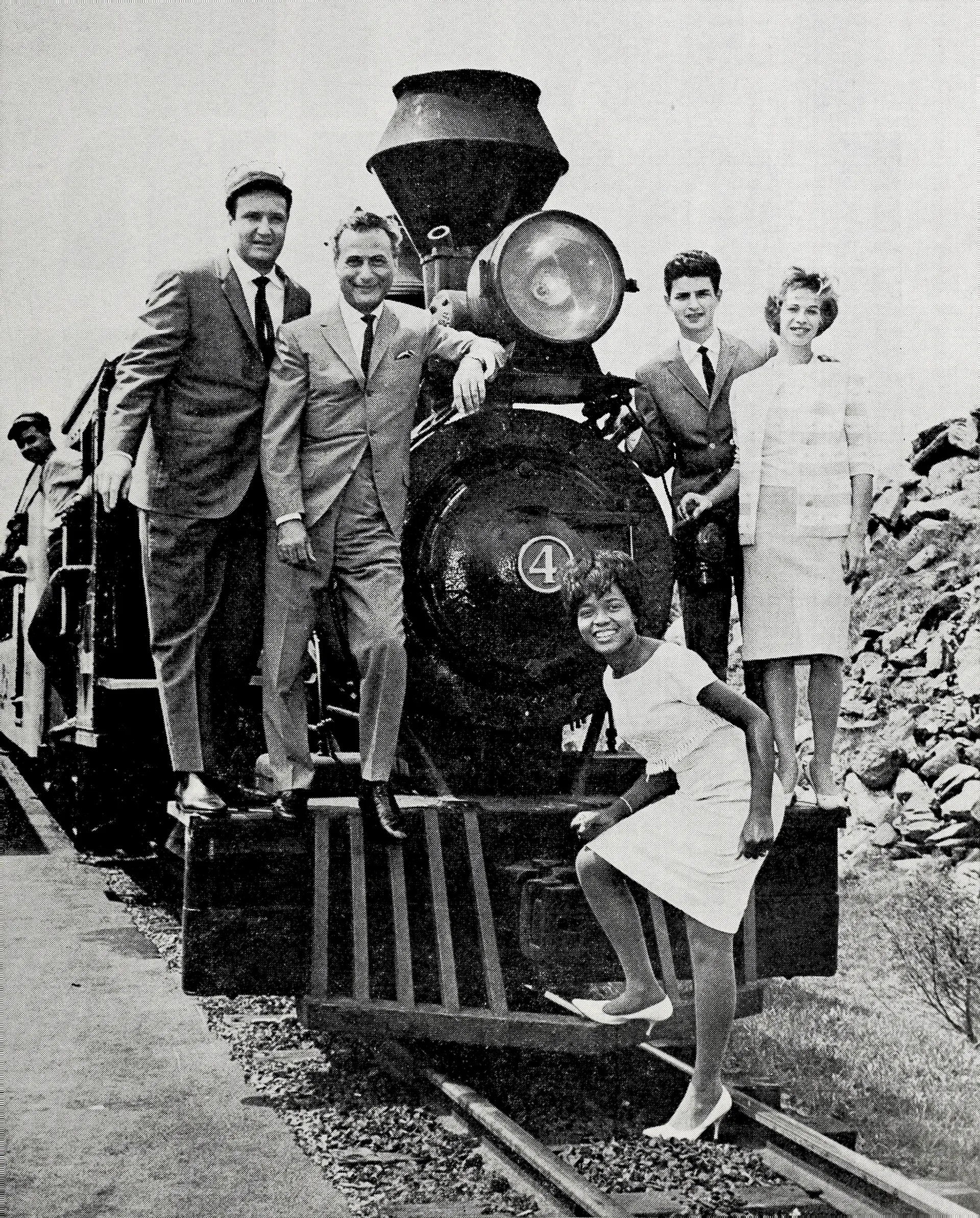
Eva Boyd worked for Goffin and King as a babysitter and sang demos. She became Little Eva on “The Loco-Motion,” released by Dimension Records in 1962. The familiar anecdote can be told as a lucky discovery inside a songwriter’s home. The Cash Box cover from that September shows the business arrangement more clearly.
Boyd stands with Goffin, King, Nevins, and Kirshner around a miniature locomotive. The image converts song title, dance, performer, writers, publishers, and label promotion into one scene. Little Eva is at the center, but the men who owned and managed the companies share the frame. The photograph documents how a voice became a record and how the record was sold.
The song’s route also crossed domestic and commercial labor. Boyd’s work in the couple’s home placed her near their writing practice; her demo singing made musical skill audible; Dimension turned that proximity into a marketed identity. Calling the result accidental hides the labor that made the supposed accident possible.
Girl-group records and adult control
Many of the era’s most durable songs were voiced by young women and organized by older publishers, producers, and label owners. The records gave female listeners language for desire, reputation, jealousy, pressure, and choice. They could also bind performers to scenarios selected by people with more contractual authority.
The tension remains audible in the work. A singer can change the social weight of a line through timing and tone. Group vocals can turn a private statement into peer conversation. Handclaps, strings, drums, and background syllables build a space in which the lead voice is watched, answered, or supported.
The name “girl group” can make professional singers sound temporary and young even when their records required exact ensemble technique. The Shirelles had formed before Goffin and King supplied their song. The writers entered an existing group history; they did not invent four blank voices.
Arrangement finishes the social scene
The piano cubicle is the easiest part of the process to reconstruct because it fits a story about authorship. The final records direct attention toward a larger room. Drummers, bassists, guitarists, percussionists, backing singers, arrangers, producers, and engineers determined how a composition occupied physical time.
A drum fill could make the chorus feel inevitable. Strings could enlarge a private sentence until it approached melodrama. A background group might repeat the title as encouragement, warning, or public rumor. These parts established the world in which the lead vocal had to act.
The strongest girl-group records make scale unstable. A close voice can sound as if it is speaking to one person while a large arrangement places that conversation before a crowd. Reverb supplies imaginary architecture; handclaps suggest bodies sharing a beat; doubled vocals let one singer sound like her own witness. The record transforms a compact lyric into social space.
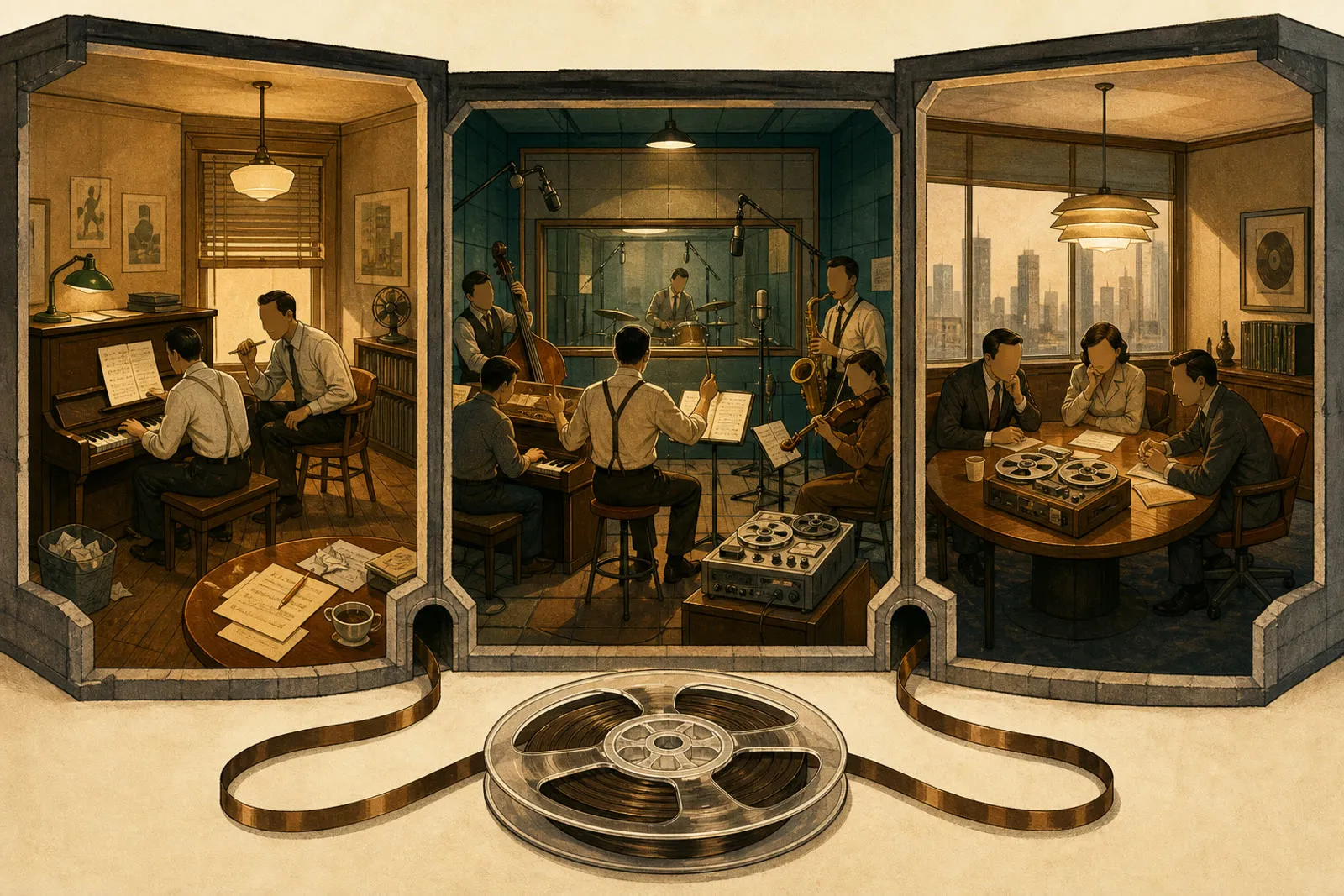
That transformation explains why a demo could be decisive without being final. The demo argued for melody and attitude. The session tested the argument against other people’s timing and sound. Pop’s division of labor was capable of exploitation, but the division itself was also a source of musical intelligence. Each stage allowed someone to hear a problem the preceding stage could not.
The British records enter the office
The system lost some of its authority after performers who wrote their own material became central to rock marketing. The Beatles and other British groups recorded songs from the New York publishing catalog, then made the self-contained band a powerful commercial model. Publishers and professional songwriting continued, but the visible center shifted.
Goffin and King’s “Chains,” first recorded by the Cookies, appeared on the Beatles’ debut album. The cover demonstrates both the reach of the New York song network and the changing terms around it. A composition written for one American vocal group could become evidence of repertory inside a British band’s identity. 3
King later moved from supplying other performers to recording her own work, most decisively on Tapestry. Describing that move as an escape from an impersonal factory misses what King carried with her. Years of writing within limits had trained her sense of melodic economy, accompaniment, vocal range, and narrative address. The office remained present at the piano.
What the shorthand conceals
The landmarked Brill Building deserves attention. Its limestone and terra-cotta facade gave music businesses a recognizable address, and by 1962 it held an extraordinary concentration of them. The city’s designation report preserves that commercial history in architectural detail. 2
The facade becomes misleading when used as a picture of a sealed institution. Aldon was at 1650. Sessions took place elsewhere. Performers arrived from their own touring, church, school, neighborhood, and label histories. Black vocal groups supplied the voices through which many white songwriting teams entered the national market. Musicians and engineers made choices that a piano demo could only propose.
A short walk across Broadway shows the network more clearly. A song leaves a cubicle, crosses into another office, becomes a demo, reaches a label, changes at a session, and returns through radio as a record everyone in the building can hear. Three minutes is the length of the object. The work around it occupies the whole block.