

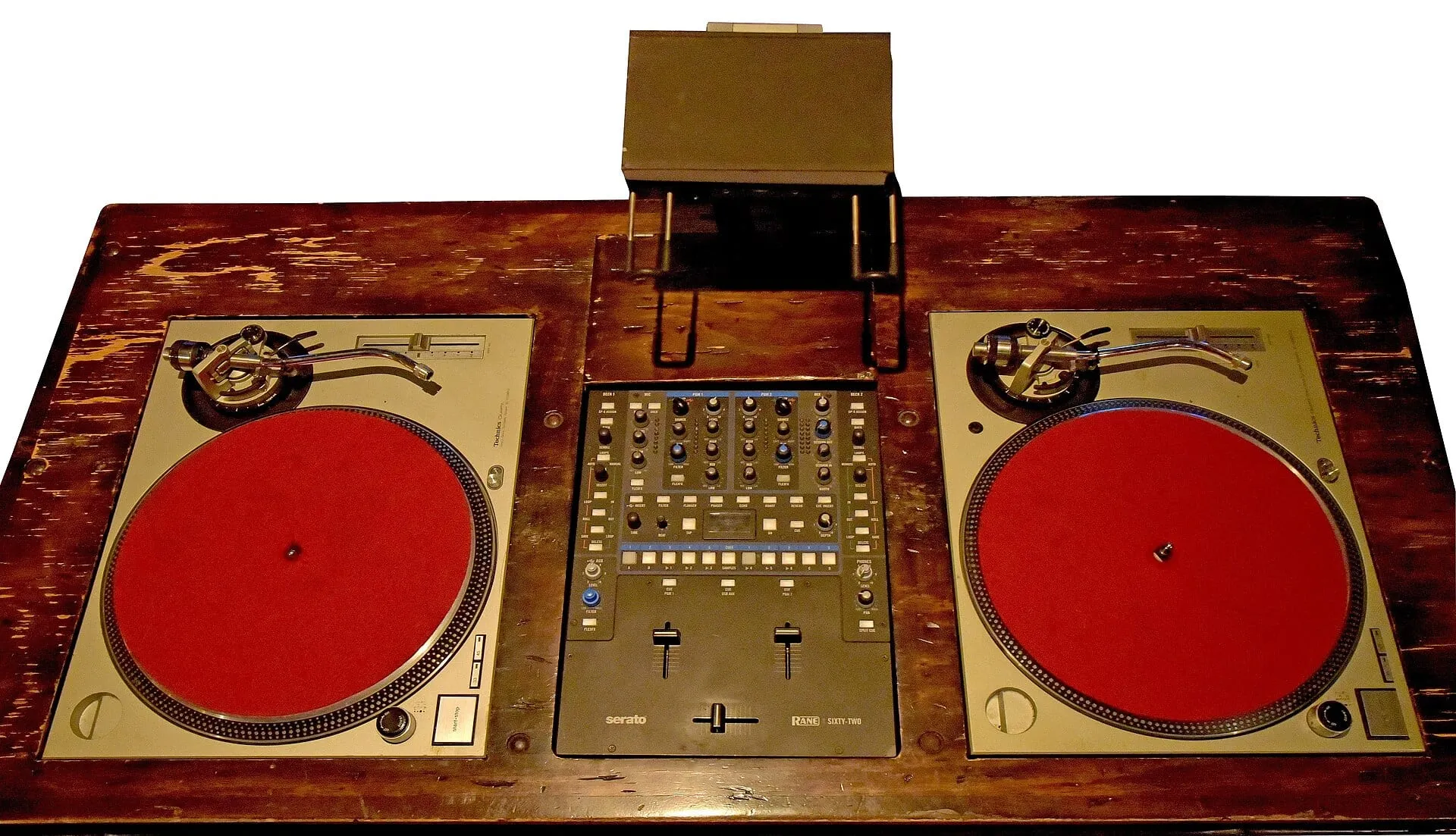
A record normally carries its own clock. The stylus enters the groove, the platter turns, and the recorded performance advances toward its end. Early hip-hop DJing changed that relationship. With two copies of one record, a mixer, headphones, and practiced hands, a DJ could keep a few seconds of percussion in the room long after the band on the record had moved on. Playback became an act of live arrangement.
Hip-hop formed through Black and Latino communities in the Bronx, with Caribbean experience among its important currents. DJs, MCs, dancers, sound-system builders, record collectors, and party audiences developed the form together. Within that shared history, Kool Herc, Grandmaster Flash, and Grand Wizzard Theodore addressed several practical problems—finding a break, repeating it, cueing it, and touching the record— that turned consumer playback equipment into an instrument. 1 4
The break belonged to the floor
A break is a passage in which percussion comes forward and other parts of an arrangement thin out. Dancers valued these exposed rhythmic sections. Clive Campbell, known as DJ Kool Herc, is widely celebrated for centering and extending them at Bronx parties, including the August 11, 1973 party at 1520 Sedgwick Avenue often used as a landmark in accounts of hip-hop’s history. Cornell’s Hip Hop Collection describes Herc linking percussive passages into a continuing sequence of breakbeats. 1
The familiar anniversary marks one event within a collective history. The Smithsonian’s account of sazón in hip-hop places African American, Caribbean, and Latino experience together in the Bronx. It also follows DJ Charlie Chase, whose knowledge of salsa and percussion complicated ideas about which records or identities belonged inside the new culture. The party was a laboratory because its people brought different records, movement, technologies, and expectations into the same room. 4
Herc’s central observation was about audience response: the percussive portion made the floor move differently. Selecting the record was therefore only the first decision. The next was temporal. A break might last several seconds, but dancers needed a longer space. The recording industry had fixed the duration. The DJ setup created a way around it.
Record knowledge came before repetition
Finding a useful break required another kind of technique. A DJ had to know where drums became exposed inside a record, how cleanly the passage began and ended, and what its tempo and character could do in a room. The source might not have been marketed as dance music. A short section inside funk, soul, rock, Latin music, or another recording could become valuable because the DJ heard a function that the album sleeve did not advertise.
Collecting became a form of preparation. Labels, grooves, remembered timings, and private knowledge helped a DJ move through a physical library quickly. Two copies cost money and occupied space. Wear mattered because the same few rotations were handled repeatedly. The break was therefore both sound and location: a known place on a particular pressing that hands had to reach under pressure.
Selection added another layer of authorship to the musicians’ recorded performance. The DJ changed its scale and setting by choosing it, placing it beside other records, and allowing dancers to inhabit it for longer. Cornell’s archive preserves records alongside flyers, photographs, and live documentation, evidence that hip-hop history lives in relationships among media rather than in a list of isolated tracks. 1
A second copy solved the timing problem
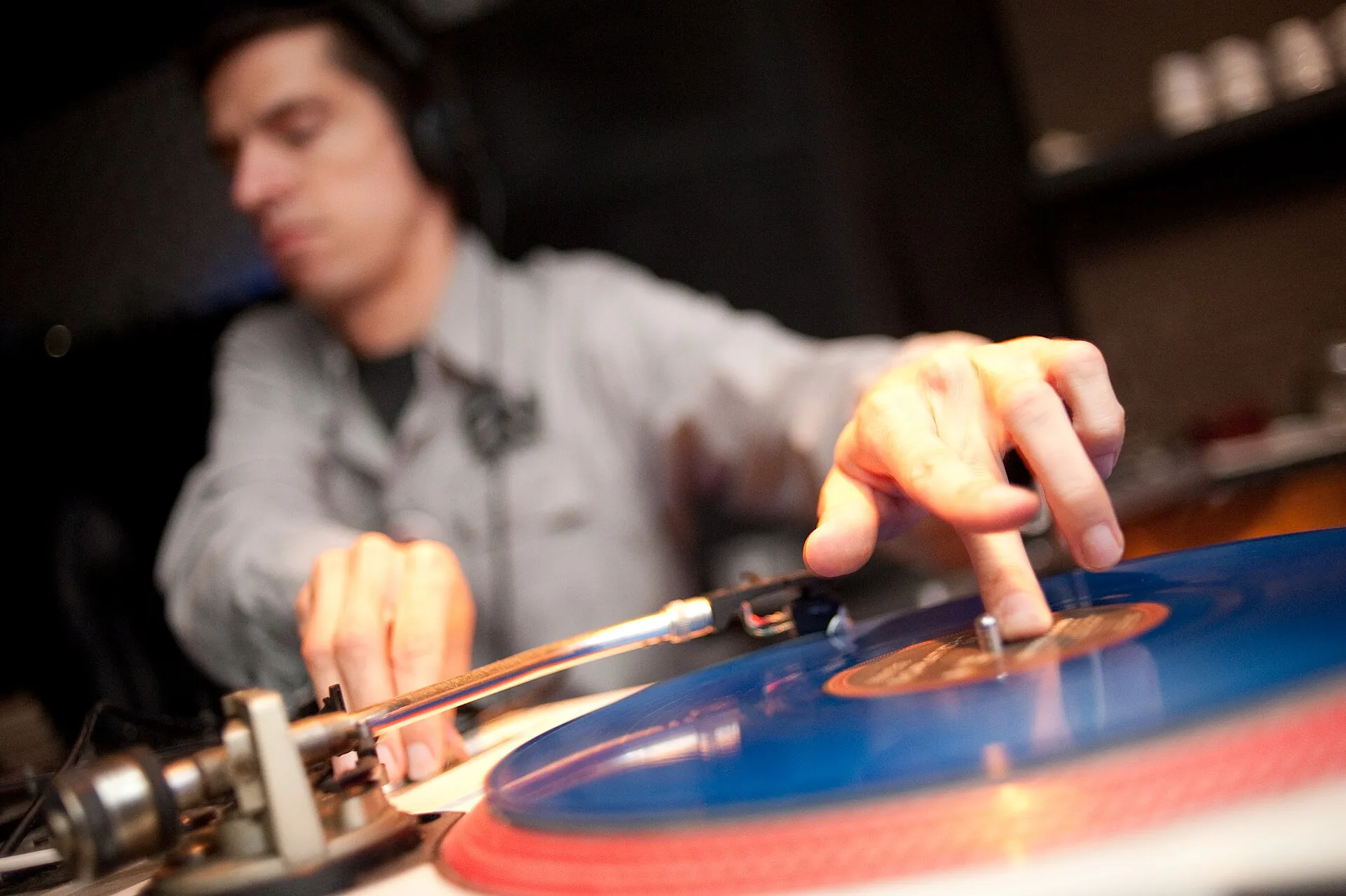
Two identical records sit on separate turntables. Break A plays on the left. While the room hears it, the DJ finds the beginning of the same passage on the right. At the correct instant, the mixer sends the right record to the speakers. The DJ can then return the left record to its starting point. Repeating the handoff makes one short passage function as an open form.
This is not a loop in the later digital sense. Nothing repeats automatically, and the source remains physically finite. Every cycle depends on the DJ knowing the break’s length, moving the silent copy backward, releasing it at speed, and changing channels without losing the pulse. The arrangement survives only as a chain of successful actions. Small errors are audible: a doubled drum hit, an empty fraction of a beat, or a new copy entering at the wrong speed.
Grandmaster Flash developed a systematic version he called Quick Mix Theory. In a Fresh Air interview, he explained the use of duplicate records and the movement back and forth between them to repeat a chosen passage. He also described Clock Theory: using the record’s rotation as a measure and marking the vinyl so the target area could be found again. Trial, observation, and equipment testing turned an exciting effect into a method that could be taught and performed. 6
The second copy broke a recorded arrangement into usable material while lengthening it. A drummer’s fill, a horn stab near the break, or the first beat after it could be selected, reordered, or excluded. As with the extended dance mixes in the story of the 12-inch single, the floor altered musical form. The difference was that the DJ now performed the extension live from already pressed records.
Cueing made one room into two
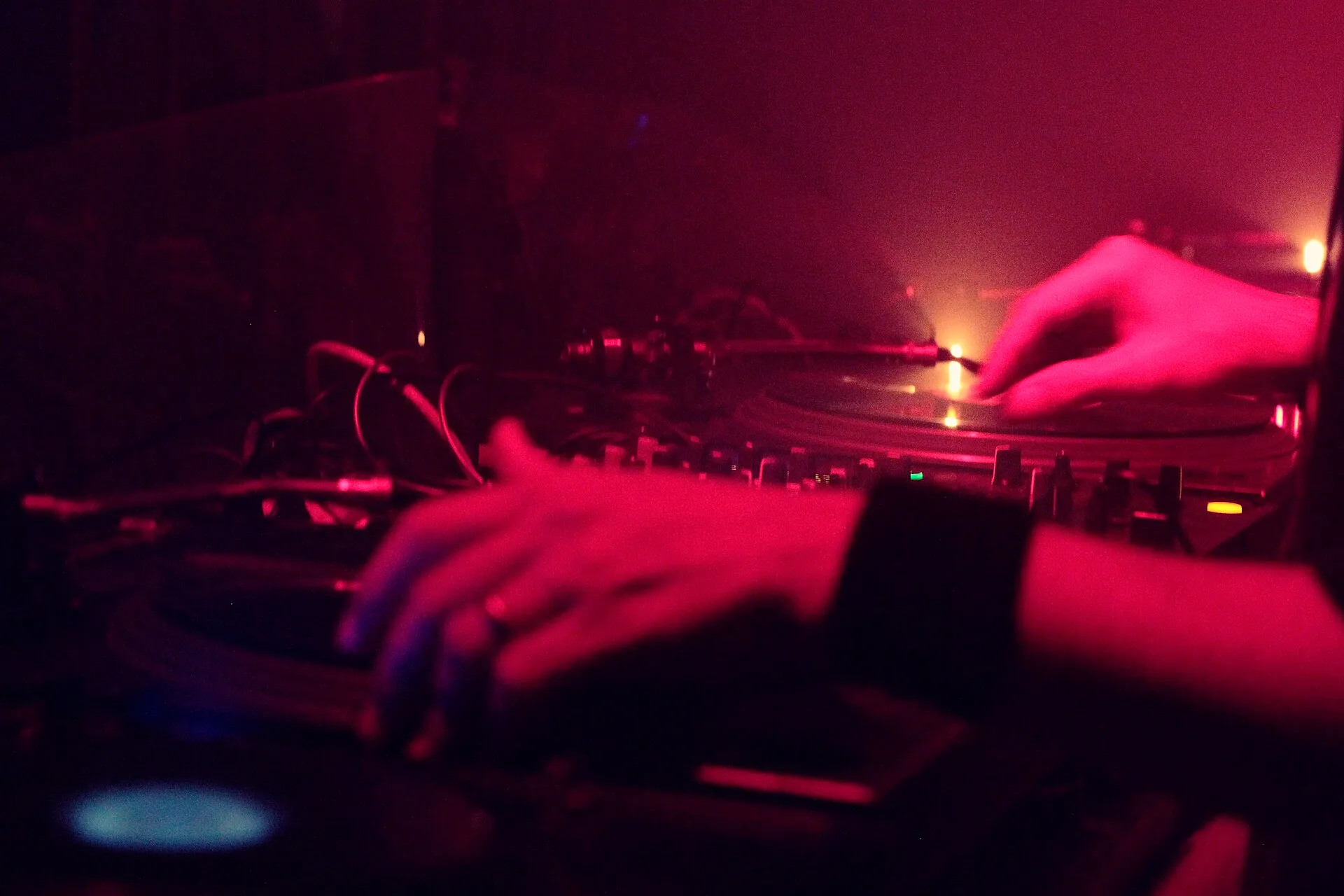
The audience must hear continuity while the DJ hears preparation. Headphone cueing creates those two simultaneous rooms. One mixer channel feeds the speakers. Another can be previewed privately, allowing the DJ to locate the break, place the stylus, and check the starting point before opening the channel. The mixer forms the boundary between rehearsal and public sound.
Flash turned the available equipment into a hip-hop instrument through experiments with cartridges, needles, turntables, mixer functions, and a way to hear the silent deck in advance. The Smithsonian Lemelson Center frames this work as African American innovation: existing technology was tested, recombined, and made to serve needs its manufacturers had not centered. 2 6
Private cueing also changes attention. A DJ has to hold the sound reaching the room in one mental track while monitoring a different moment in the headphones. One hand controls the record; another reaches for the mixer. Eyes move among vinyl marks, tonearm position, and controls. The apparent simplicity of a repeating break rests on divided perception.
The platter had to answer the hand
A domestic turntable is designed to rotate at a stable speed while the listener leaves it alone. Hip-hop technique asks for a harder combination: stability during playback and fast recovery after the DJ stops, drags, or releases the record. A slipmat lets the vinyl move with less direct friction against the rotating platter. Motor torque helps the system return to speed. A secure stylus must keep contact while the record moves in directions its original user manual did not encourage.
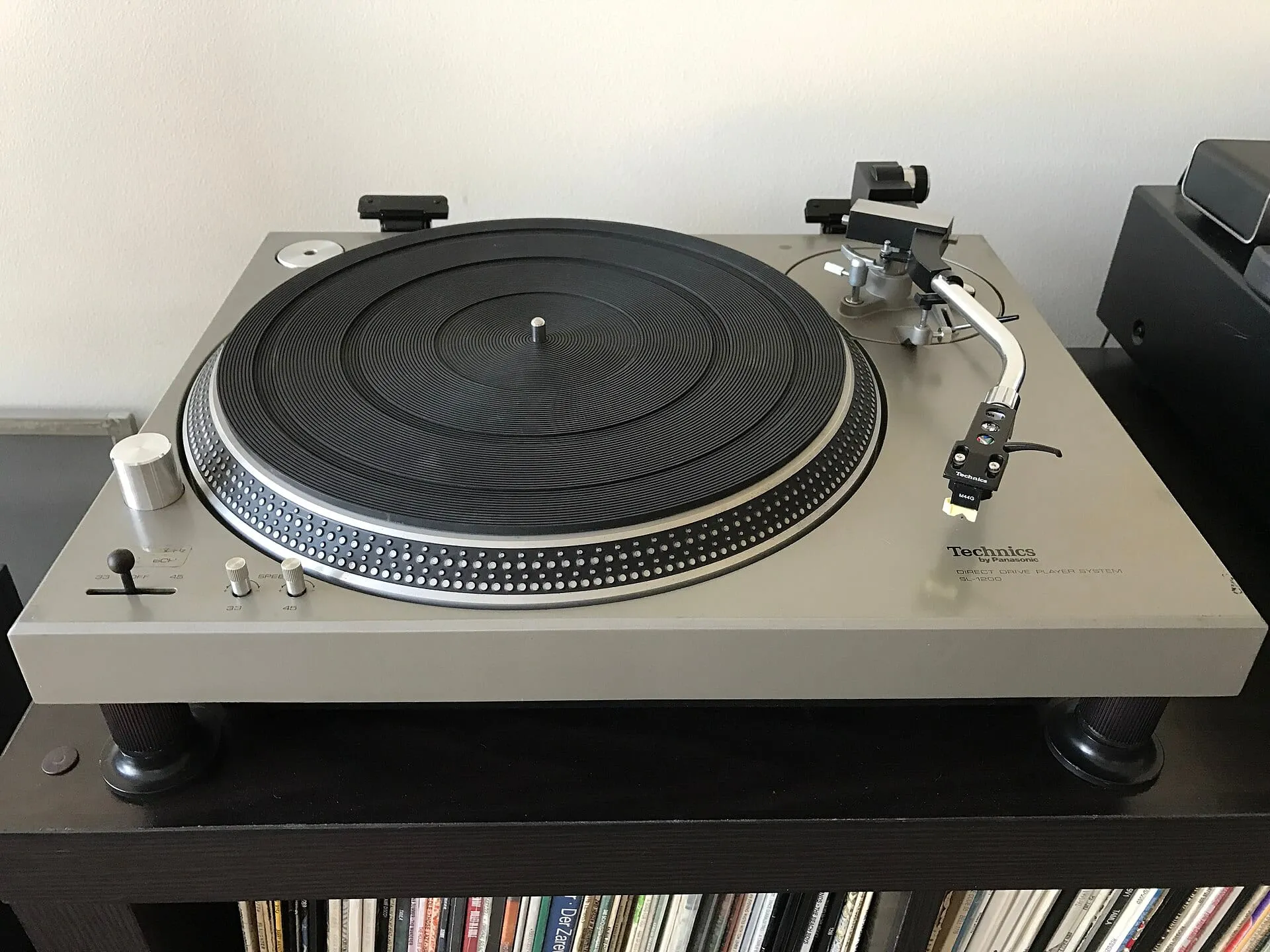
Technics introduced the first SL-1200 in 1972. The company’s history emphasizes direct drive, fast startup, pitch adjustment, and resistance to acoustic feedback; it presents the 1979 SL-1200Mk2 as a revision shaped by professional DJ requirements. Manufacturer history naturally promotes the product, but the Smithsonian’s Grandmaster Flash object record independently documents an SL-1200Mk2 used by Flash and identifies the model as popular among early hip-hop DJs. 3 7
The famous deck remained one part of a larger system. Records, cartridges, headphones, mixers, amplifiers, speakers, tables, and the room itself all affected what was possible. Money mattered too: owning two copies and dependable equipment was a material condition of the technique. The available pieces had to work as a responsive chain.
Cutting turned playback into phrasing
Once a DJ can locate a sound precisely, the mixer can shape it. A quick channel opening lets a drum hit or word reach the room; closing the channel removes what follows. Repeated entries make recorded sound behave like a played phrase. This practice, often called cutting, focuses attention on the start of a sound. Timing the fader becomes as important as choosing the record.
Moving the record adds another dimension. Pulling vinyl backward reverses the recorded waveform beneath the stylus; pushing it forward accelerates the passage through time. The Smithsonian credits Grand Wizzard Theodore with the development of scratching and preserves his turntables as instruments of that practice. Attribution histories in an oral and collaborative culture deserve care, but Theodore’s role is central to the documented account. 5
Scratching is sometimes represented as frantic motion over any record. Its musical force depends on control. The source sound, hand speed, direction change, rhythm, stylus contact, and fader shape interact. A short vocal or drum attack can become a sustained rhythmic voice because the DJ repeatedly moves the same small section. Recorded time is no longer only paused or resumed. It is articulated by gesture.
Tape music also treated recorded sound as material that could be cut, moved, and layered. The turntable method works differently: in real time, before dancers, with commercial records kept legible even as their order changes.
The instrument included the party
The instrument extended beyond the two decks. DJs learned from the floor which breaks held attention. Dancers answered the selection with movement. MCs spoke over the extended space, first supporting the party and then developing increasingly elaborate rhythmic language. Sound-system knowledge determined how bass and drums occupied a community room. Record collectors expanded the available vocabulary.
This feedback made the arrangement social. A break might be repeated longer because the floor remained active, shortened because energy changed, or followed by a contrasting record. The DJ did not execute a fixed score from start to finish. Selection and duration responded to people in the room. Cornell’s archive, which preserves flyers, recordings, photographs, records, and other materials, is valuable precisely because no single object can contain that network. 1
Later samplers and digital audio workstations could store a break as data and repeat it with exact boundaries. They expanded what producers could build. The two-turntable method retained its own logic: preparation occurs beside projection, duration stays responsive, and the seam can become part of the performance.
Listen for the seam
Choose a recording with an exposed percussion break. First, hear it in the original song and count how long it lasts. Then imagine the labor required to return a second copy to the first attack before the active copy reaches the end. The musical unit is not only the break. It is the break plus the time needed to reset its double.
In a DJ performance, listen at the boundary. Does the next copy enter with an identical drum hit, a slight overlap, or a deliberate change? Can you hear the mixer cutting a fragment shorter than its source? When the record moves backward, follow the rhythm of the hand rather than trying to reconstruct the original phrase immediately.
Finally, watch the division of attention. One deck is public while the other is becoming ready. Headphones hold a future moment that the speakers have not reached. The two copies contain the same recording, but they do not perform the same job. Between them, a closed piece of vinyl opens into a form that can continue as long as technique and the room ask it to continue.
.jpg)


.jpg)
