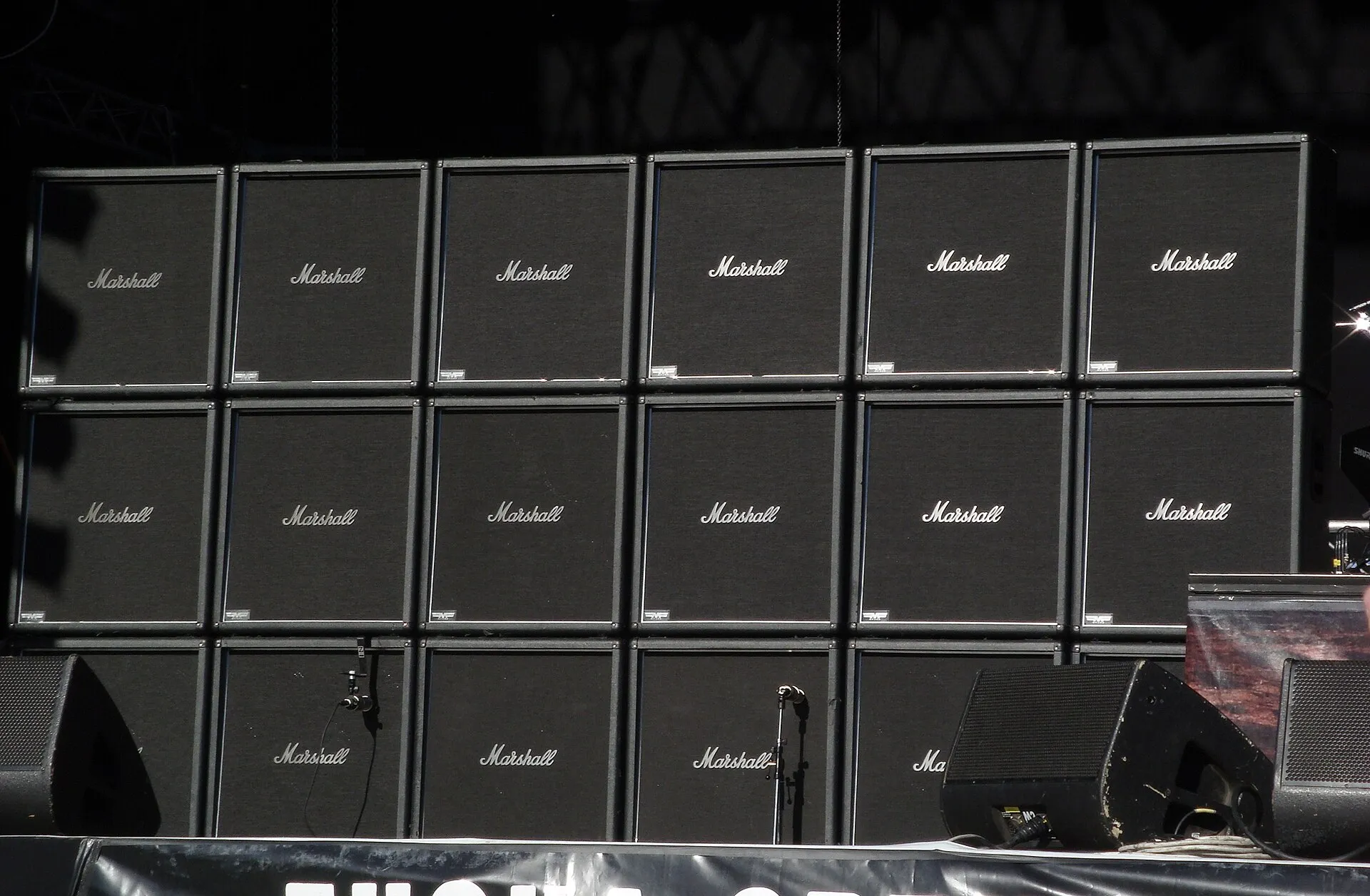
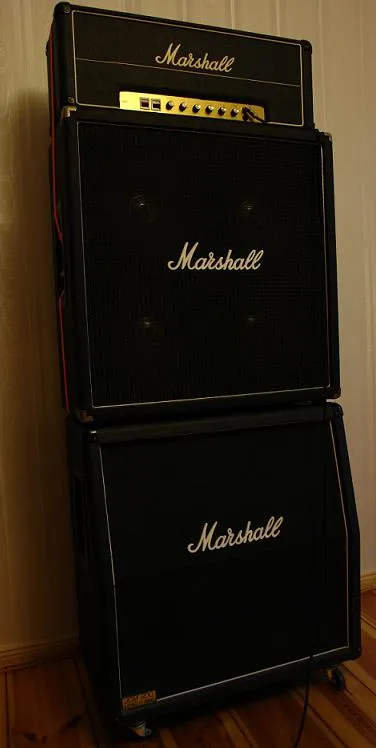
A Marshall stack is easy to recognize and difficult to hear in a photograph. The white script, black covering, gold control panel, and two large cabinets have become a visual abbreviation for loud guitar. Yet the familiar tower joins several technologies that need not stay together: an amplifier head, loudspeakers in closed boxes, a stage, a room, and often a microphone feeding a public-address system. The stack changed how players produced distortion and how a band occupied visual space. Those changes overlap, but a wall of cabinets may be acoustically essential, partially used, or entirely theatrical. 1
The JTM45 begins as a practical alternative
Jim Marshall opened a drum shop in west London in 1960. Guitarists who visited the shop wanted amplification that was easier to obtain and service than imported Fender equipment. Working with Ken Bran, Dudley Craven, and Ken Underwood, Marshall developed the amplifier later known as the JTM45. The initials referred to Jim and his son Terry; the number described an intended power class more than an exact modern measurement. 2
The circuit drew heavily on the Fender 5F6-A Bassman, but available British components and construction choices changed the result. Different valves, transformers, speakers, and a closed-back cabinet mattered. The early Marshall was not created from nothing, nor was it a sonically identical copy with a new badge. It was a local adaptation of a proven circuit that developed its own response through substitution.
Separating the amplifier head from the speaker cabinet made transport and variation possible. The head contained the preamplifier, tone controls, phase inverter, power stage, and transformers. The cabinet turned electrical output into moving air. A player could change the cabinet without rebuilding the amplifier, while a closed box loaded with four twelve-inch Celestion speakers projected differently from the Bassman’s open-backed four-ten arrangement.
More watts alter the stage problem
The JTM45 arrived when club bands often relied on their own amplifiers to reach the audience. Public-address systems were primarily for vocals, and stage monitors were limited. Drummers and crowds set a practical floor beneath which a guitarist could not be heard. Pete Townshend and John Entwistle of the Who asked Marshall for more power. The response was a series of prototypes that led to the JTM45/100 and the 100-watt Super Lead. 3
Doubling amplifier power does not make a system sound twice as loud. Perceived volume depends on speaker sensitivity, cabinet design, distance, room, and frequency as well as wattage. The 100-watt design still changed available headroom and the level at which the power stage distorted. Four output valves and larger transformers could drive more speakers with authority. The player’s amplifier became capable of dominating the stage rather than merely surviving it.
The first large cabinet proposed for the new head held eight twelve-inch speakers. It was physically unwieldy. Splitting those speakers into two 4×12 cabinets made the load possible to move and created the full-stack arrangement: a straight lower cabinet and an angled upper cabinet, with the head on top. Terry Marshall’s later account recalls that the split solved transportation while preserving the desired scale. 4
The angled upper cabinet did more than complete the outline. Its upper speakers faced slightly upward, helping some high-frequency content reach the player instead of passing at leg level. Stacking also raised multiple speakers. The tower’s height made the amplifier visible to the audience, but first it changed where sound left the stage.
Distortion moves through the circuit
An early Super Lead has no master-volume control. Each channel’s volume affects the signal entering and moving through the amplifier, while the power stage remains directly tied to the result. To produce the compression and harmonic distortion associated with a “cranked” amplifier, a player raises the channel volume, which also produces substantial acoustic output through an efficient 4×12.
Distortion does not occur at one magic component. Preamp valves can clip, the phase inverter and power valves can be driven, the power supply can sag or compress under load, the output transformer contributes limits, and loudspeakers change behavior as they work. Pickups, pedals, and the player’s attack determine what enters that chain. “Power-tube distortion” is a useful shorthand only if it does not erase the rest of the system.
The two input channels of a Super Lead offer different voicings. Players often bridge, or “jump,” the channels with a short cable and blend their volumes. This practice turns a simple front panel into a more interactive network. The settings also explain why photographs cannot reveal tone: two visually identical heads may be connected, biased, serviced, and operated in different ways.
The stack reorganizes everyone else
Large guitar rigs affected the drummer, singer, bassist, and sound engineer. A loud backline reduced the engineer’s ability to balance the room through the PA. Vocal microphones picked up stage sound. Musicians needed monitors that could compete. Audience experience changed sharply by position; listeners near one stack received a different mix from those in the center.
High volume also became expressive material. Sustain lengthened as guitar and loudspeaker interacted. Feedback could be controlled by distance and orientation. The physical attack of low and mid frequencies made a chord bodily apparent. The recent scholarly history of amplification argues that volume became an aesthetic value, not merely a requirement for audibility. The 100-watt Marshall was one of the devices through which that value became repeatable. 5
Repeatable did not mean safe. Sustained exposure at concert levels can damage hearing, and the celebrated volume wars placed musicians, crews, and audiences at risk. Historical accounts that treat loudness as harmless masculine competition ignore that cost. The stack’s influence includes the development of hearing protection, isolation, attenuation, improved monitoring, and stage-volume rules intended to control it.
Cabinet construction shapes that exposure and the sound reaching a microphone. Four speakers do not radiate like one larger speaker. Their outputs combine differently by frequency and listening angle, producing a strong forward field with irregularities off axis. A closed back limits the rear radiation that an open combo allows and changes low-frequency response. The top cabinet’s angle adjusts part of that field without turning the stack into an evenly distributed PA.
Engineers learned to treat one speaker as the recordable source. Moving a microphone from the center of its cone toward the edge can reduce brightness; changing distance adds room and alters phase relations. The audience may see eight speakers while the recording chain uses one close microphone. That mismatch does not make the other seven irrelevant. They change what the player feels, what spills into other microphones, and how the guitar feeds back onstage.
Early-history accounts also note continual circuit revision. The label “Plexi” groups amplifiers whose panels, filtering, transformers, voltages, and component values can differ by year. Service history adds more variation. A replacement transformer or capacitor may alter behavior while leaving the logo intact. Model names are starting points for technical description, not exact sonic fingerprints. 6
Master volume separates gain from output, partly
By the mid-1970s, Marshall’s model 2203 placed cascaded preamp stages and a master volume into a 100-watt head. A player could drive the preamp harder while reducing the signal sent onward, gaining more distortion without operating the power stage at the same extreme level. The solution did not make a 100-watt stack quiet, nor did preamp distortion sound identical to a fully driven Super Lead. It changed where control could be exercised.
The 2203 was carried into the JCM800 line in 1981. Marshall’s history presents that series as its first built-in master-volume design, though the relevant JMP models preceded the JCM800 name. The renaming coincided with the end of a distribution agreement and gave existing circuit ideas a strong new visual identity. 6
For hard rock and metal players, the master-volume arrangement offered a tighter, more controllable attack and an easier way to add gain. Pedals could push the input further. The stack remained, but its relationship between visible size and power-stage distortion was no longer fixed. A guitarist could use the same cabinet tower with a different distribution of gain.
Master volume also shifted technique. With more preamp distortion available, a player could obtain sustained notes while keeping the power section cleaner, producing a firmer low end and a different response to picking. An overdrive pedal used as a boost could reduce low frequencies before the amplifier and sharpen attack. The iconic cabinet outline now supported sounds that an early Super Lead had not been designed to make.
When the silhouette exceeds the signal
As PA systems improved, guitar amplifiers no longer needed to cover the entire room directly. A microphone could capture one speaker and send it through a controlled front-of-house mix. Cabinets could be placed offstage or isolated. Smaller amplifiers could produce useful distortion at lower levels. Load boxes, attenuators, digital models, and in-ear monitoring separated the sound heard by the player from the image seen by the audience.
The Marshall wall survived because it communicates before a note. Multiple empty cabinets can frame a drummer, enlarge a stage, and attach a new tour to rock history. Sometimes only one cabinet is connected; sometimes a working rig sits behind the decorative line. This is not simply fraud. Stage scenery has always represented scale. The error is assuming the photographed quantity of boxes measures the electrical system.
Conversely, dismissing every wall as fake overlooks productions that use multiple heads, wet/dry signal paths, backups, or genuinely loud backlines. Evidence has to be specific: cables, microphones, technical documentation, or testimony from the crew. The silhouette alone proves only that the silhouette was wanted.
The half stack further complicates the icon. One head and one 4×12 preserve the brand, speaker area, and raised black rectangle while removing the lower cabinet. For many stages it is the practical working form; advertising and audience memory often promote the two-cabinet full stack as the completed image. Musicians therefore learned to choose between acoustic need, transport, and what a genre expected to see.
Transport is not a footnote. Cabinets require castors, ramps, vehicles, storage, and people able to lift them safely. A touring stack is a labor arrangement surrounding an electrical one. Splitting the original 8×12 solved a problem but did not make two 4×12 boxes light. Road crews and local stagehands are part of the technology’s repeatability, even when equipment histories name only designers and star users. The stack sounds different after someone has first managed to place it safely.
The stack changed sound by joining high-powered valves to a raised field of speakers. It changed performance by giving feedback and sustain architectural dimensions. It changed stage pictures by making amplification look like a building. Later technology could replace each acoustic function separately, but no substitute made the original tower less legible. That is why the Marshall stack can be absent from the signal chain and still present in the show.